
The ceramic 3D printing market is experiencing explosive growth as industries demand high-performance ceramic 3D printing solutions for producing complex ceramic structures that traditional manufacturing simply cannot achieve. From extreme-temperature aerospace components to precision biomedical implants and durable electronic parts, additive manufacturing innovations are unlocking new possibilities and driving substantial industrial adoption.
At Shenzhen AdventureTech Co., Ltd. (ADT), a pioneer in ceramic additive manufacturing since 2015, we provide complete ceramic 3D printing systems—including precision DLP ceramic 3D printers, high-quality slurries, and one-stop services—that empower researchers, universities, and manufacturers to capitalize on these emerging opportunities.
This in-depth analysis explores the Ceramic 3D printing market forecast for 2026–2033, key growth drivers, major applications, regional trends, and actionable opportunities, drawing from industry reports and real-world deployments.
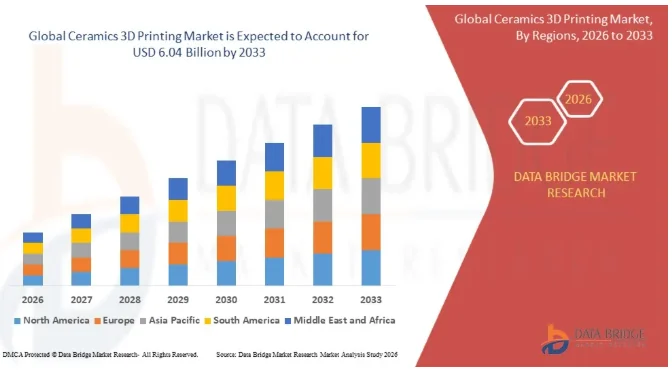
Figure 1: Global Ceramics 3D Printing Market by Regions, 2026–2033 This bar chart illustrates the projected regional breakdown and cumulative growth, reaching approximately USD 6.04 Billion by 2033, with Asia-Pacific leading the expansion.
Global Ceramic 3D Printing Market Overview & Forecast (2026–2033)
Recent industry analyses project strong expansion in the ceramic additive manufacturing sector through 2033. While estimates vary across sources, consistent themes emerge: robust CAGR ranging from ~11–22% in specialized segments, with market value potentially reaching hundreds of millions to approaching $1 billion by the early 2030s, depending on scope (equipment, materials, services).
Key consensus drivers include:
- Advancements in high-performance ceramic 3D printing technologies (DLP, SLA, binder jetting)
- Ability to fabricate intricate complex ceramic structures with lattice designs, internal channels, and multi-scale features
- Rising adoption in high-value industries requiring thermal, wear, and chemical resistance
ADT has supported this growth trajectory since 2015, delivering DLP-based ceramic 3D printers and optimized alumina, zirconia, and silica-based slurries. With over 40 exclusive patents, 10,000+ slurry and process tests, and a postdoctoral R&D team from Tsinghua University, USTC, and NTNU, ADT enables clients to achieve production-grade results in both research and industrial settings.
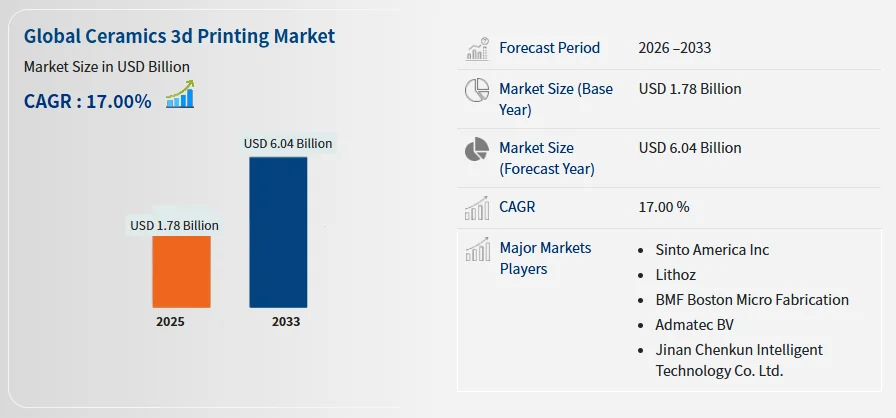
Figure 2: Global Ceramics 3D Printing Market Size & CAGR Overview (2026–2033) Market size is projected to grow from USD 1.78 Billion (base year) to USD 6.04 Billion by 2033, achieving a strong CAGR of 17.00%. The chart also highlights major players driving innovation in the space.
Primary Growth Drivers Fueling the Ceramic 3D Printing Market
- High-Performance Ceramic 3D Printing Demand Industries require ceramics that withstand extreme conditions. Additive manufacturing allows precise control over microstructure, density, and properties—resulting in superior mechanical strength, thermal stability, and functionality.
- Industrial 3D Printing Opportunities On-demand production, reduced tooling costs, supply chain resilience, and small-batch customization are transforming manufacturing. Ceramic 3D printing excels where subtractive methods fail, especially for low-volume, high-value parts.
- Complex Ceramic Structures The core advantage of additive manufacturing: geometries impossible via traditional forming, molding, or machining. Lattices, conformal cooling channels, lightweight optimized designs—all become feasible, driving efficiency gains in aerospace, energy, and medical sectors.
- Additive Manufacturing Innovations Improvements in printable slurries/resins, sintering optimization, software simulation, multi-material capabilities, and post-processing have dramatically increased reliability, resolution, and scalability.
ADT’s self-developed DLP ceramic 3D printers and materials are engineered precisely for these innovations—delivering high-resolution prints, excellent green-body handling, and consistent densification after sintering.
Key Applications Driving Market Expansion
- Aerospace & Defense — Turbine blades, nozzles, heat shields, and lightweight structural components that endure extreme temperatures and stresses.
- Automotive — Engine components, sensors, wear-resistant parts improving efficiency and longevity.
- Medical & Dental — Custom bioceramic implants, surgical guides, dental restorations with superior biocompatibility.
- Electronics — Insulators, substrates, thermal management parts, high-frequency components, and emerging multi-material conductive ceramics.
- Energy & Industrial — Filters, crucibles, wear parts, and tooling for harsh environments.
ADT systems are trusted by over 200 universities and research institutions worldwide and increasingly deployed in production environments requiring complex ceramic structures and repeatable performance.
Regional Insights: Where Growth Is Accelerating
- Asia-Pacific — Fastest-growing region, fueled by automotive, electronics manufacturing, and government support for advanced materials.
- North America — Strong in aerospace/defense and medical applications; early adopter of industrial-scale ceramic AM.
- Europe — Emphasis on precision engineering, medical devices, and sustainable manufacturing.
ADT maintains offices in Shenzhen, Foshan (China), and Germany—providing localized technical support, training, and rapid response to help customers in these high-growth regions adopt high-performance ceramic 3D printing seamlessly.
Why Partner with ADT to Capture Ceramic 3D Printing Market Opportunities?
Since 2015, Shenzhen AdventureTech Co., Ltd. (ADT) has been dedicated to "Beyond Materials, Beyond Limits" — leading the future of ceramic 3D printing.
What sets ADT apart:
- Precision DLP and DIW ceramic 3D printers optimized for research and production
- High-performance ceramic slurries (alumina, zirconia, silica) with excellent printability and sintering results
- One-stop ceramic 3D printing services for prototyping to small-batch manufacturing
- Expert team with deep expertise in materials science, mechanics, and additive processes
- Global track record: Trusted by 200+ universities and research centers
Whether you're exploring additive manufacturing innovations, scaling complex ceramic structures, or entering high-value industrial 3D printing opportunities, ADT delivers the tools, materials, and knowledge to succeed.
Ready to position your organization at the forefront of the ceramic 3D printing market forecast 2026–2033? Contact ADT today:
- Shenzhen Office: +86 16675199919 | adventuretech@adt-ceramic3dp.com
- Foshan Office: +853 6825 1349
- Germany Office: +49 174 2023009
Visit https://adt-ceramic3dp.com to request a quote, view case studies, or schedule a technical consultation.
By leveraging proven high-performance ceramic 3D printing solutions from ADT, businesses can capture the substantial growth projected in the Ceramic 3D printing market through 2033—turning complex challenges into competitive advantages. Start building tomorrow’s ceramic components today!