

Although sustainable 3D printing can reduce material waste to some extent, it may still exhibit lower material efficiency and higher energy consumption compared with certain conventional manufacturing processes. By applying a comprehensive life cycle assessment (LCA) within sustainable 3D printing workflows, researchers can systematically identify and address these limitations, facilitating the development of next-generation eco-friendly materials and additive manufacturing processes.
By integrating life cycle thinking into additive manufacturing workflows, ceramic 3D printing technologies can progressively evolve toward higher resource efficiency, reduced environmental impact, and long-term sustainability, supporting their broader adoption in industrial and biomedical applications.
Original link: https://www.nature.com/articles/s41893-024-01313-x
Official website: http://www.adventuretech.cn/
Research Overview
Sustainable 3D printing is rapidly emerging as a transformative approach to reduce environmental impact across manufacturing sectors. Recently, a team of researchers published the article “A Vision for Sustainable Additive Manufacturing” in Nature Sustainability. The article outlines their perspective on building a circular and eco-friendly additive manufacturing (AM) ecosystem. The authors emphasize that adopting a system-level development approach allows sustainable 3D printing technologies to support more environmentally responsible manufacturing pathways, from design to end-of-life.
Achieving this vision requires integrating sustainability across the entire additive manufacturing value chain. This includes designing 3D printing equipment, optimizing raw material processing routes, selecting eco-conscious supply chains, and implementing end-of-life strategies such as recycling and material reuse. The researchers also recommend embedding sustainability-oriented optimization strategies into existing Design for Additive Manufacturing (DfAM) principles. At the same time, the additive manufacturing industry must align with global sustainability initiatives, including the United Nations Sustainable Development Goals (SDGs) and the European Green Deal.
Looking ahead, the authors highlight a new role for sustainable additive manufacturing in driving the transition toward a circular economy. While additive manufacturing is not inherently circular or sustainable, thoughtful design, material innovation, and responsible process integration enable sustainable 3D printing to reduce waste, conserve resources, and advance eco-friendly industrial practices.
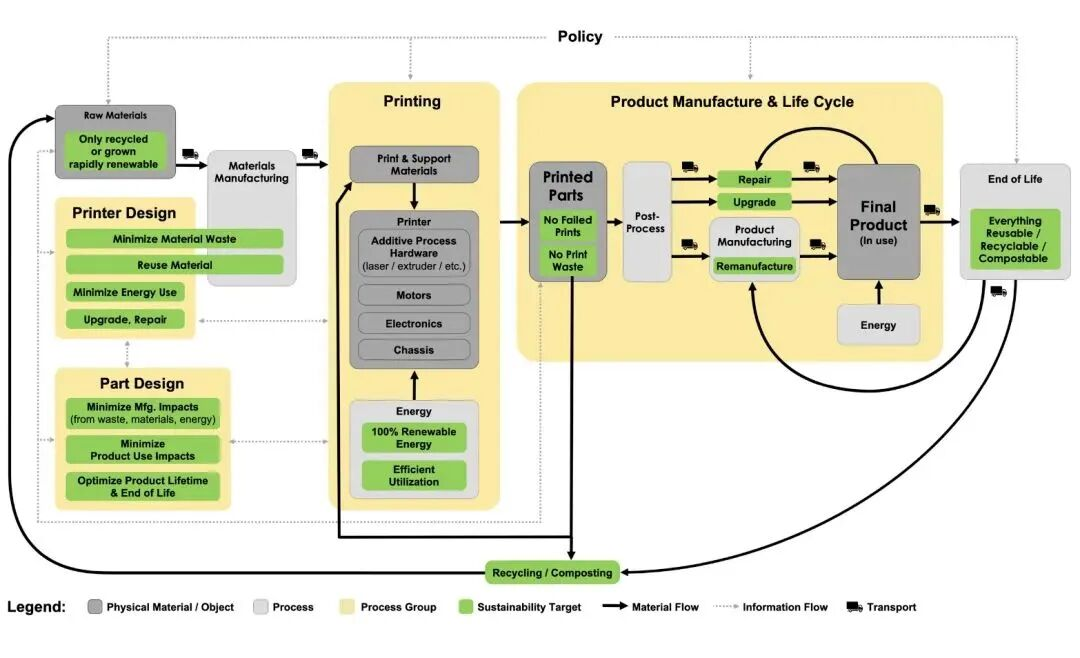
△ Researchers’vision for sustainable additive manufacturing
Is 3D Printing Sustainable?
This section examines how sustainable 3D printing technologies, including ceramic 3D printing and polymer additive manufacturing, affect material efficiency, energy consumption, and environmental outcomes.
Researchers from universities in Italy, the Netherlands, Singapore, Switzerland, Sweden, and the United States highlight growing threats to raw material supply. These threats include global climate change, biodiversity loss, and geopolitical instability.
A common argument for 3D printing is that it reduces material waste. However, the researchers emphasize that this effect is not guaranteed. They note that “significant reductions in waste rarely occur.”
Their findings show that additive manufacturing can reduce material waste in some cases. However, the results depend heavily on the specific 3D printing technology used and the application scenario.
When comparing sustainable 3D printing to conventional methods such as injection molding, casting, and extrusion, many additive manufacturing processes still show lower material efficiency. For example, polymer powder bed fusion (PBF) in sustainable 3D printing can generate up to 44% waste plastic powder. By optimizing material recycling and integrating LCA strategies, we can significantly reduce this waste.
The paper also highlights the environmental impact of 3D printer energy consumption. Studies show that most polymer-based 3D printers consume more energy than injection molding ABS plastics. Likewise, additive manufacturing of metal typically requires more energy per kilogram than casting, molding, forging, or extrusion.
The researchers challenge the idea that additive manufacturing eliminates transportation-related emissions. Companies must still transport the raw materials for 3D printing globally. Additive manufacturing mainly reduces transportation of finished or semi-finished components, but it does not remove it entirely.
To address these misconceptions, the authors recommend more comprehensive, context-specific life cycle assessments (LCA). Future studies should identify where and when 3D printing faces sustainability challenges. Ignoring material production and end-of-life impacts may miss opportunities to develop more sustainable 3D printing materials and processes.
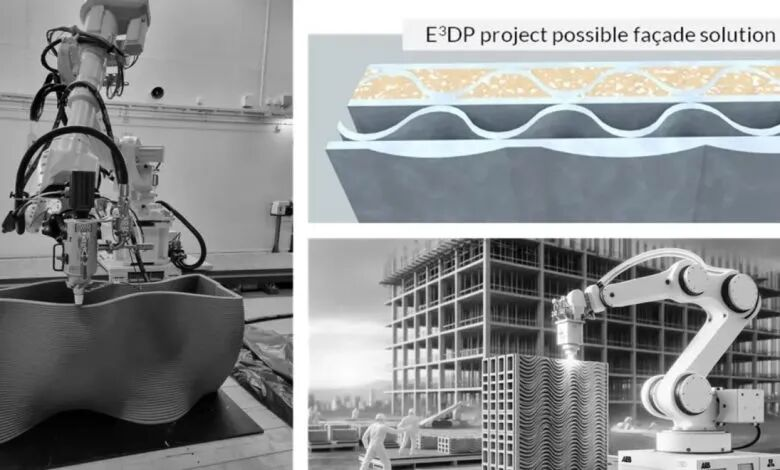
△ Researchers’vision for sustainable additive manufacturing
How Can 3D Printing Be Made More Sustainable?
The authors outline strategies to make additive manufacturing more sustainable. They argue that achieving this goal requires redesigning 3D printing processes, equipment, and materials. One approach is to use bio-composite pastes instead of plastic-based feedstocks in direct ink writing (DIW). Components made from these bio-based pastes use five times more material and have thicker walls than conventional DIW parts. Despite this, their overall environmental impact drops by about 50%. The researchers note that further improvements in the mechanical performance of these paste-based materials are still needed.
The authors also stress the importance of improving the recyclability of 3D printing materials. Currently, multi-material 3D printers complicate polymer recycling. Different materials are hard to separate and often accumulate impurities during processing. Therefore, the authors suggest designing future 3D printing materials with compostable components, allowing more environmentally friendly end-of-life treatment.
To further enhance sustainability, the authors recommend adopting sustainable design tools. For instance, engineers can embed life cycle assessment (LCA) within optimization software. This approach guides material selection, process parameters, and geometric design. As a result, engineers can make more informed, sustainability-driven decisions in additive manufacturing workflows.

△ A concept for sustainably 3D-printed wind turbine blades in remote regions
The Sustainability Potential of 3D Printing
The authors explain how additive manufacturing can make design practices more sustainable. They recommend designing all products for repairability and maintenance. When mass production and long-term storage of spare parts are no longer cost-effective, rapid manufacturing technologies allow on-demand production of replacement components.
The authors also promote design for upgradability. Manufacturers should update existing products by adding new features and functionalities. This approach extends product lifetimes and reduces waste. They note, however, that the economic feasibility of such business models needs further study.
Another key consideration is the reusability of components at the end of their life cycle. Manufacturers and operators should be able to easily disassemble and reassemble parts into new products. This effectively gives components a second life. Additive manufacturing is particularly well suited for this approach. At the same time, industry stakeholders must develop new guidelines, decision-support tools, and intelligent systems to fully realize this potential.
Finally, the authors highlight the importance of recyclability in product design. Poor design often forces manufacturers to downcycle raw materials, reducing material quality. Although researchers have applied additive manufacturing to materials with varying fractions of recycled content, impurities can cause printing failures. This emphasizes the need for further research to develop optimal strategies for handling recycled feedstocks.
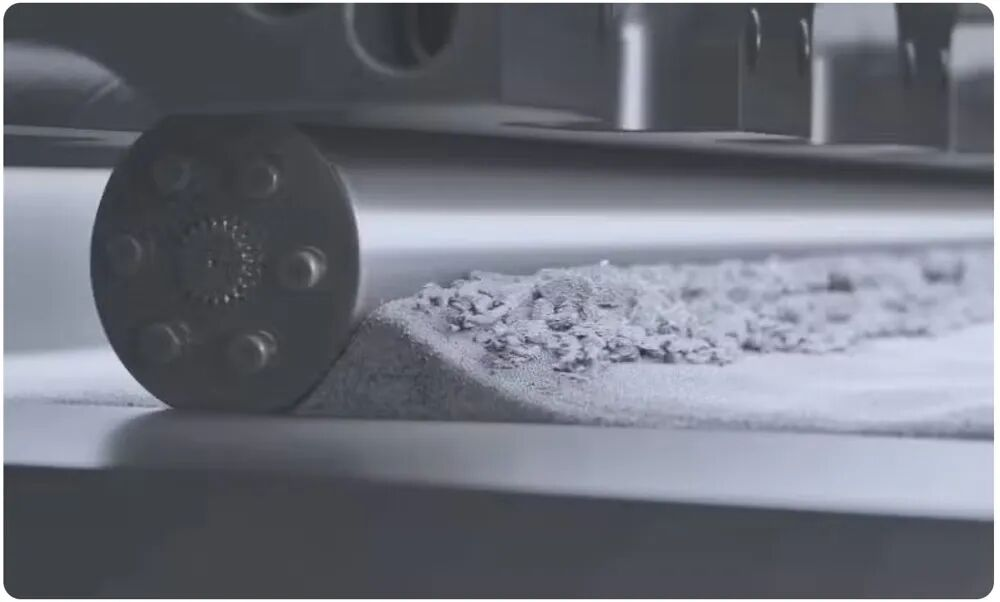
△ A sustainable and recyclable 3D printing powder material
The Future of Sustainable Additive Manufacturing
To achieve this vision, the report emphasizes the need to maximize the utilization of 3D printers, particularly by reducing the number of machines operating continuously around the clock. Higher utilization rates can significantly lower the material and energy consumption per part, with reductions of one to two orders of magnitude (10× to even 100×) compared with conventional manufacturing methods.
In addition, the authors highlight the importance of next-generation technologies and materials, as well as design workflows that explicitly account for the sustainability advantages of additive manufacturing.
Ultimately, the researchers conclude that key stakeholders can only realize their vision of sustainable additive manufacturing by sharing a common intent and commitment toward sustainability goals, and by actively aligning technological innovation, design strategies, and industrial practices.
More articles
Progress in Light Curing 3D Printing: Advances in Photosensitive Resin Modification
Mastering Debinding in Ceramic 3D Printing: The “Invisible” Stage That Determines Success
Optimizing Silicon Nitride Performance: Understanding the Sintering Logic for Microstructural Excellence in Ceramic 3D Printing
DLP Ceramic 3D Printing of W-Band Gradient Refractive Index (GRIN) Metalens: Fabrication and Performance Analysis
Request A quote
