

In the rapidly advancing field of DLP 3D printing ceramics, creating complex ceramic structures with dual functionality — exceptional mechanical strength and superior broadband microwave absorption — has become a game-changer for aerospace, radar stealth, and electromagnetic compatibility applications. At AdventureTech (Shenzhen Adventure Tech Co., Ltd.), pioneers in high-precision DLP 3D printing ceramics since 2015, we empower researchers and engineers to fabricate Gyroid structure 3D printing metamaterials from SiOC-based preceramic polymers with unmatched accuracy and repeatability.
Our industrial-grade DLP systems, trusted by Tsinghua University, Harbin Institute of Technology (HIT), and the Chinese Academy of Sciences (CAS), deliver the resolution and material compatibility required for intricate triply periodic minimal surface (TPMS) designs like the gyroid. This guide explores how Gyroid structure 3D printing combined with polymer-derived ceramics (PDCs) transforms SiOC precursors into high-performance absorbers, drawing on cutting-edge research while highlighting the practical advantages of AdventureTech’s complete DLP solutions.
Why SiOC is Ideal for Broadband Microwave Absorption
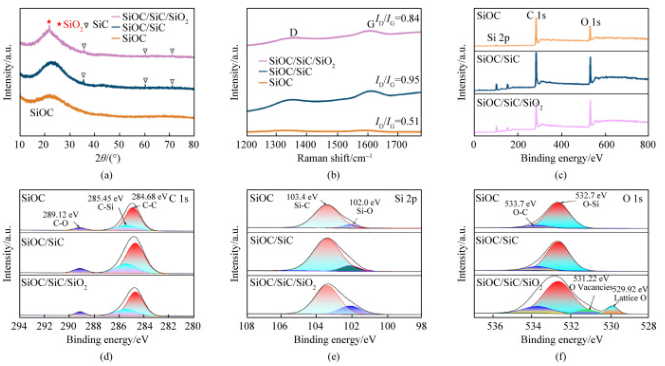
SiOC material properties make it a standout choice for electromagnetic wave (EMW) absorption. Derived from polysiloxane preceramic resins, SiOC ceramics offer tunable dielectric constants, high thermal stability (up to 1200–1400 °C), and excellent oxidation resistance. When processed via DLP 3D printing ceramics, the resulting amorphous SiOC matrix (with free carbon phases) provides multiple loss mechanisms: dielectric polarization, conduction loss, and interfacial polarization.
Recent studies on SiOC/SiC/SiO₂ composites demonstrate how precise carbon regulation and microstructural control turn these materials into lightweight, high-temperature absorbers — perfectly suited for complex ceramic structures that traditional machining cannot achieve.
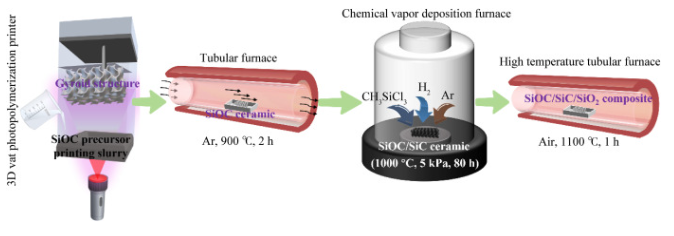
DLP 3D Printing Process for Complex Ceramic Structures
AdventureTech’s desktop and industrial DLP ceramic 3d printer platforms excel at printing high-viscosity preceramic slurries with layer thicknesses as fine as 25–50 μm. The proprietary ADT-Slicer 4D engine ensures one-stroke forming of intricate Gyroid structure 3D printing geometries while the dual-cylinder sinking-scraping system and automatic filtration prevent defects in high-solid-loading resins.
Typical workflow:
- Photosensitive polysiloxane resin formulation (ceramic yield >76 wt%)
- High-resolution DLP printing of gyroid TPMS lattice
- Debinding at 400–600 °C
- Pyrolysis at 1000–1300 °C under inert atmosphere
The result: linear shrinkage of ~21.5 % with excellent shape retention, enabling complex ceramic structures with densities of 1.43–1.61 g/cm³.
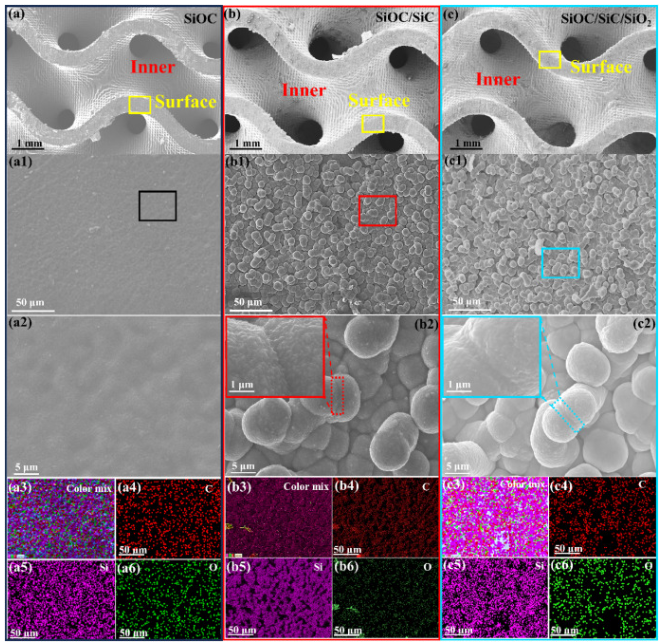
The Power of Gyroid Structure 3D Printing
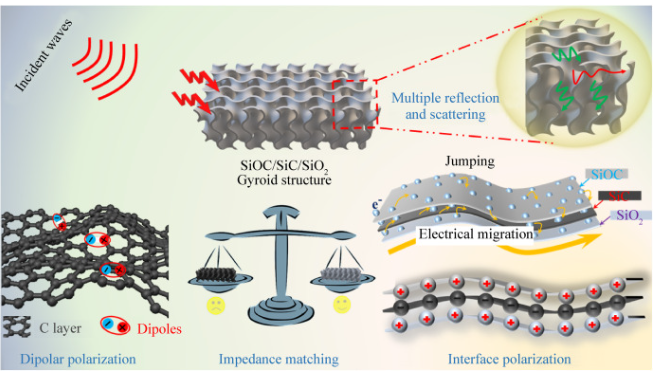
The gyroid TPMS topology stands out among metamaterial designs due to its zero mean curvature, large surface area, and ability to promote multiple internal reflections and scattering of EM waves. In DLP 3D printing ceramics, the gyroid’s interconnected channels create continuous impedance gradients that dramatically improve broadband microwave absorption compared to simple lattices.
CST Microwave Studio simulations confirm that optimized gyroid unit cells (shell thickness 200–400 μm, cell size ~2.5 mm) achieve perfect impedance matching across X and Ku bands — a direct result of the synergistic effect between the SiOC material properties and the 3D architecture.
<img src=”https://adt-ceramic3dp.com/wp-content/uploads/2026/03/%E5%BE%AE%E4%BF%A1%E5%9B%BE%E7%89%87_2026-03-10_150329_782.jpg” alt=”Reflection loss (RL) curves and effective absorption bandwidth demonstrating broadband microwave absorption performance of Gyroid SiOC composites”>
Outstanding Broadband Microwave Absorption Performance
State-of-the-art gyroid SiOC composites deliver:
- Minimum reflection loss (RLmin) of −62.2 dB at 4.3 mm thickness
- Effective absorption bandwidth (EAB) up to 8.4–9.82 GHz (covering full X-band and extending into Ku-band)
- Strong absorption maintained even under high-temperature oxidation
These results stem from combined dielectric loss, conduction loss from free carbon, and structural resonance effects unique to the gyroid design. The same parts also exhibit excellent load-bearing capability, with compressive strengths reaching 31.6 MPa — making them true multifunctional complex ceramic structures.
Why AdventureTech’s DLP Systems Excel for SiOC Gyroid Applications
Founded in 2015 by Dr. Pengfei Zhu (Ph.D. University of Science and Technology of China, Tsinghua postdoctoral researcher and Shenzhen high-level talent), AdventureTech integrates deep materials science with industrial-grade DLP 3D printing ceramics hardware. With 50+ patents and installations at China’s top institutions, we provide complete solutions — from high-resolution DLP printers and optimized preceramic slurries to full pyrolysis protocols.
Our systems are uniquely suited for Gyroid structure 3D printing and SiOC material properties exploration:
- Ultra-low material consumption (only 80 mL for experimental builds)
- Peristaltic feeding + auto-filtration for stable high-viscosity resins
- ADT-Slicer 4D with built-in support for TPMS designs
- Proven track record in functional ceramics for electronics, aerospace, and microwave applications
Whether you are developing next-generation stealth materials or high-temperature absorbers, AdventureTech delivers the precision and reliability required to turn theoretical gyroid designs into real-world performance.
Ready to unlock broadband microwave absorption with Gyroid-structured SiOC via DLP 3D printing? Contact AdventureTech today at adt-ceramic3dp.com and discover how our DLP 3D printing ceramics solutions can accelerate your innovation in complex ceramic structures.
More articles
Gyroid-Structured SiOC Composites via DLP 3D Printing for Broadband Microwave Absorption
Sintering Stress Control Strategies for Complex Ceramic Parts Using CTE Insights in 3D Printing
From Powder to Performance: A Systematic Quality Control Pathway for High-Performance Alumina Ceramics
How to Prepare High-Performance Silica Ceramics Using DLP Technology and Optimized Reinforcements
Request A quote
