

Debinding is the critical yet often overlooked phase in ceramic 3D printing, where organic binders are carefully removed from the green body to prevent defects like cracks, deformation, or collapse. This “invisible” process bridges printing and sintering, directly impacting the final part’s structural integrity, dimensional accuracy, and performance in demanding applications such as aerospace, biomedical implants, and precision engineering.
At Adventure Tech (ADT Ceramic 3D Printing), our advanced DLP 3D printers and ceramic 3D printers are engineered for superior material compatibility and process control, minimizing debinding challenges from the outset. With optimized slurry formulations and precise printing parameters, we help users achieve reliable, defect-free results.
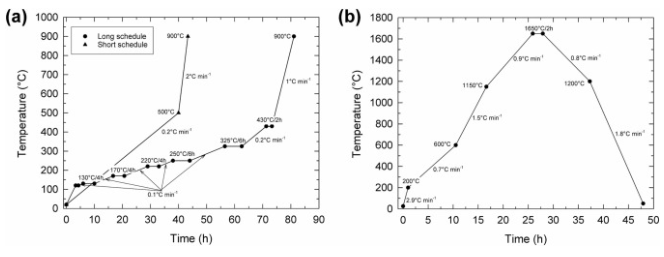
Heating profiles play a pivotal role in successful debinding—slow rates (e.g., ≤2°C/min) prevent gas buildup and thermal stress in ceramic 3D printing.
Why Debinding Is the Bottleneck in Ceramic 3D Printing
Debinding removes binders while preserving the delicate green body structure. Imbalances in gas release, thermal stress, or shrinkage can introduce defects that amplify during sintering, leading to scrap rates as high as 30% in poorly controlled processes.
Key challenges include:
- Cracks from rapid decomposition or layered anisotropy
- Deformation affecting precision in complex geometries
- Pores, bubbles, or delamination reducing mechanical reliability
Adventure Tech’s DLP 3D printers address these from the design stage, supporting low layer thicknesses and uniform particle distribution for smoother debinding.
Cracks: The Most Severe Debinding Defect
Cracks often originate during debinding but become visible post-sintering, caused by:
- Gas Pressure Buildup: Heating rates >2°C/min cause faster binder decomposition than gas escape, spiking internal pressure.
- Layered Anisotropy: Density variations (20–30%) in printed layers create shear stress, especially with thick layers (>0.15 mm).
- Poor Atmosphere Flow: Insufficient gas circulation (<0.5 L/min) leads to temperature gradients (20–80°C) and microcracks.
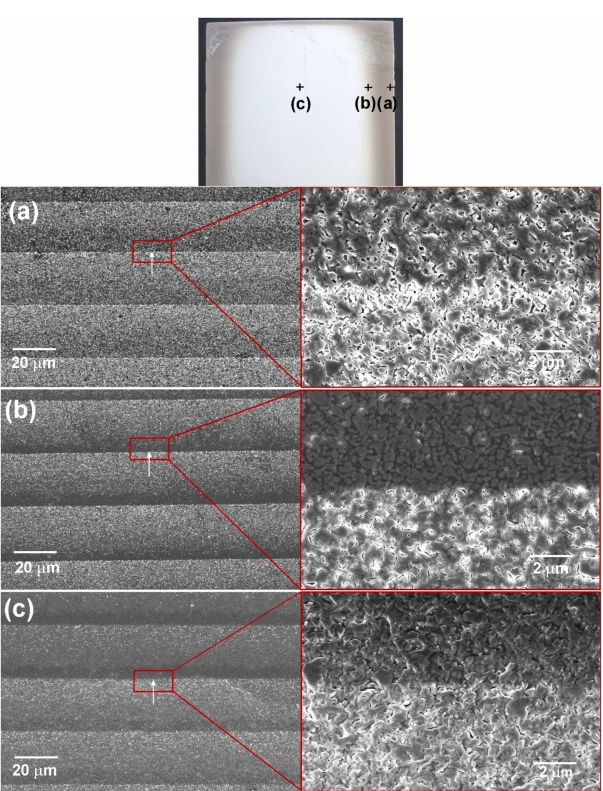
SEM analysis reveals layered microstructures and early defect formation in debinded ceramics, highlighting the need for precise control in DLP 3D printing.
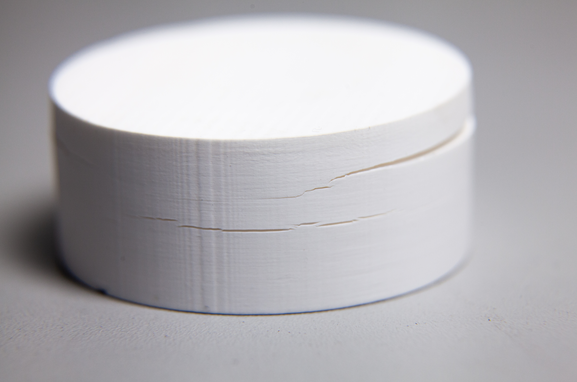
Real-world example of debinding failure: Cracks in a printed ceramic part due to uncontrolled heating or gas dynamics.
Deformation: Undermining Dimensional Precision
Deformation accumulates subtly, driven by:
- Residual binders (>1%) causing ongoing gas release and distortion (>±0.15 mm in small parts)
- Excessive heating rates (>1°C/min) generating thermal gradients and stress exceeding green body strength
- Structural instability in high-aspect-ratio designs without adequate supports
Optimized supports and slow ramps via Adventure Tech’s ceramic 3D printers reduce these risks significantly.
Other Common Debinding Defects
- Pores and Bubbles: Blocked gas pathways or binder mismatches
- Delamination: Uneven interlayer shrinkage
- Surface Issues: Stress-induced dents or waves
These defects underscore debinding’s multi-factor complexity—thermal, mechanical, and gas dynamics.
Adventure Tech: Pioneering Reliable Ceramic 3D Printing Solutions
Established in 2015, Adventure Tech specializes in DLP 3D printers for ceramic 3D printing, offering experimental systems (requiring just 80 mL material) and industrial ultra-high-speed models (up to 700 layers/hour). Backed by over 50 patents and collaborations with Tsinghua University, Harbin Institute of Technology, and the Chinese Academy of Sciences, we provide end-to-end solutions—from printers and materials to process expertise—that make debinding predictable and efficient.
Our ceramic 3D printers empower researchers and manufacturers to overcome traditional limitations and produce high-performance parts.
Conclusion: Achieving Predictable Debinding Outcomes
Mastering debinding requires integrated optimization: material selection, topology design, controlled heating, and advanced modeling. With the right tools, this challenging stage becomes a strength.
Adventure Tech is dedicated to advancing ceramic 3D printing technology. Explore our DLP 3D printers to elevate your debinding success.
Ready for defect-free ceramic parts? Contact Adventure Tech for expert guidance and solutions.
More articles
Progress in Light Curing 3D Printing: Advances in Photosensitive Resin Modification
Mastering Debinding in Ceramic 3D Printing: The “Invisible” Stage That Determines Success
Optimizing Silicon Nitride Performance: Understanding the Sintering Logic for Microstructural Excellence in Ceramic 3D Printing
DLP Ceramic 3D Printing of W-Band Gradient Refractive Index (GRIN) Metalens: Fabrication and Performance Analysis
Request A quote
