

In the world of advanced ceramic 3D printing, producing complex geometries with high reliability demands mastery of the final — and often most critical — stage: ceramic 3D printing sintering. At AdventureTech (ADT Ceramic 3DP), pioneers in high-precision ceramic 3d printer technology since 2015, we have developed proven strategies to manage sintering stress control for complex ceramic parts, minimize thermal mechanical coupling effects, and optimize microstructure evolution in ceramic sintering 3D printing.
Our complete DLP-based ceramic 3d printer systems, combined with turnkey sintering protocols, are trusted by Tsinghua University, Harbin Institute of Technology (HIT), Chinese Academy of Sciences (CAS), and leading industrial partners. This guide shares industry-best practices enriched by our decade of real-world experience, helping engineers achieve crack-free, high-performance parts every time.
1. Understanding Sintering Stress in Ceramic 3D Printing
During ceramic 3D printing sintering, particles bond and densify while the part undergoes significant shrinkage (typically 15–22 % linear). In complex geometries — thin walls, overhangs, internal channels — non-uniform shrinkage generates sintering stress that can exceed the material’s green strength, leading to warping, cracking, or delamination.
Thermal mechanical coupling amplifies this: temperature gradients create differential expansion/contraction governed by the coefficient of thermal expansion (CTE). AdventureTech’s industrial-grade ceramic 3d printer users routinely achieve <0.5 % distortion on parts up to 200 mm by applying the systematic controls outlined here.
2. The Critical Role of CTE Insights in Thermal Mechanical Coupling
CTE mismatch between different sections of a printed part (or between part and support structures) is the root cause of many sintering failures. For alumina and zirconia printed on our DLP systems:
- Typical CTE: Al₂O₃ ≈ 7.5–8.5 × 10⁻⁶ /K
- Local variations from density gradients can reach 15–20 %
Practical strategy: Pre-sintering simulation using finite-element analysis (FEA) that incorporates both sintering shrinkage and CTE data allows us to optimize support design and heating profiles. Our ADT-Slicer 4D engine now includes built-in CTE-aware slicing for complex parts.
3. Microstructure Evolution in Ceramic Sintering 3D Printing
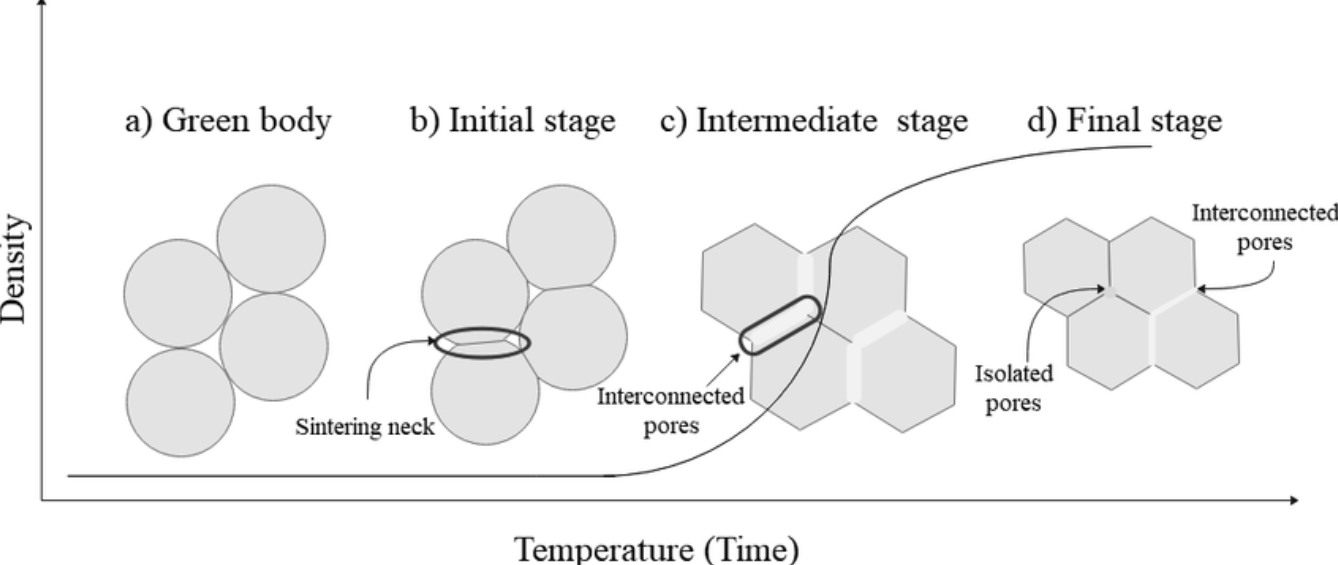
Microstructure evolution follows four classic stages, each directly influencing final stress distribution:
<img src=”https://adt-ceramic3dp.com/wp-content/uploads/2026/03/%E5%BE%AE%E4%BF%A1%E5%9B%BE%E7%89%87_2026-03-03_211435_839.png” alt=”Schematic diagrams of particle packing and pore evolution (initial solid particles to final interconnected pore network) during sintering of 3D printed ceramics”>
a) Green body (loose particle packing) b) Initial stage — neck formation c) Intermediate stage — pore channel closure d) Final stage — isolated spherical pores
On AdventureTech ceramic 3d printer systems, high layer resolution (25–50 μm) and uniform slurry deposition ensure consistent green density, dramatically reducing microstructural gradients that drive stress.
4. Proven Sintering Stress Control Strategies for Complex Ceramic Parts
Drawing from our hands-on work with hundreds of complex components, here are the most effective strategies:
- Multi-stage heating profiles with slow ramps (0.5–2 °C/min) through the critical 800–1200 °C range where viscous flow dominates
- Support structure optimization using low-CTE or sacrificial materials that match shrinkage
- Atmosphere control (air, vacuum, or reducing) to manage grain-boundary diffusion and minimize abnormal grain growth
- Pressure-assisted sintering (SPS/HIP) for ultra-dense parts where standard pressureless sintering induces excessive stress
- CTE-tailored material design — blending micron and sub-micron powders to fine-tune local expansion behavior
These strategies, validated on our desktop ADT-3D-ZM and industrial ultra-high-speed DLP ceramic 3d printer platforms, routinely deliver >99 % relative density with zero visible cracks even in lattice structures and thin-walled heat exchangers.
5. Why AdventureTech Ceramic 3D Printers Excel in Sintering Performance
Founded by Dr. Pengfei Zhu (Ph.D. University of Science and Technology of China, Tsinghua postdoctoral researcher), AdventureTech integrates deep materials science with industrial-grade ceramic 3d printer hardware. With 50+ patents and installations at China’s top research institutions, we deliver not just printers — but complete ceramic 3D printing sintering solutions:
- High-speed DLP systems (up to 700 layers/hour for alumina)
- Peristaltic feeding + automatic filtration for stable high-solid slurries
- Full technical packages including debinding, sintering furnaces, and FEA-supported process design
- Proven results in aerospace insulators, biomedical implants, and electronic substrates
Ready to master sintering stress control for your complex ceramic parts? Contact AdventureTech today at adt-ceramic3dp.com and discover how our ceramic 3d printer technology and CTE-optimized protocols can transform your most challenging designs into reliable, high-performance components.
More articles
Gyroid-Structured SiOC Composites via DLP 3D Printing for Broadband Microwave Absorption
Sintering Stress Control Strategies for Complex Ceramic Parts Using CTE Insights in 3D Printing
From Powder to Performance: A Systematic Quality Control Pathway for High-Performance Alumina Ceramics
How to Prepare High-Performance Silica Ceramics Using DLP Technology and Optimized Reinforcements
Request A quote
