

3D printing alumina with DLP 3D printers has revolutionized the fabrication of advanced millimeter-wave components. High-purity alumina ceramics, known for low dielectric loss (tan δ ~ 10⁻⁴) and stable performance in the W-band (75–110 GHz), enable the creation of sophisticated gradient refractive index (GRIN) metalenses for beam steering in radar, satellite communication, and 6G systems.
At AdventureTech (ADT Ceramic 3D Printing), our cutting-edge Ceramic 3D Printer systems excel in 3D printing alumina for such demanding RF applications. Backed by proprietary innovations in slurry formulation and precision light curing, ADT delivers sub-50 µm resolution and near-full density for complex metamaterial structures.
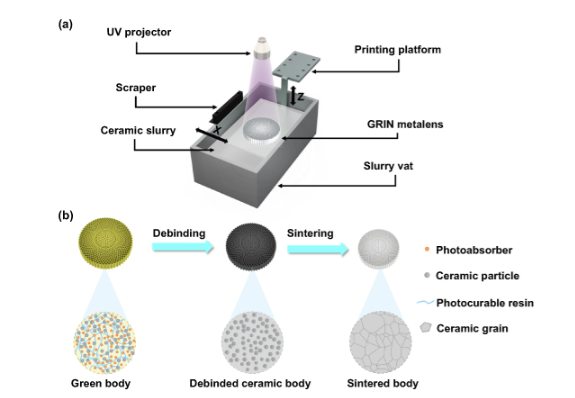
mina GRIN metalens prototypes showcasing intricate unit cell designs and overall lens structure
Why Alumina and DLP for W-Band GRIN Metalenses?
3D printing alumina via Digital Light Processing (DLP 3D printer) offers unique advantages over traditional machining or injection molding:
- Low-loss dielectric properties: High-purity alumina (≥99.9%) maintains ε_r ≈ 9.8 and minimal loss tangent across W-band frequencies.
- Design freedom: GRIN profiles achieved through varying unit cell geometries (e.g., pillar height/diameter) for phase control from 0–2π.
- Precision: Layer thicknesses down to 25 µm enable subwavelength features critical for millimeter-wave operation.
ADT’s DLP Ceramic 3D Printer platforms optimize high-solid-loading alumina slurries (>55 vol%) for defect-free green bodies and predictable shrinkage during thermal processing.
SEM micrographs of DLP-printed high-purity alumina microstructures, highlighting fine grain size and dense sintering
Fabrication Process Overview
The workflow for 3D printing alumina GRIN metalenses typically includes:
1. Slurry Preparation & Rheology
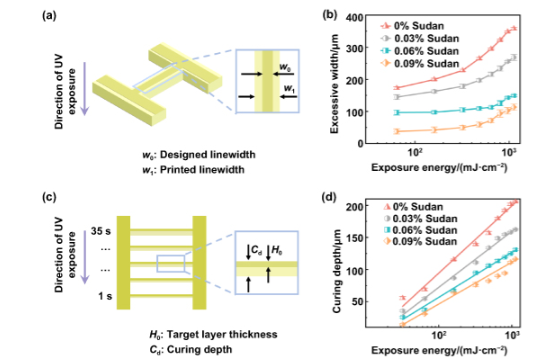
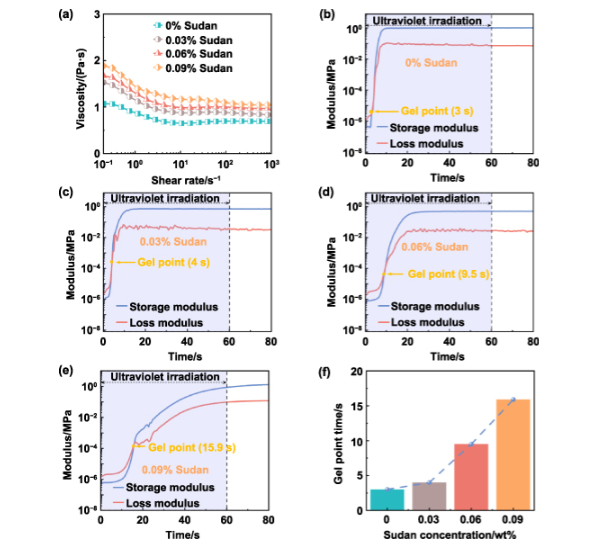
The process begins with high-purity alumina powder mixed with photosensitive resin and additives. Research highlights that introducing light absorbers (Sudan Orange G) and optimizing solid loading (> 55 vol%) are key to controlling light scattering and viscosity (< 3000 cP).
2. Debinding & Sintering
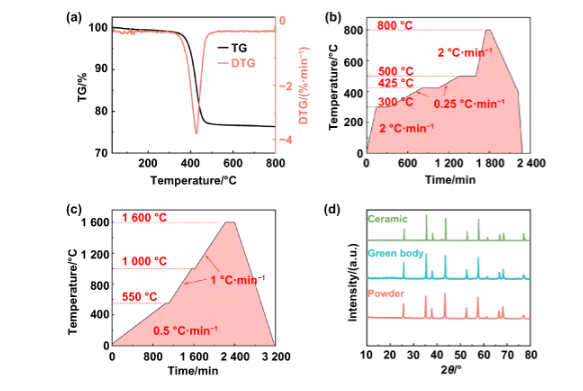
Printing is followed by a critical thermal treatment. Thermogravimetric analysis (TG-DTG) is used to design a multi-stage debinding profile to remove organics without cracking. Final densification at 1600°C achieves > 99% relative density.
3. Dimensional Accuracy
Due to linear shrinkage (~18–22%), a size compensation strategy is applied in the CAD design (e.g., 1.24x scaling in radial direction).
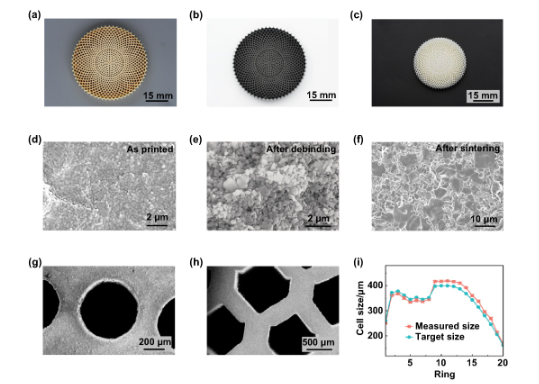
ADT’s patented debinding/sintering protocols ensure dimensional accuracy better than ±0.5% for complex GRIN lattices.
Performance Highlights
Recent advancements demonstrate:
- Beam deflection: ±30° scanning range with minimal sidelobes.
- Gain enhancement: Up to 18–20 dBi realized gain.
- Efficiency: Aperture efficiency >50% across 80–100 GHz.
- Wideband operation: Consistent phase response enabling broadband focusing/steering.
These metrics position 3D printing alumina GRIN metalenses as lightweight, conformal alternatives to traditional phased arrays.
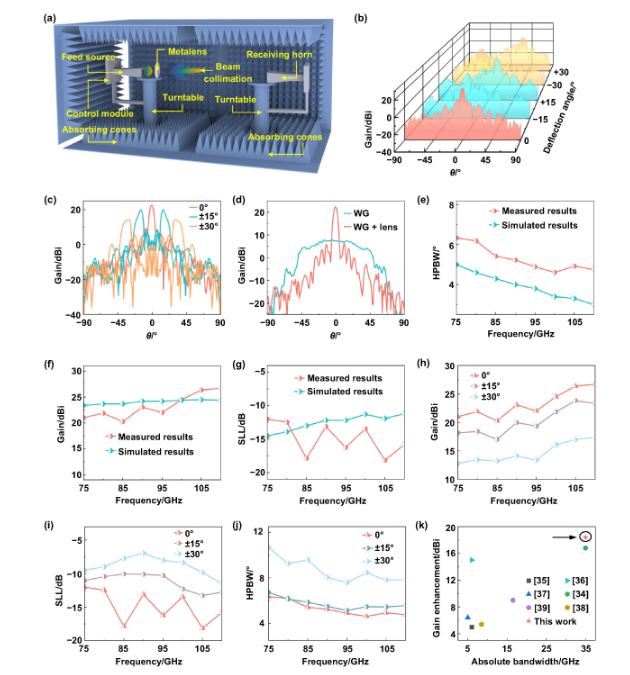
Simulated and measured radiation patterns showing wide-angle beam steering and high directivity in W-band
Why Choose AdventureTech for Your Alumina 3D Printing Projects?
AdventureTech (ADT) leads in Ceramic 3D Printer solutions specialized for 3D printing alumina and other technical ceramics. Our DLP 3D printer series supports research-to-production workflows with proven results in RF metamaterials, aerospace components, and semiconductor packaging.
Explore our innovation portfolio at ADT Invention Patents and contact us to discuss how our technology can accelerate your W-band GRIN metalens development.
More articles
Progress in Light Curing 3D Printing: Advances in Photosensitive Resin Modification
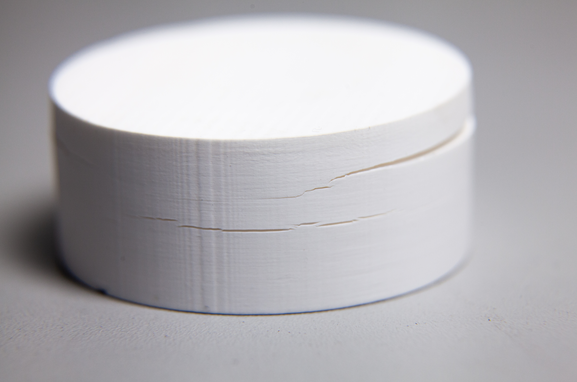
Mastering Debinding in Ceramic 3D Printing: The “Invisible” Stage That Determines Success
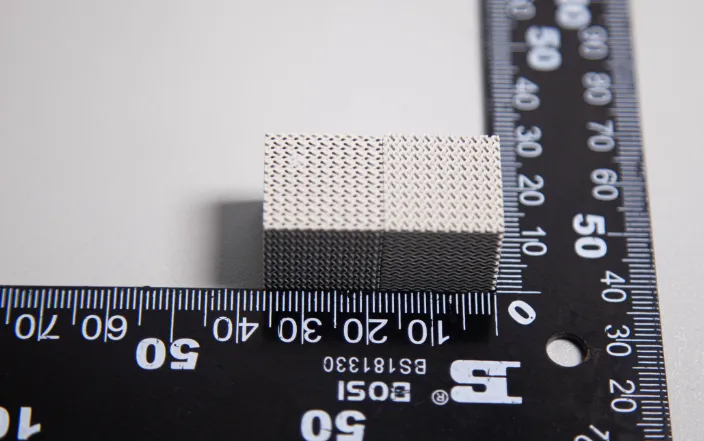
Optimizing Silicon Nitride Performance: Understanding the Sintering Logic for Microstructural Excellence in Ceramic 3D Printing
DLP Ceramic 3D Printing of W-Band Gradient Refractive Index (GRIN) Metalens: Fabrication and Performance Analysis
Request A quote
