
Porous ceramics play a critical role in high-tech applications such as sound absorption, thermal insulation, filtration, tissue engineering, transducers, and hydrophones. The unique attributes of these materials can be tailored by adjusting pore shape, size, and porosity, expanding their application fields.Although 3D printing for dense ceramics has been studied extensively, more is needed to optimize 3D printing processes for fabricating porous ceramics. Mainly because the pore properties of porous ceramics determine their performance, an in-depth investigation is needed to determine how the thermal treatment conditions control these pore properties.
Challenges and Solutions in Manufacturing Porous Ceramics
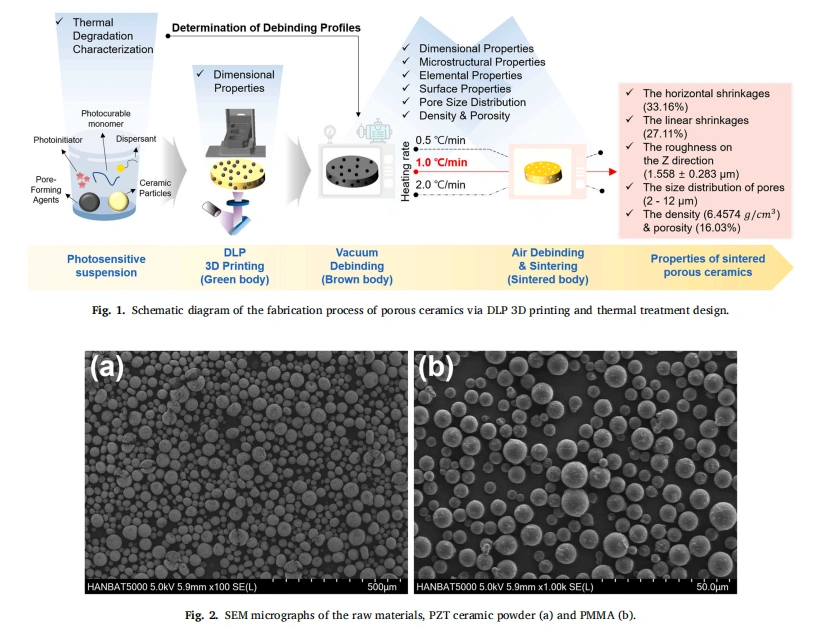
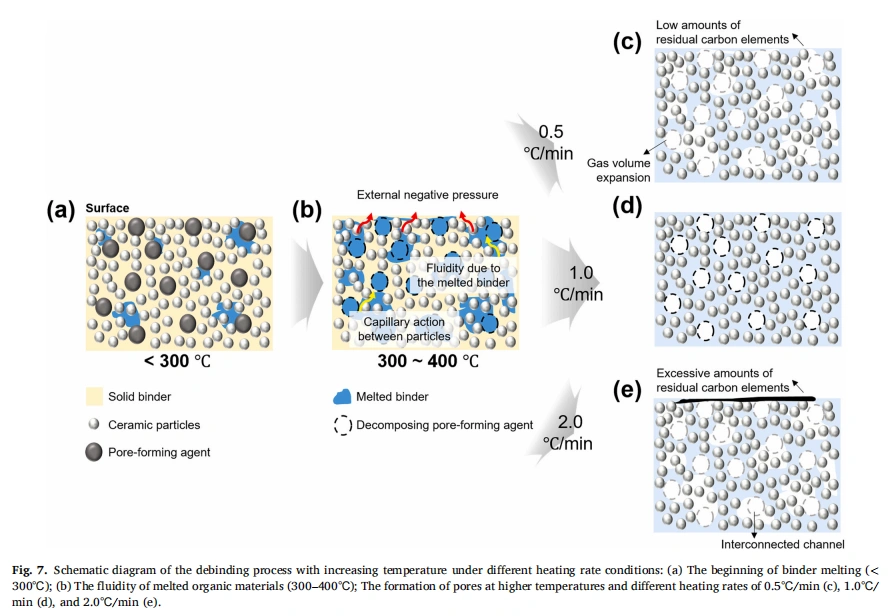
The process of creating porous ceramics via DLP 3D printing involves several steps: optimizing ceramic suspension, setting 3D printing parameters, and defining thermal treatment conditions. Among these, the debinding process is crucial for removing organic materials and forming pores. A systematic study conducted by Insup Kim and Yong-Jin Yoon at KAIST highlights the importance of controlling heating rates during debinding to achieve optimal results.
Impact of Heating Rates on Debinding
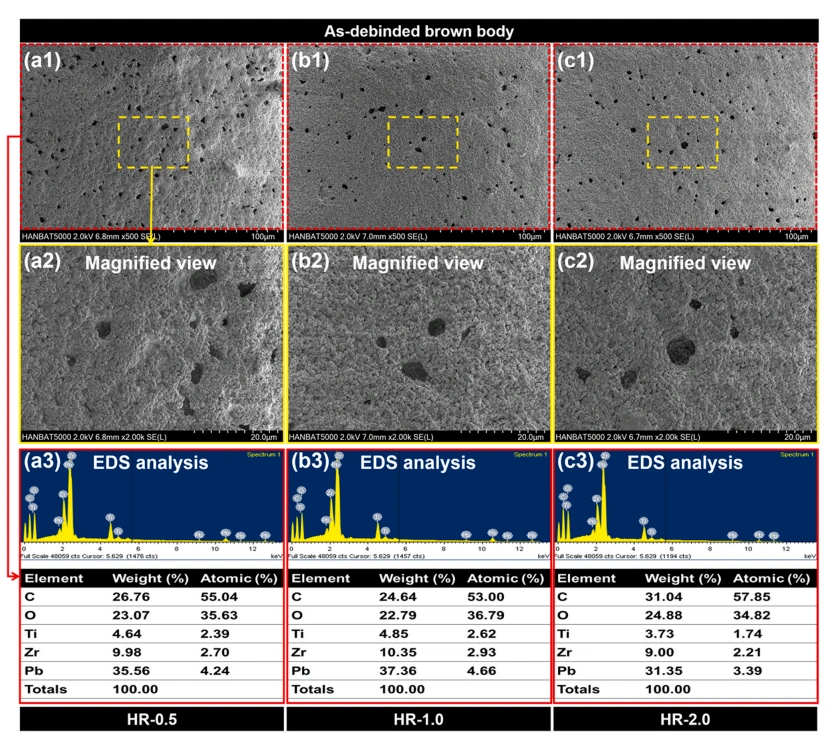
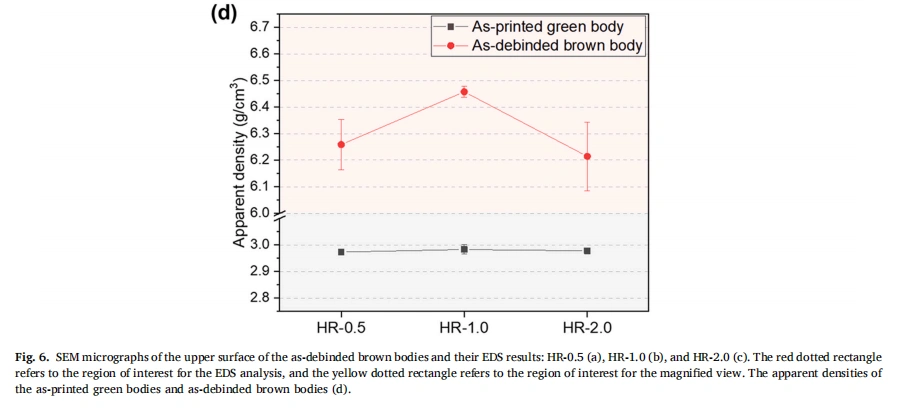
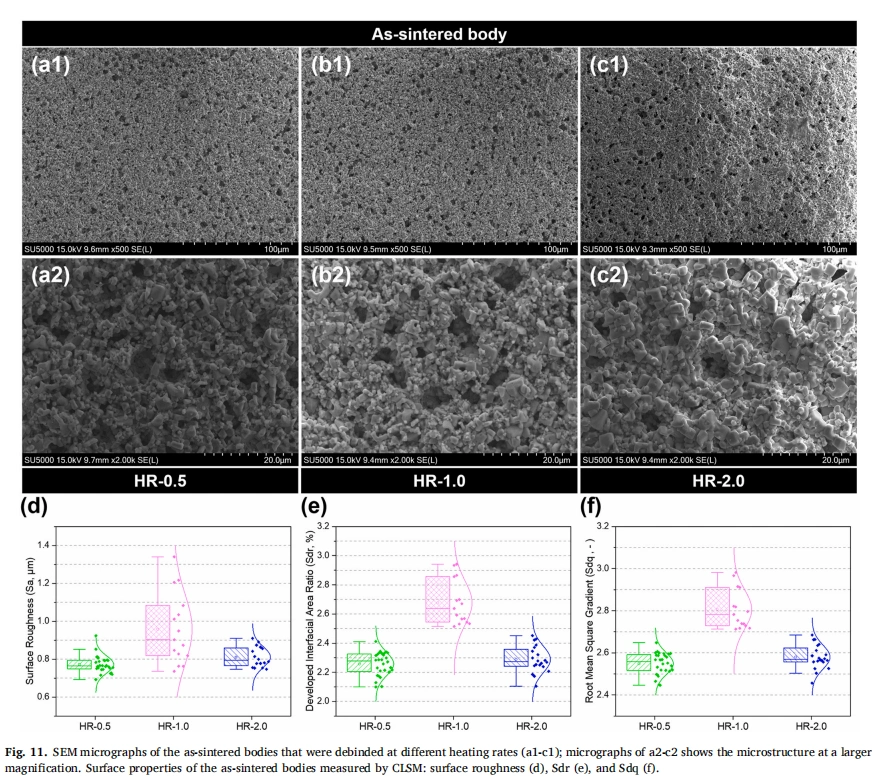
Kim and Yoon’s research demonstrates that varying heating rates significantly affect key properties of the debinded or sintered samples, including dimensional changes, microstructural and surface properties, and pore characteristics. Specifically, a heating rate of 1.0℃/min produced the lowest shrinkages, surface roughness, and improved stair effect, leading to porous ceramics without cracks and with pores matching the size distribution of the pore-forming agent used.
Microstructural Analysis and Surface Properties
Microstructural analysis using confocal laser scanning microscopy (CLSM) and field emission scanning electron microscopy (FE-SEM) revealed that the optimal heating rate condition led to strengthened bonding between adjacent layers, verified by line profiles and line roughness measurements. Moreover, the porosity and density of the sintered bodies were influenced by the heating rate, with HR-1.0 showing desirable properties due to its narrower range of pore sizes (2–12 μm), closely aligned with the particle size distribution of the pore-forming agents (2.75 – 11.2 μm).
Conclusion
Our findings show that this heating rate condition affects the shrinkages, stair effect, roughness, and pore properties of as-DLP printed green bodies developed during the thermal treatment. In sum mary, among the three heating rates used for the vacuum debinding step, 1.0℃/min produced the lowest shrinkages both in the X-Y plane (33.16 %) and along the Z direction (27.11 %) of the sintered porous ceramics. The findings from this study provide valuable insights for determining the optimal heating rate condition to manufacture porous ceramics by DLP 3D printing technology. While the thermal treatment conditions proposed may be limited to the material type and properties used in this study, they lay the foundation for designing processes that reflect the size of pore-forming agents into the final porous ceramics. This approach is particularly beneficial for applications where pore characteristics critically impact mechanical, chemical, and electrical performances.
Article source: https://www.sciencedirect.com/science/article/pii/S221486042400455X
Our website: https://www.adventure-tech.cn/