
Advances in technology have increased the popularity of removable braces. However, they have difficulty coping with certain tooth movements. Composite "attachments" address this issue by being bonded to the teeth to improve the movement control of the braces. Certain dental restorations present additional challenges to orthodontists in terms of bonding failure. This study aims to introduce an innovative strategy to provide a provisional restoration with attachments manufactured as a single unit (e.g., a 3D printed restoration with attachments) to improve strength and prevent debonding issues.
Methods
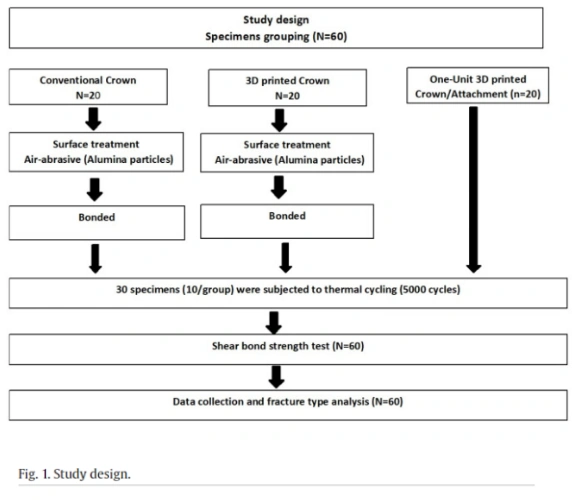
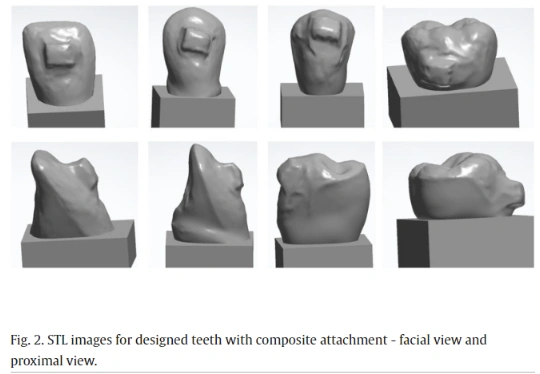
A total of 60 crowns with attachments were prepared: 20 conventional (Protemp) and 40 3D-printed (20 bonded with attachments; 20 integrated with composite attachments as a single unit) using NextDent resin. Two central incisors were scanned (once without attachments and once with attachments) to create STL files for specimen printing. Half of the specimens (30, n = 10 per group) underwent thermal cycling (5000 cycles). Shear bond strengths (MPa) were evaluated using a universal testing machine. The debonded areas and attachment failures were analyzed to determine the fracture type. Data analyses were performed using ANOVA and post hoc Tukey tests (α = 0.05).
Experimental results
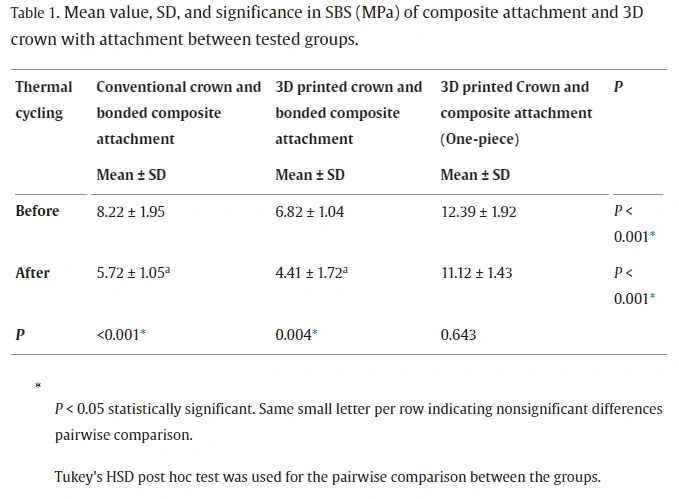
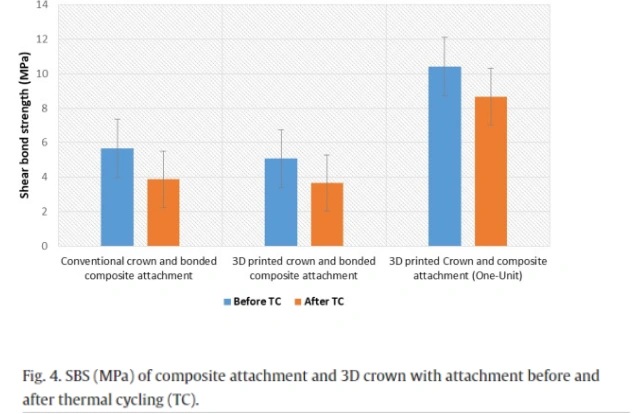
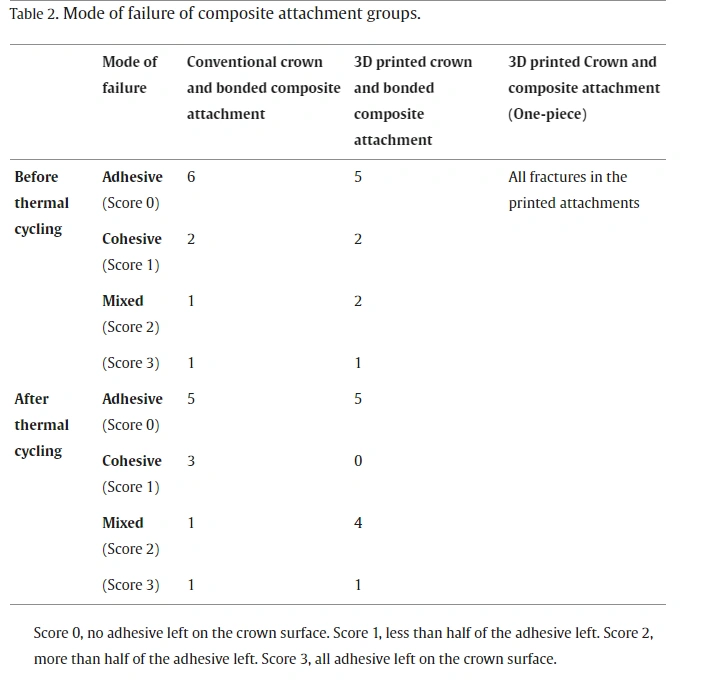
The 3D-printed specimens showed higher strength values than the bonded attachments per group (P < 0.001). The 3D-printed crowns with attachments demonstrated the highest strength (12.39 ± 1.92 MPa). Thermal cycling significantly decreased the bond strength of the attachments (P < 0.001), except in the 3D-printed crowns with composite attachments as a single unit, which showed no significant change after thermal cycling (P = 0.643). In the bonded attachment groups, the adhesive type was the predominant failure mode, while in the 3D-printed groups, attachment fractures were the primary cause of failure.
Conclusion
The 3D-printed provisional crowns with attachments have high strength and is clinically appropriate for orthodontic treatment when temporization of teeth is indicated.The developed technique for fabricating 3D-printed provisional restorations with orthodontics attachments as a single unit is a promising approach. The technique may be incorporated into the digital orthodontic treatment workflow when temporization is indicated.
Article source:https://doi.org/10.1016/j.jdent.2024.105406