
Introduction
This systematic review and meta-analysis aims to compare the differences in physical and mechanical properties and clinical applications of zirconia ceramics prepared by 3D printing (AM) and traditional grinding (SM) processes.These studies are of great significance for optimizing the application of zirconia ceramics in the field of oral restoration.
Print methods of dental restorative materials
CNC machining technology is currently the main method for making dental restoration materials, but it has disadvantages such as low efficiency and difficulty in producing complex structures. Therefore, 3D printing technology is considered to be a new way to solve these problems. Although ceramic 3D printing is a complex process, the accuracy and physical and mechanical properties of the final product can be affected by controlling multiple factors. In recent years, SLA, DLP, robocasting/DIW, NPJ, IJP and other technologies have been widely used in the production of zirconia ceramic restorations. Among these technologies, SLA, DLP, robocasting/DIW, NPJ and IJP are the most common technologies.
Comparison of SLA and IJP ceramic 3D printing
By comparing the experimental data of different processing methods and materials, it was found that in terms of mechanical strength, zirconia ceramics printed by SLA have a slight advantage over zirconia ceramics printed by IJP; and the performance of mechanical strength is also different for different dental restoration designs. In addition, the effects of different processing methods on surface roughness, wettability and adhesion were also explored, and corresponding conclusions were drawn.
Material Testing
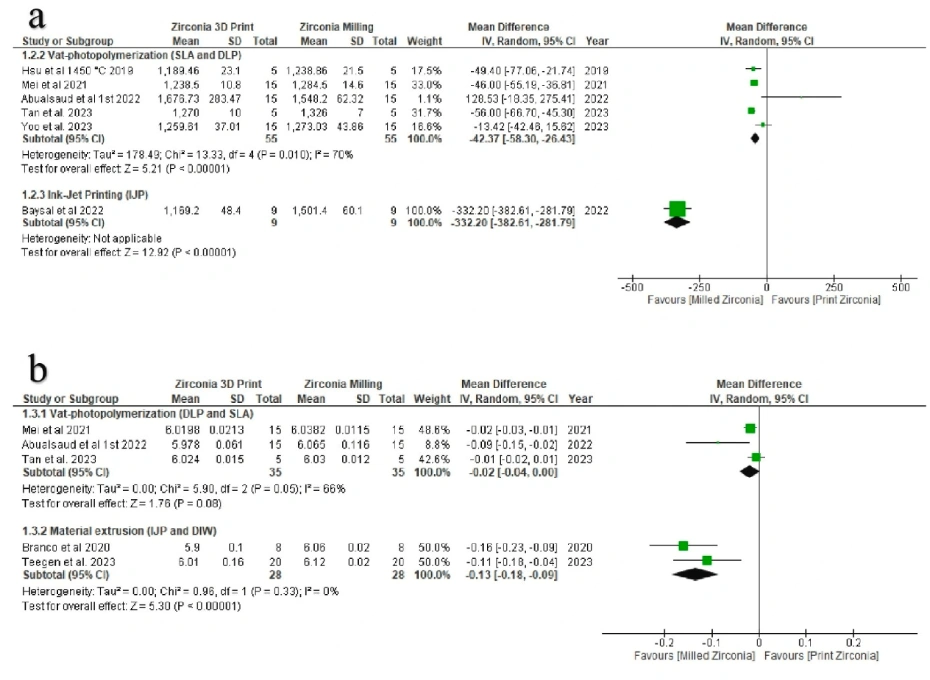
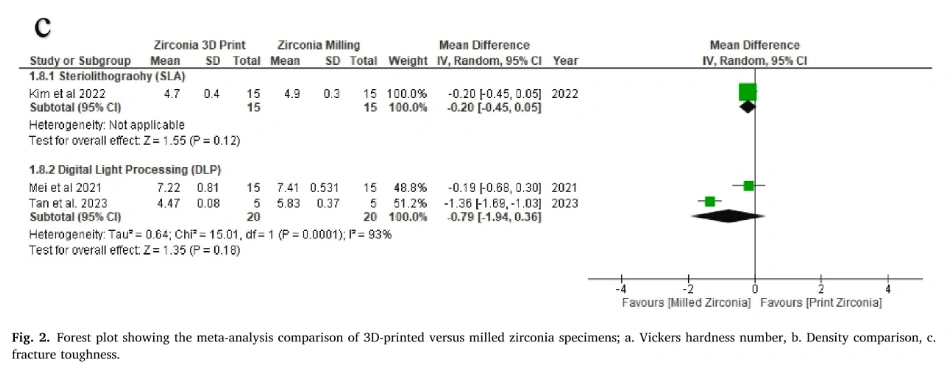
The author mainly introduces the influence of different 3D printing methods on the mechanical properties of materials, and lists the experimental data and results of multiple studies. Among them, different 3D printing methods such as SLA, IJP, DLP are compared, and different materials are also tested. In general, most studies have shown that 3D printing technology can improve the strength and hardness of materials, but also reduce their toughness. These studies are of great significance for understanding the application of 3D printing technology in material manufacturing.
Conclusions
Studies have found that 3D printing technology can produce zirconia ceramic products with high precision and complex shapes, and its biocompatibility and mechanical properties are comparable to or even better than those of zirconia ceramics prepared by traditional processing methods. Clinical trials have shown that 3Y-TZP crowns made by AM technology have no obvious mechanical or biological complications in the short term, indicating its clinical feasibility. This review emphasizes that although AM technology has shown advantages in some aspects, more long-term studies on its long-term mechanical behavior and biocompatibility are necessary.
Source: https://www.sciencedirect.com/science/article/pii/S1751616124002339?via%3Dihub