
On January 13, 2023, Shenzhen Adventure Technology Co., Ltd. and researchers from Shenzhen Graduate School of Tsinghua University published a report entitled "Additive Manufacturing"4D printing of ceramic structuresThe 4D printing strategy of complex ceramic structure is proposed and successfully realized, and the controllable shape deformation of ceramic structure is realized by accurately adjusting the solid content and printing path of ceramic material.
Original link:
https://doi.org/10.1016/j.addma.2023.103411
Introduction to the study
4D printing enables controlled shape deformation of 3D printing and enables multiple possibilities for complex shape design. However, 4D printing is usually applied to soft materials that are easily deformed. Ceramics are inherently hard and brittle, which has hindered their development in 4D printing. In this study, the stress mismatch in the sintering process of printed ceramics was used to realize the 4D printing of ceramic structures. In general, the shrinkage of a 3D printed ceramic body after sintering is inversely proportional to the solids content of the ceramic material used. By printing double-layer zirconia (ZrO2) ceramics with high solid content in the bottom layer and low solid content in the top layer, the Adventure Science and Technology team made the direction of internal stress of sintering shrinkage consistent with the axial direction of low shrinkage materials, realizing its shape from flat to curved structure. In this process, the researchers customized the shape deformation behavior of the ceramic structure by selecting different printing processes. Finally, by programming the solid content of the ceramic material and the printing path, 4d printed ceramic flowers with various characteristics are realized.
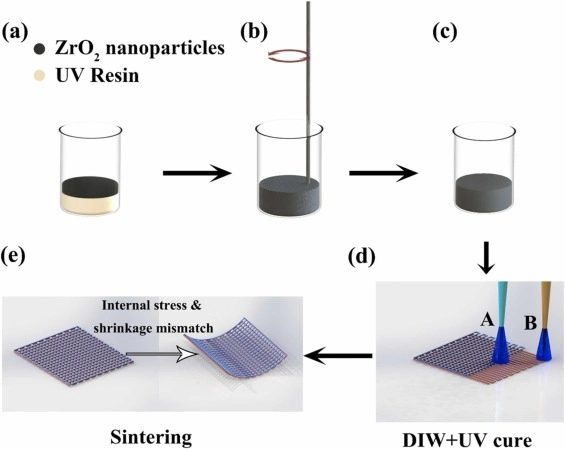
Figure 1 4D printing of ceramic structure by direct writing-sintering method (a, B) mixing ZrO2 nanoparticles with UV resin in different proportions (c) UV material ink containing uniformly dispersed ZrO2 nanoparticles (d) 3D printing of ceramic sheet with double nozzles equipped with DIW technology and UV curing treatment (e) converting 3D printed ceramic sheet into 4D printed ceramic structure after sintering
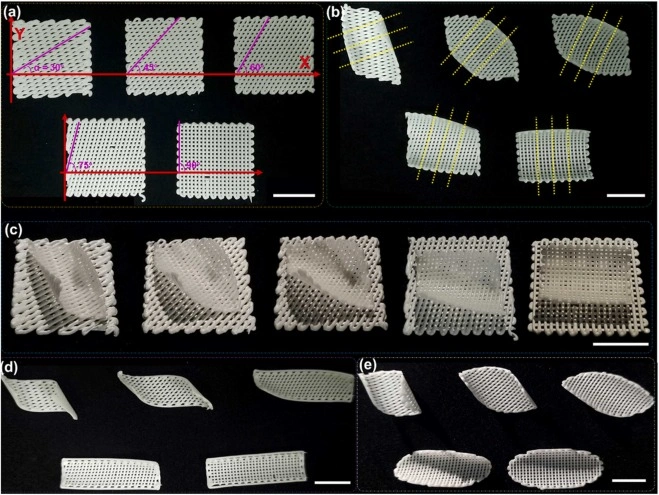
Figure 2 Self-deformation of ceramic bilayers during sintering (a) Printing double-layer ceramic cubes in different paths (B) Shape changes of double-layer ceramic cubes after sintering (c) Comparison of ceramic cubes before and after sintering (d) After sintering The geometry of the double-layer ceramic rectangle (e) The geometry of the double-layer ceramic ellipse after sintering
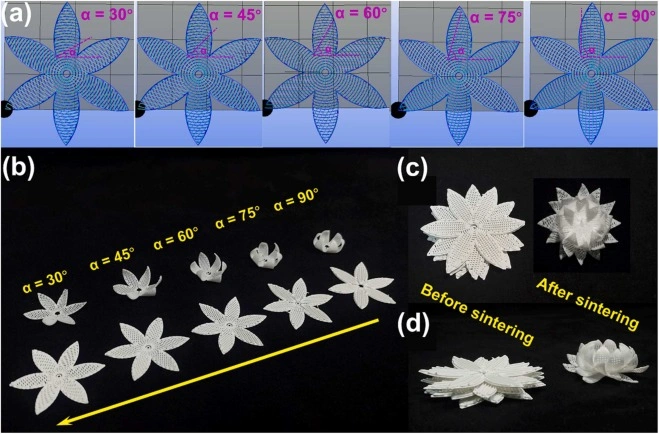
Figure 3 4D printing of ceramic flowers through programmed printing paths (a) The top layer of double-layer ceramics is printed in different paths (B) The shape changes of various double-layer ceramic polygons after sintering (c) The top view of stacked ceramics before and after sintering (d) The side view of stacked ceramics before and after sintering
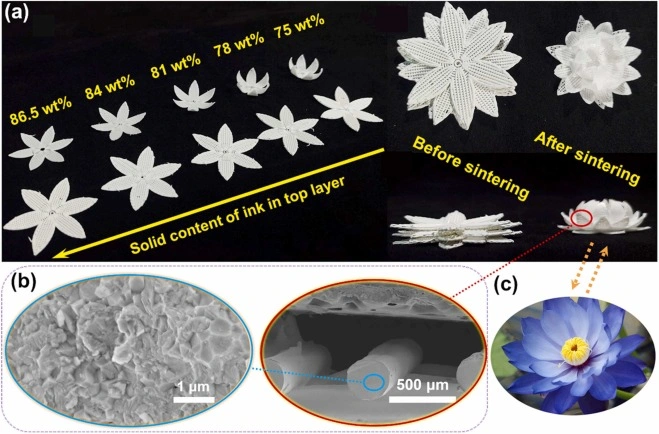
Fig. 4 4D printing of ceramic flowers by adjusting the solid content of UV ink (a) shape changes of various double-layer ceramic polygons and laminated ceramic structures after sintering (B) microstructure of double-layer ceramics after sintering (c) flower geometry imitated by 4D printed ceramic structure
research conclusion
In this paper, the 4D printing technology of ceramic structure is proposed and studied. Firstly, the shrinkage of ink sintered ceramics with different solid content was estimated. Then, double layer ZrO was prepared by DIW technology2Ceramics. We found that during the sintering process, the shrinkage mismatch between the top and bottom layers caused the shape change of the double-layer ceramic. Therefore, 4D printing of ceramics is achieved by sintering-derived double-layer self-deformation. Both the solid phase content of the ceramic ink and the printing path will affect the self-deformation process of the ceramic. By tailoring the above two parameters, a 4d printed ceramic structure that mimics the geometry of a flower can be obtained. In this way, 4D printing provides a viable strategy for designing complex ceramic structures for the DIW sintering process. The 4D printed ceramic structure proposed in this paper also shows a programmable self-deformation strategy, which is a promising bottom-up advanced ceramic manufacturing method.