
Original link: https://www.sciencedirect.com/science/article/pii/S2214860424001295?via%3Dihub
AdventureTech website: http://www.adventuretech.cn/
Research Focus
In ceramic photopolymerization-based additive manufacturing, high vertical separation forces often arise between the cured ceramic layer and the bottom of the slurry tank due to interfacial adhesion and viscous resistance. This issue is particularly critical when fabricating large-area ceramic components, where excessive separation forces can trigger crack initiation, propagation, or even detachment of the part from the build platform, leading to print failure.
To overcome this challenge, we introduce a novel interfacial modification strategy: the polydimethylsiloxane (PDMS) film at the bottom of the slurry tank is coated with talc powder, effectively minimizing adhesion. This modification ensures compliant and stable separation behavior during platform movement.
Compared to conventional unmodified PDMS systems, our approach achieves up to 93% reduction in maximum separation force, significantly enhancing printing reliability and process stability, particularly for large ceramic structures. This method represents a robust solution for high-precision, large-scale ceramic 3D printing applications.
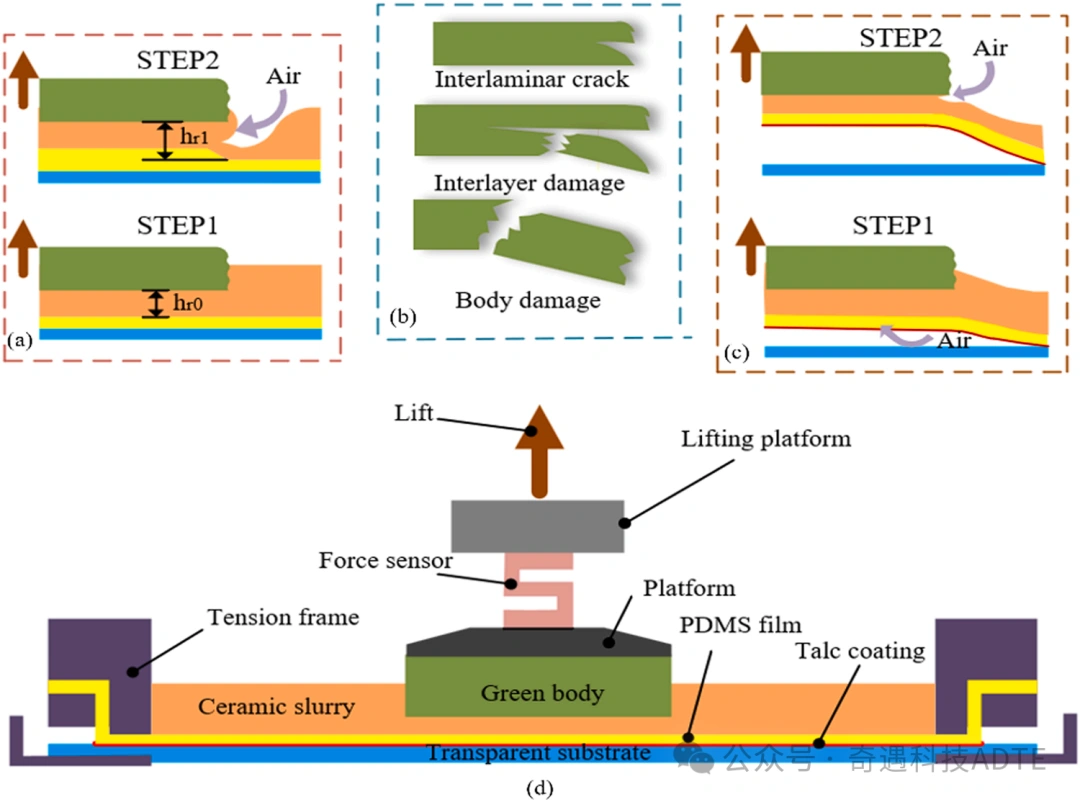
Figure 1. Schematic illustration of the flexible separation system with a coated PDMS film: (a) Separation process in a conventional PDMS film system; (b) Typical printing defects observed in the conventional PDMS system; (c) Separation process in the coated PDMS flexible system; (d) Overall configuration of the flexible separation system with the coated PDMS film.
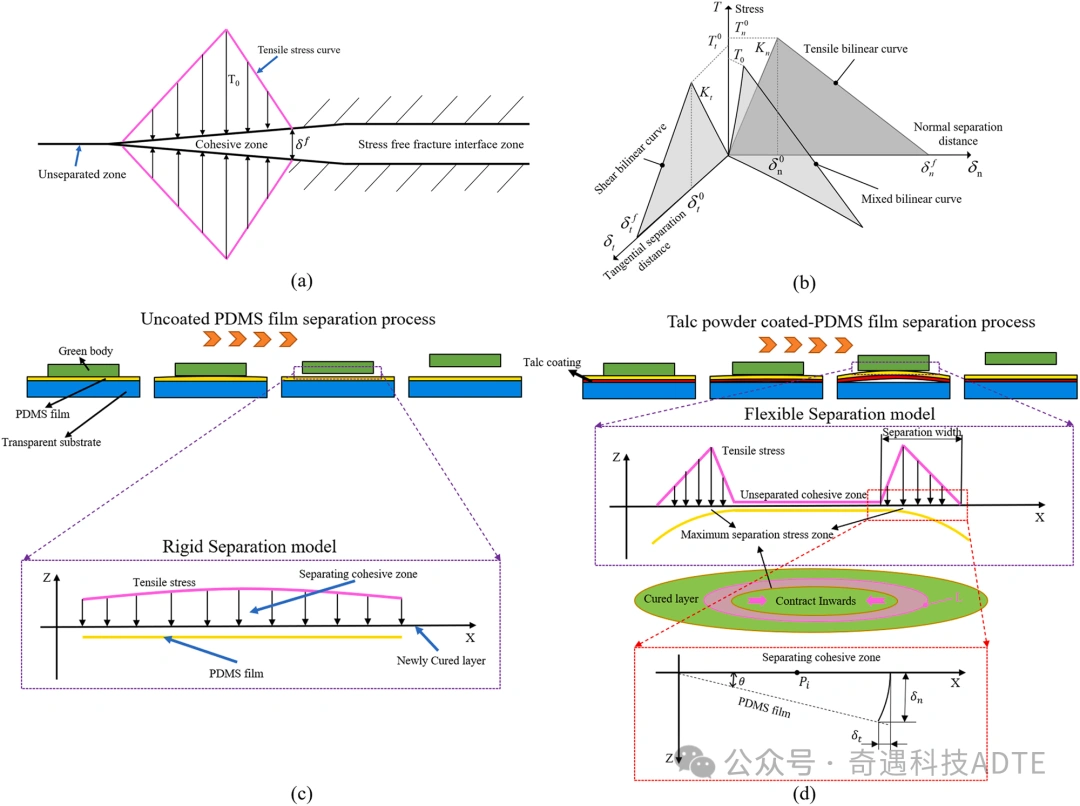 Figure 2. Comparative illustration of the PDMS film flexible separation model based on the cohesive zone approach and the conventional PDMS film separation process: (a) Microscopic mechanism of crack formation in the cohesive zone model; (b) Three relative motion modes of separation predicted by the cohesive zone model; (c) Separation model of the uncoated PDMS film; (d) Separation model of the PDMS film system coated with powder.
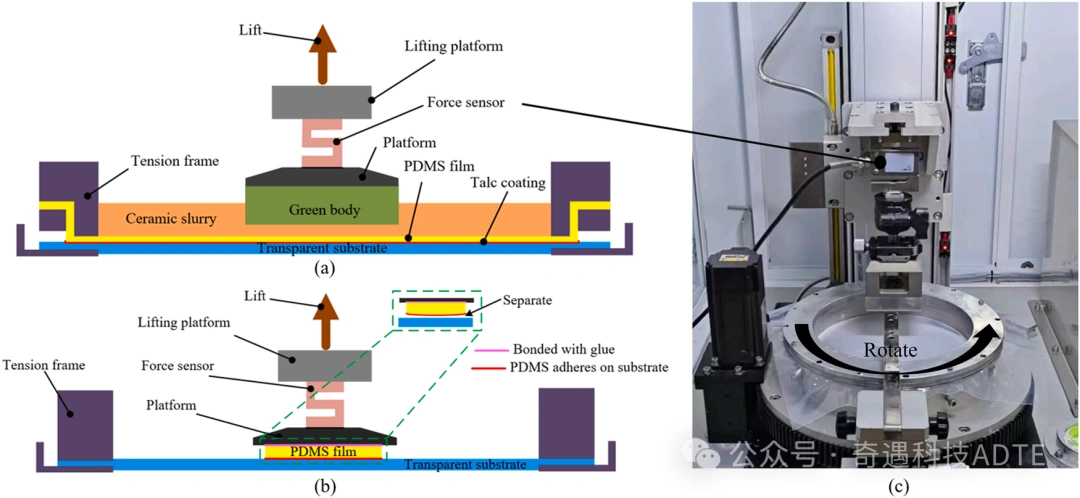
Figure 3. 3D Printing and Force-Sensing Platform for Adhesion Evaluation.
(a) Schematic overview of the integrated 3D printing and force-sensing system, designed for real-time monitoring of separation forces;
(b) Illustration of the adhesion test between the PDMS film and the transparent substrate, used to quantify interfacial forces during printing;
(c) Structural design of the combined printing and force-sensing setup, enabling precise control and measurement for high-precision ceramic additive manufacturing.
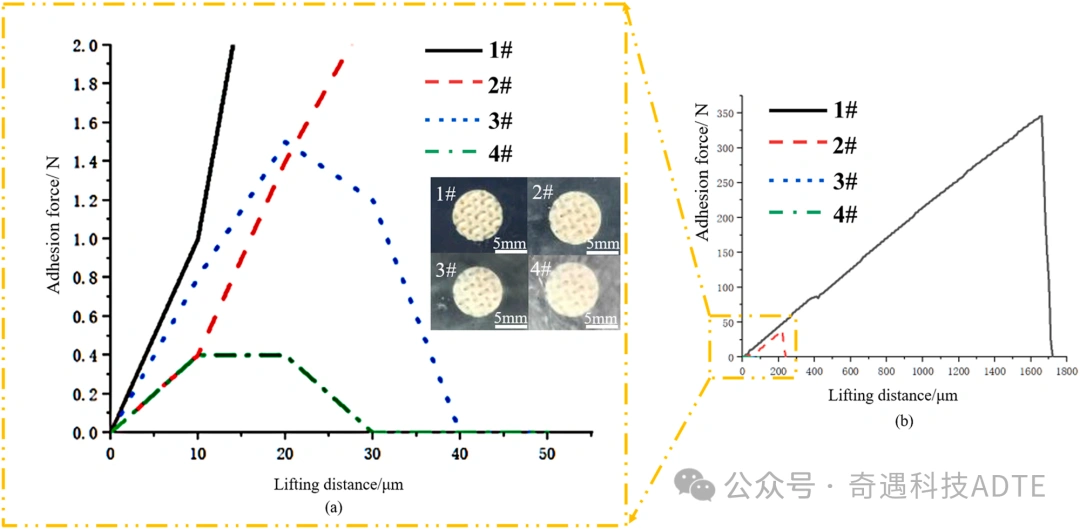 Figure 4. Effect of powder coating concentration on the adhesion behavior of PDMS films.
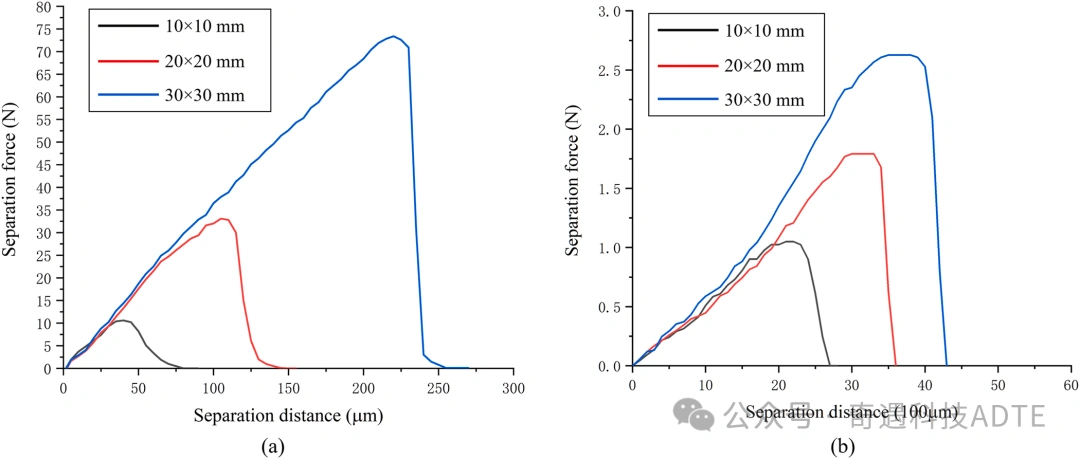 Figure 5. Comparison of separation forces in PDMS film systems with and without nanoparticle coatings: (a) Separation force curves of conventional PDMS films with different square dimensions; (b) Separation force curves of PDMS films coated with nanoparticles.
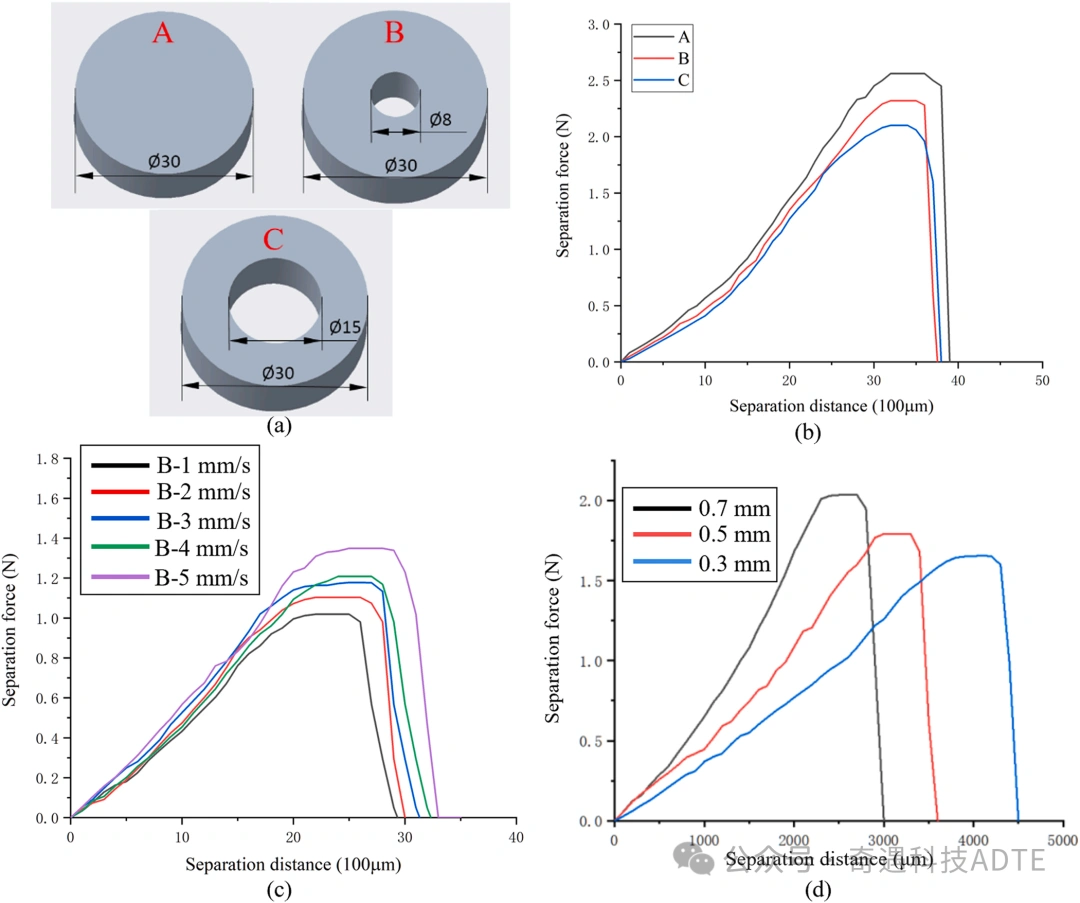 Figure 6. Investigation of factors influencing the separation force in the PDMS film separation system: (a) Experimental models with uniform circumferences and varying cross-sectional areas; (b) Separation force measurements for groups A–C; (c) Influence of build platform lifting speed on the separation process; (d) Effect of PDMS film thickness on the separation process.
 Figure 7. SEM images showing the microstructure and edge features of ATZ ceramics with (a) 30 vol%, (b) 35 vol%, and (c) 42.5 vol% loading in HDDA:PEGDA575, after sintering at 1550 °C.
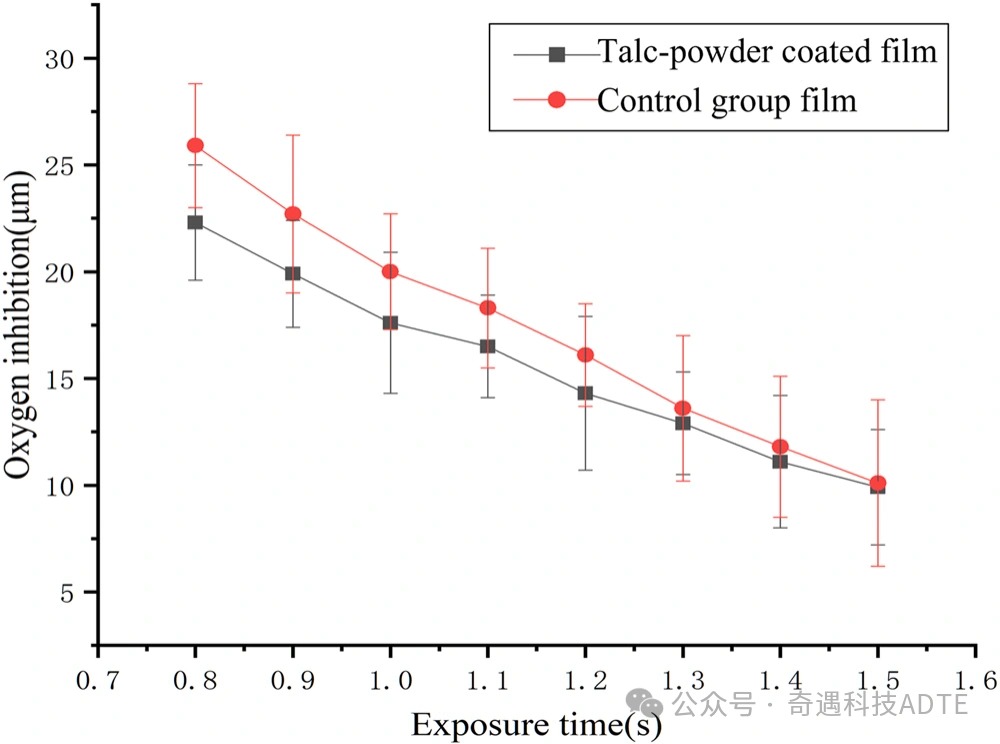 Figure 8. Effect of the ceramic powder coating on the thickness of the oxygen inhibition layer.
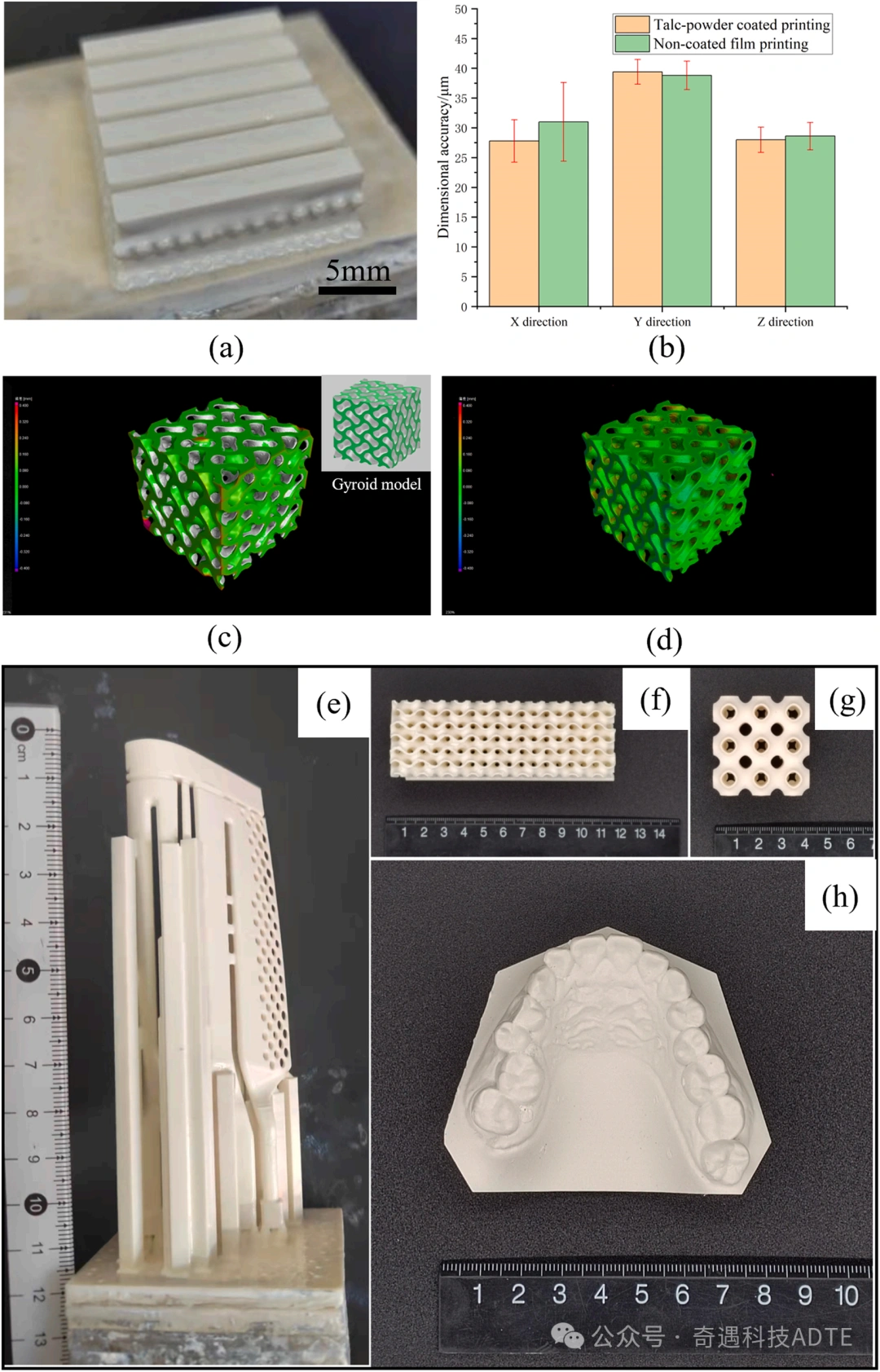 Figure 9. Evaluation of 3D Printing Accuracy and Representative Ceramic Components Fabricated via Talc-Coated PDMS.
(a) Standard test bar used for printing accuracy assessment in ceramic 3D printing;
(b) Comparative analysis of printing accuracy between talc-coated PDMS and uncoated PDMS films;
(c–d) Micro-CT reconstructions of spiral structures fabricated using (c) unmodified PDMS and (d) talc-coated PDMS, highlighting improved structural fidelity;
(e–h) Representative ceramic components printed using the talc-coated PDMS film:
(e) Aero-engine blade core,
(f–g) TPMS-based lattice structures,
(h) Dental model.
Conclusions
This study introduces a novel interfacial modification strategy to overcome adhesion challenges in ceramic 3D printing using inverted vat photopolymerization (IVP). By coating the PDMS film at the bottom of the vat with talc powder, the method effectively reduces the separation force between the cured ceramic layer and the PDMS surface.
The proposed approach significantly enhances process stability and reliability, enabling a more robust and consistent forming process across a variety of ceramic materials. This advancement not only facilitates the fabrication of complex geometries but also improves the manufacturability of large-area ceramic components.
Our findings suggest that talc-coated PDMS films can serve as a practical solution to minimize adhesion-related failures in additive manufacturing of ceramics, paving the way for more efficient and scalable production of high-precision ceramic parts.