
Introduction
Biomaterials have evolved over centuries to support modern clinical applications, such as hard tissue replacement using stainless steel, titanium, and chrome-cobalt alloys. However, these non-degradable materials can cause problems such as ion release and inflammation.
The rise of 3D printing, a form of additive manufacturing, has enabled the precise and customizable creation of complex biomaterial structures. Compared to traditional methods, 3D printing allows for greater control over design details such as structure and porosity, but is limited to static structures.
4D printing builds on this by introducing adaptability through smart materials that respond to stimuli, allowing printed objects to change shape or function over time. This dynamic feature is particularly beneficial in tissue engineering because it can mimic the natural tissue healing process through adaptive behavior.
Materials with physical stimulus-responsive properties
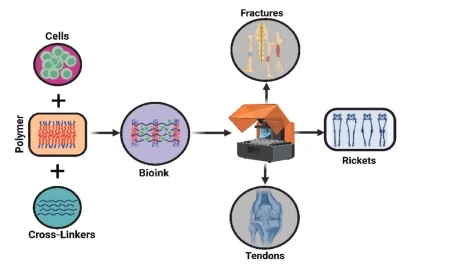
Fig. 2. Utilization bioink in 4D printer for treating different bone defects.
Physical stimulus-responsive materials, like temperature-, humidity-, and light-responsive biomaterials, benefit from moderate to high porosity, which is favorable for both dynamic functionality and biological applications.Such material enables 4D-printed implants to be in active interaction with biological systems, providing ways for further cell growth, tissue integration, and adaptive responses to the physiological environment.
Mechanism, design, and printing strategies for 4D printing
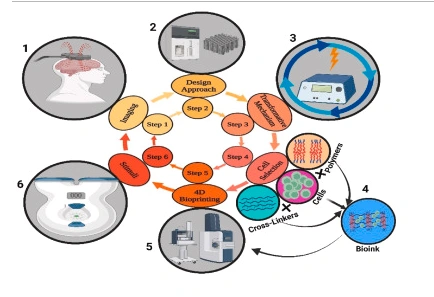
Fig. 3. Workflow for 4D bioprinting using design, imaging, cell selection, and stimuli for dynamic biomedical applications.
Similar techniques applied in 3D printing are used in 4D bioprinting. These include DIW, SLA, DLP, and FDM. DIW extrudes viscous bio-ink that allows embedding of cells, and thus very flexible in forming soft structures that carry cell-laden. The high resolution applied in SLA and DLP uses light to cure resin for forming very complex structures like vascular networks .
Underlying 4D bioprinting is the advancement of sophisticated bio-inks that are biocompatible, support cell viability, and respond to external cues. Modular peptide-polymer hybrid hydrogels offer a new avenue for the dynamic control of cell-hydrogel interactions, making way for the response of bio-inks with time in a manner that promotes good cell growth and tissue function .
4D printing in bone tissue engineering
In this study, researchers focused in particular on the domain of 4D BTE and showcased many contemporary applications of 4D printing within this domain.
- 4D-printed bone tissue using injectable stimuli-responsive hydrogels.
- 4D printing of bone tissue using shape memory scaffolds
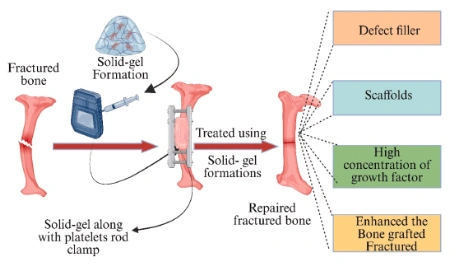
Fig. 4. Diagram Illustration of Solid-gel mediated bone repair process using scaffolds, growth factors, and defect fillers for enhanced fracture healing.
- 4D printing of bone tissue using functional transformation mechanisms
- 4D-printed bone constructs with integrated blood vessels and neural networks
- 4D bioprinting for vascularization:Innovative 4D structures for blood vessels and tissues;Shape-Memory Polymers (SMPs) in vascular structures.
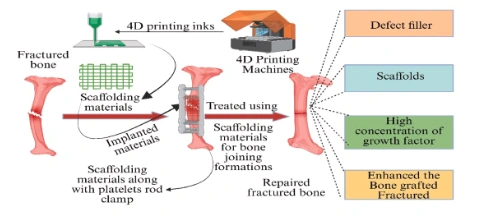
Fig. 5. 4D printing approach for bone fracture repair using scaffolding materials, growth factors, and defect fillers for enhanced healing.
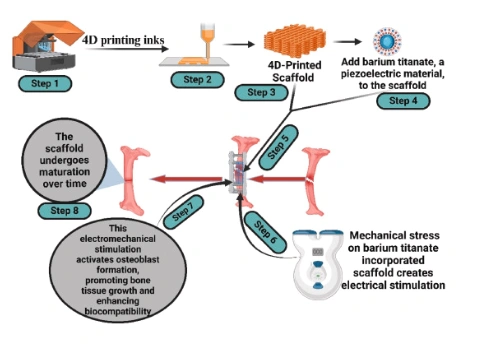
Fig. 6. 4D bioprinting workflow for bone tissue engineering using a piezoelectric scaffold, highlighting mechanical stimulation to enhance osteoblast activity and bone regeneration.
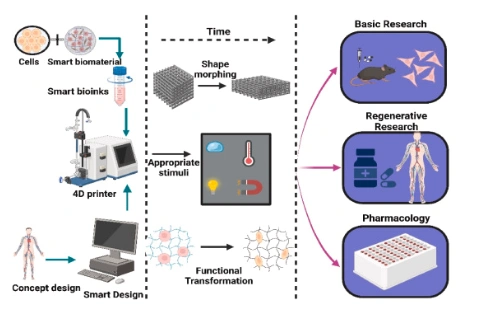
Fig. 7. 4D bioprinting process using smart biomaterials for shape morphing and functional transformation, applied in basic research, regenerative medicine, and pharmacology.
In addition, the article also mentions many application areas, conditions affecting development and prospects for the future.
Conclusion
In summary, this article outlines how 4D printing is revolutionizing bone tissue engineering by creating adaptive stimuli-responsive materials that can dynamically reshape after implantation. Key advances include the use of injectable hydrogels, shape memory scaffolds, and the integration of vascular and neural networks within the bone structure. However, challenges remain in ensuring precise shape memory functionality, achieving seamless integration with native tissue, and scaling up the technology for clinical applications. The future potential of 4D printing in bone tissue engineering is enormous and marks a transformative step forward for regenerative medicine.