
Industry Insights
Guangzhou Medical UniversityDeputy Chief Physician Huang Jiangyong and Professor Li PingThe team collaborated with Dr. Zhu Pengfei from Adventure Technology to publish a study titled 'Zirconia crowns manufactured using digital light processing: Effects of build angle and layer thickness on the accuracy' in the Journal of Dentistry.The study explored the effects of build angle and layer thickness on the accuracy of zirconia crowns produced by digital light processing (DLP) ceramic 3D printing.

Original link: https://doi.org/10.1016/j.jdent.2024.105359
Adventure Technology official website: http://www.adventuretech.cn/
If you cannot open it, please copy the URL to your browser to view.
Research Content
Zirconia has excellent mechanical properties, wear resistance, biocompatibility, and aesthetic translucency, making it widely used in dental restorations, especially as a crown material.Although traditional crown manufacturing methods are reliable, they have limitations such as insufficient accuracy, poor fit, material waste, and equipment wear, which may lead to clinical failures.
DLP technology has gained widespread attention due to its fast printing speed, high resolution, reliable manufacturing process, and cost-effectiveness, becominga research focus in the medical and materials fields.The accuracy of dental restorations printed by DLP is influenced by various factors, includingprinter quality, object geometry, support structures, build angle, and layer thickness.
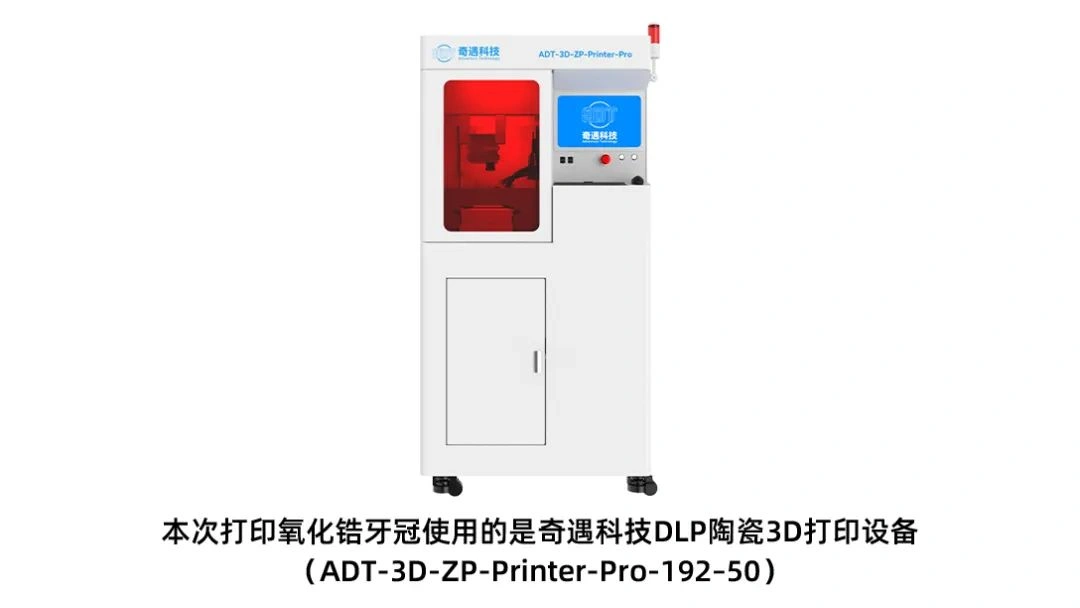
This article uses Adventure Technology's DLP ceramic 3D printing equipment (ADT-3D-ZP-Printer-Pro-192-50) to print zirconia crowns atthree different build anglesandtwo different layer thicknessesto assess their impact on accuracy.
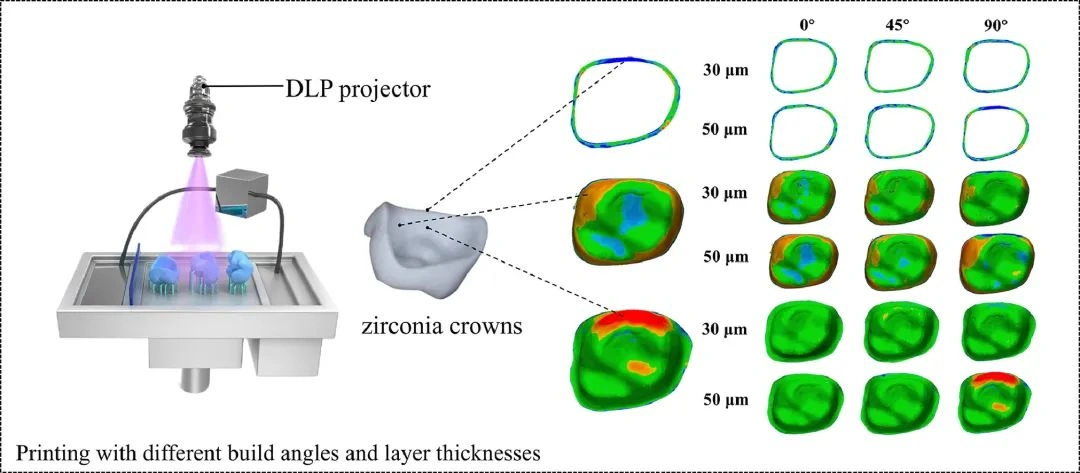
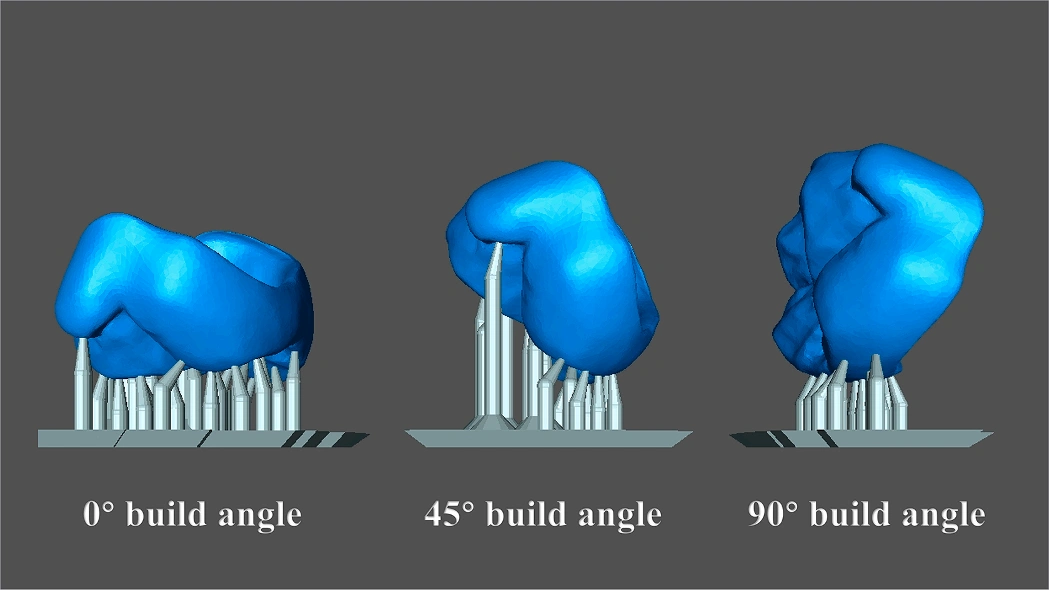
The specific steps are as follows:
△Figure 1, three different build angles (0°, 45°, and 90°) printing methods, with corresponding support structures automatically generated by the software.
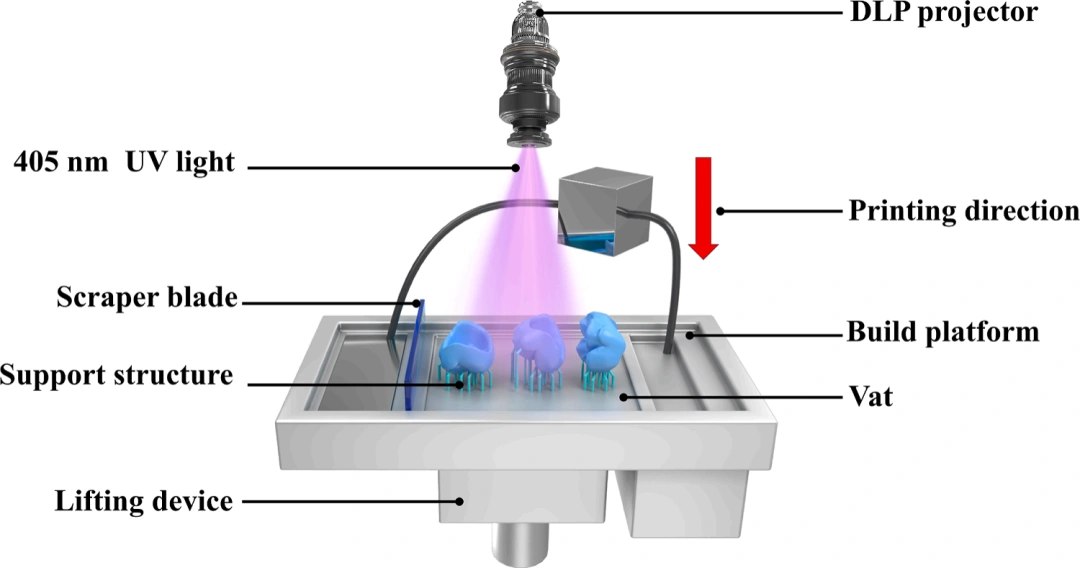
△Figure 2, schematic diagram of the Adventure Technology ceramic 3D printing equipment in a downward forming position.
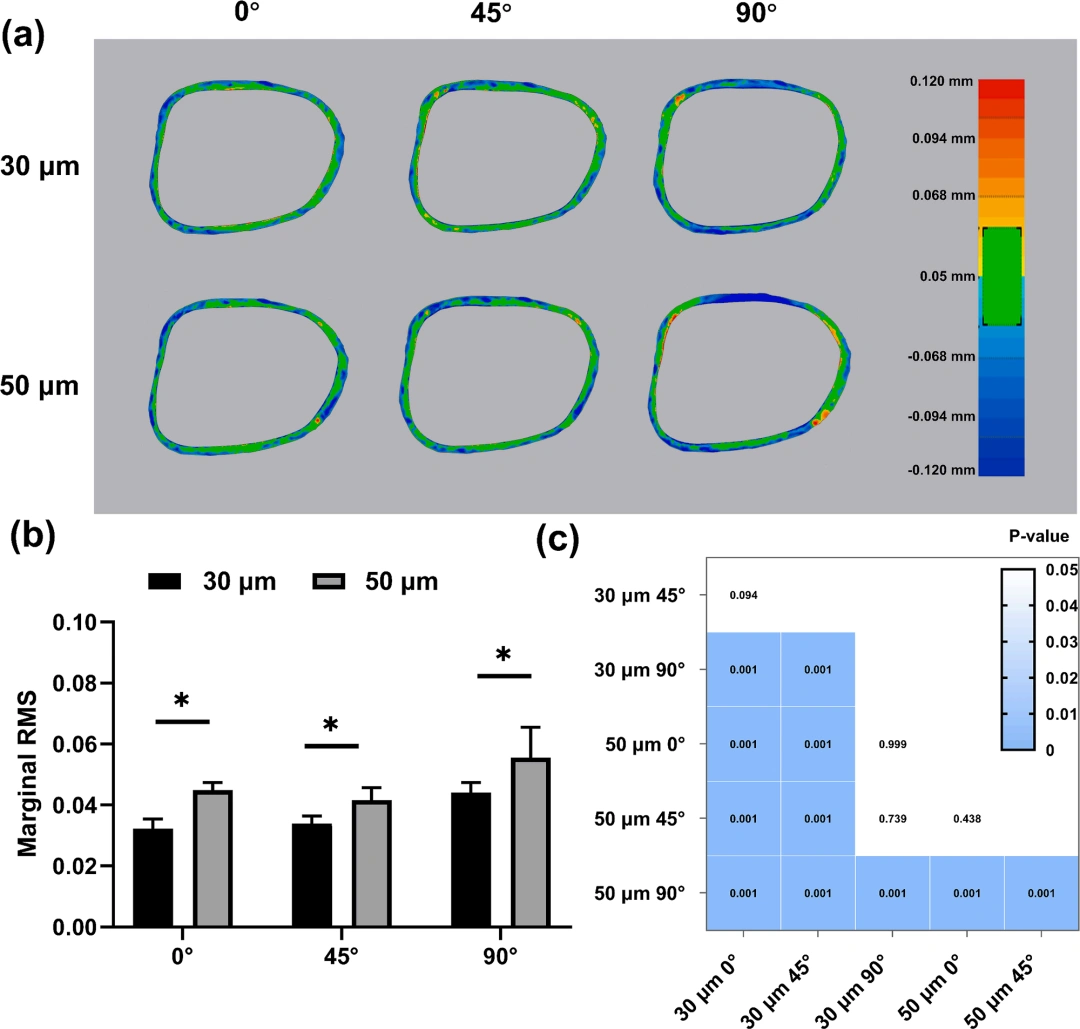
△Figure 3, evaluation of edge morphology accuracy of DLP printed samples at different build angles and layer thicknesses. (a) The color map shows the accuracy of the edges of DLP printed crowns, demonstrating a tolerance range of ± 0.05 mm and a maximum acceptable deviation of ± 0.120 mm; (b) Edge root mean square (RMS) values - asterisks indicate significant differences (*p < 0.05); (c) Heat map shows Tukey multiple comparison analysis, comparing the differences in edge area accuracy between groups. The blue box indicates statistically significant differences (p < 0.05), while the white box indicates no statistical difference (p > 0.05).
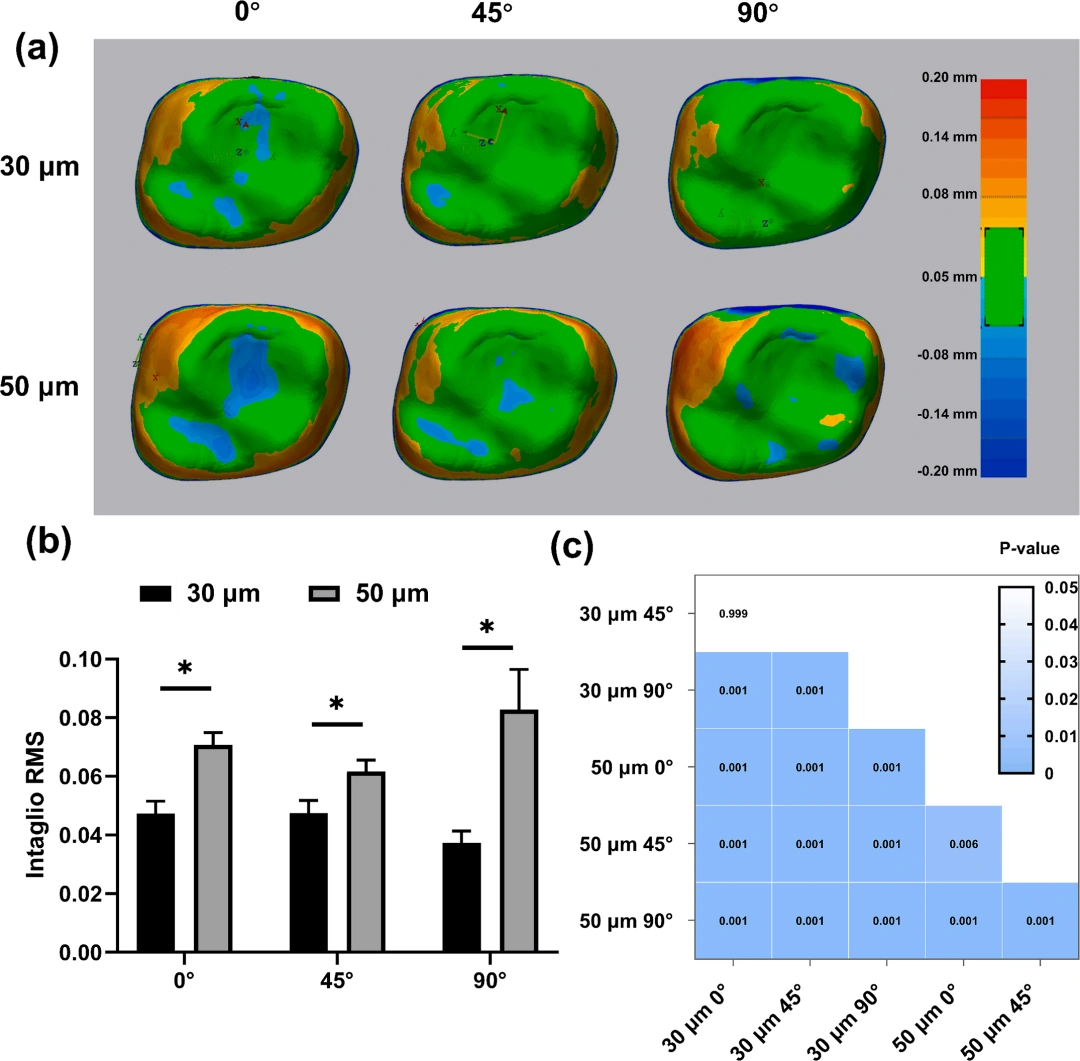
△Figure 4, evaluation of inner surface morphology accuracy of DLP printed samples at different build angles and layer thicknesses. (a) The color map shows the accuracy of the inner surface of DLP printed crowns, demonstrating a tolerance range of ± 0.05 mm and a maximum acceptable deviation of ± 0.20 mm; (b) Inner surface root mean square (RMS) values. Asterisks indicate significant differences (*p < 0.05); (c) Heat map shows Tukey multiple comparison analysis, comparing the differences in inner surface area accuracy between groups. The blue box indicates statistically significant differences (p < 0.05), while the white box indicates no statistical difference (p > 0.05).
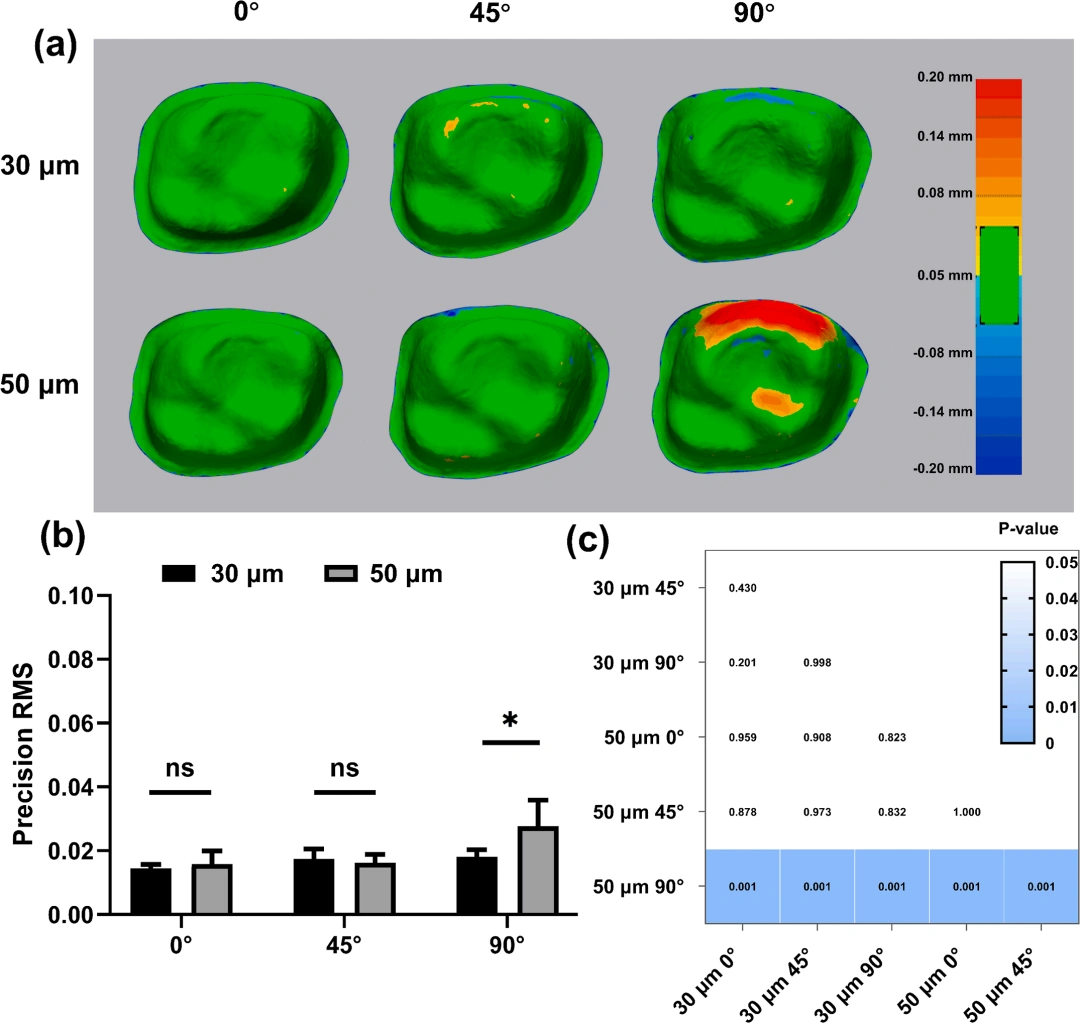
△Figure 5, evaluation of accuracy of DLP printed samples at different build angles and layer thicknesses. (a) The color map shows the accuracy of the inner surface and edge areas of DLP printed crowns, demonstrating a tolerance range of ± 0.05 mm and a maximum acceptable deviation of ± 0.20 mm; (b) Accuracy root mean square (RMS) values. Asterisks indicate significant differences (*p < 0.05), 'ns' indicates no significant difference; (c) Heat map shows Tukey multiple comparison analysis, comparing the differences in accuracy between inner surface and edge areas among groups. The blue box indicates statistically significant differences (p < 0.05), while the white box indicates no statistical difference (p > 0.05).
△Figure 6, DLP printed zirconia crowns and representative scanning electron microscope (SEM) images, magnification ×30. (a) Overview of the samples; (b) 0° angle - defect-free edges; (c) 45° angle - defect-free edges; (d) 90° angle - defects appeared after support removal (indicated by red arrows).
Conclusion
The research results indicate that build angle and layer thickness significantly affect the precision of zirconia crowns printed using DLP technology (p<0.05). At a layer thickness of 30μm, crowns printed at 0° (32.2±3.2μm) and 45° (33.9±2.4μm) exhibited the best edge morphology accuracy, outperforming other groups (p<0.05). Notably, crowns printed at a 90° angle showed the best inner surface morphology accuracy (37.4±4.0μm). At a layer thickness of 50μm, crowns printed at a 90° angle performed the worst in terms of edge and inner surface accuracy (27.7±8.2μm).
Therefore, compared to a layer thickness of 50μm, a layer thickness of 30μm provides higher accuracy. To ensure edge accuracy, it is recommended to use a layer thickness of 30μm and a build angle of 0° or 45° when printing zirconia crowns using DLP.