
Industry new knowledge
Recently, the advanced ceramic 3D printing research team of Shandong industrial ceramic research and design institute published the Digital light processing of high-strength Si3N4 ceramics in Ceramics International: role of particle grading on slurries curing and mechanical properties. the effects of different proportions on slurry rheological properties, curing properties and sintered body properties of silicon nitride powder were studied.
Original link: https://doi.org/10.1016/j.ceramint. 2024.03.375
Adventure Technology official website: http://www.adventuretech.cn/
If it cannot be opened, please copy the URL to the browser.
research content
Silicon nitride (Si3N4) ceramics, with its excellent high temperature mechanical properties, thermal stability, wear resistance, corrosion resistance and self-lubricating properties, are increasingly used in aerospace, electronics, medical and automotive fields, and gradually become one of the most promising engineering ceramics.However, with the rapid progress of science and technology, the comprehensive performance and structural requirements of silicon nitride ceramics in various industries are constantly improving, and the traditional molding and machining of silicon nitride ceramic parts with complex integration and structural function integration are difficult to meet the manufacturing needs.
Compared with traditional manufacturing methods, additive manufacturing (AM) technology breaks through the limitations of increasing or decreasing material manufacturing, and has the advantages of fewer processing steps, high precision, no dependence on molds and fixtures, and the ability to freely shape complex and irregular shapes. among them,Digital light processing (DLP), as a 3D printing technology based on the principle of photocuring, has become a new scheme for near-net-size shaping of high-performance, complex-shaped silicon nitride ceramic samples.However, for dark powders such as silicon nitride ceramics, there are problems that the absorbance of the powder is too high and the refractive index difference from the photosensitive resin is large, resulting in a significant reduction in the curing depth of the slurry.
This study discusses the particle size distribution ratio of two different particle sizes of silicon nitride powder. By optimizing the grading ratio, Shandong Institute of Ceramics successfully solved the problems of high viscosity and low curing depth of DLP printing silicon nitride paste, and then realized the manufacture of complex silicon nitride ceramic parts.
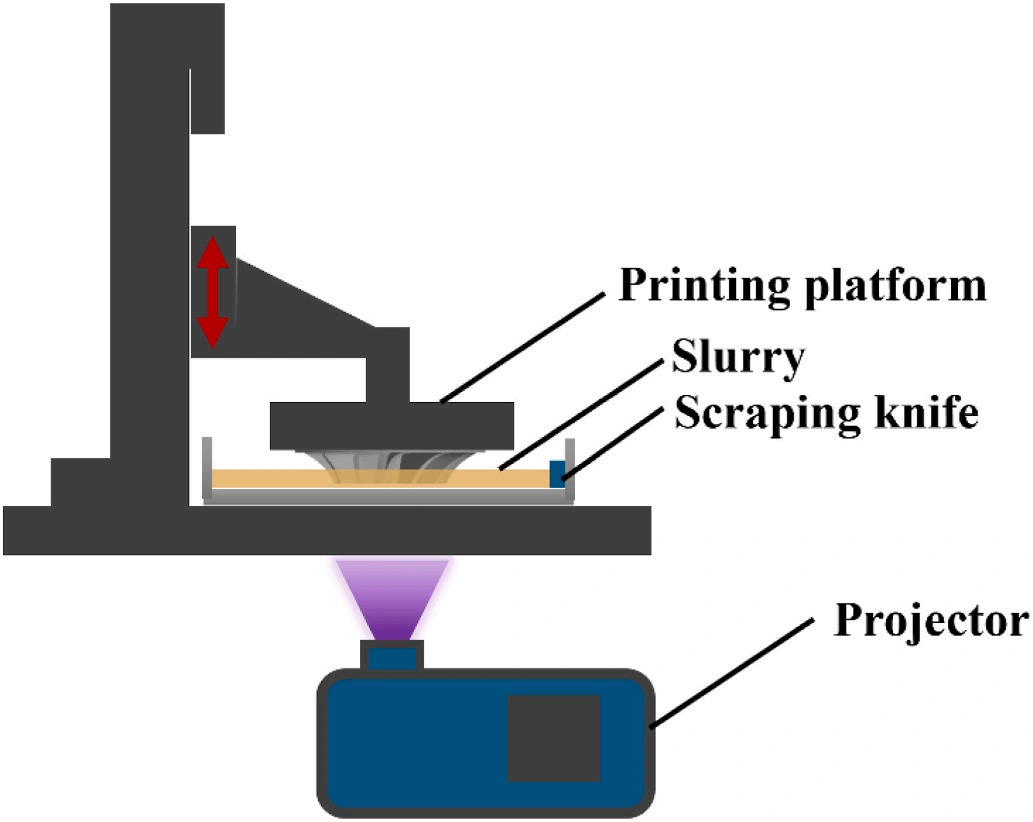
△ Figure 1, DLP ceramic 3D printing equipment using inverted pull molding.
With the increase of the particle size of the ceramic powder, the viscosity of the slurry decreases gradually, and the fluidity increases. However, large particle size powder has obvious sedimentation problems. Through particle grading, the phenomenon that large particle powder is easy to settle in the slurry is effectively improved, thereby obtaining a silicon nitride ceramic slurry with high fluidity and low viscosity, which is for achieving higher quality and more uniform and stable DLP printing Provides support, as shown in Figure 2 and Figure 3.
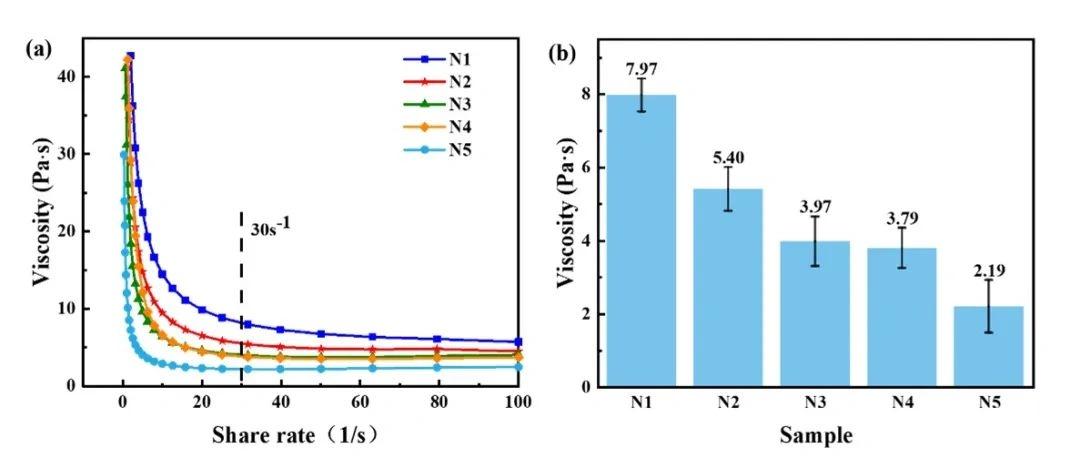
△ Fig. 2 Rheological property curves of different grading proportion slurries.
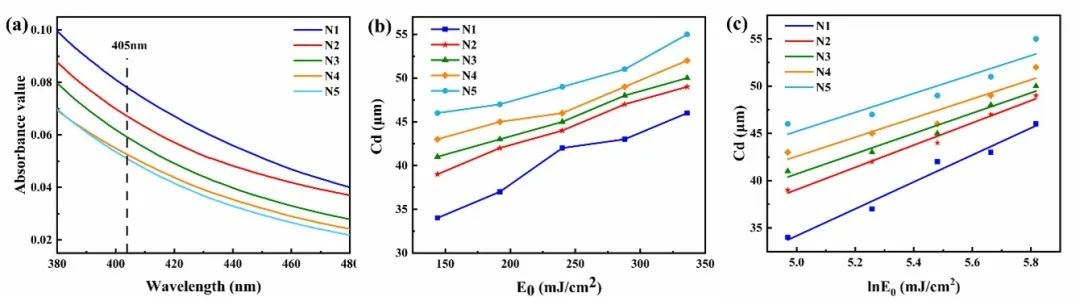
Figure 3, the curing performance curve of different grading ratio slurry.
Through thermogravimetric analysis, a suitable degreasing and sintering process was established, and the samples with different grading ratios were degreased and sintered, and the densified silicon nitride ceramics were successfully obtained.
When the powder gradation ratio is fine: coarse = 7:3, the obtained slurry viscosity is 5.4 Pa · s, the cured thickness is 43 μm, the density after sintering is 3.06g/cm², and the relative density is 95.63. The bending strength reaches 679 MPa, the elastic modulus is 278 GPa, the Vickers hardness is 12.8 Hv, and the fracture toughness is 7.12 MPa m. Compared with a single coarse powder, its performance is improved by more than 20%, as shown in Figures 4 and 5.
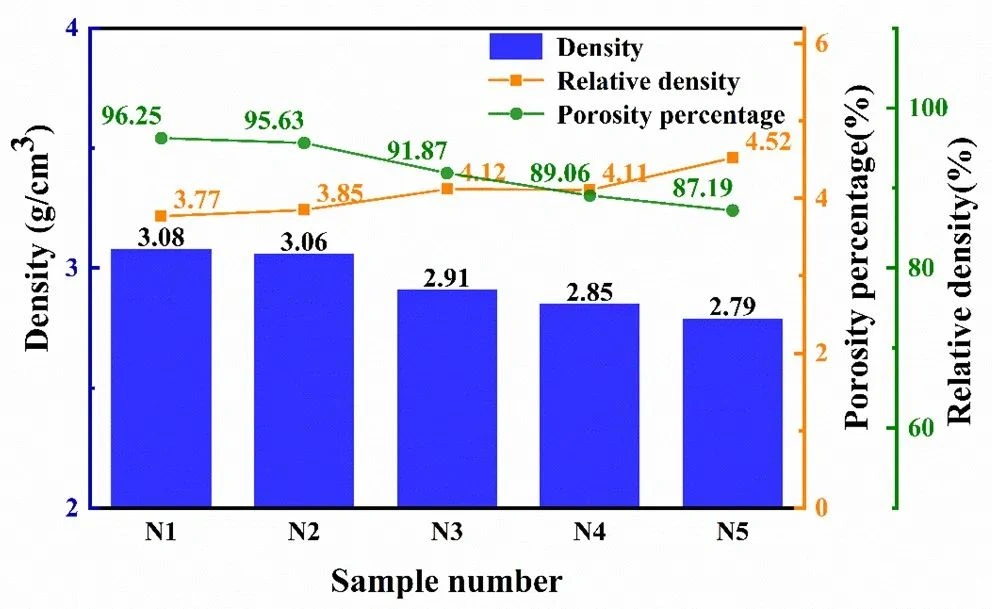
4, density, relative density and porosity of different graded powder samples after sintering.
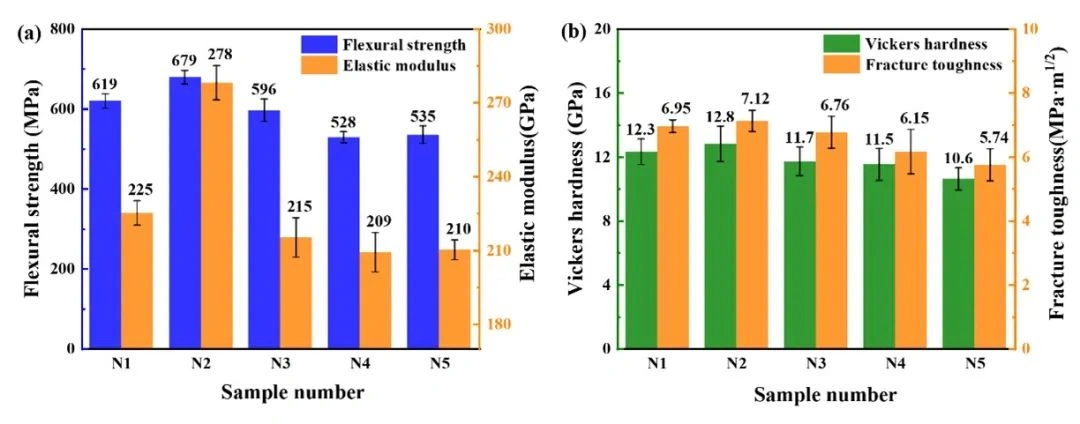
△ Figure 5, mechanical properties of samples with different grading ratios after sintering.
Under the optimized gradation ratio, the photocuring 3D printing molding and sintering preparation of the complex-shaped silicon nitride ceramic impeller scaled parts were successfully completed, as shown in Figure 6.
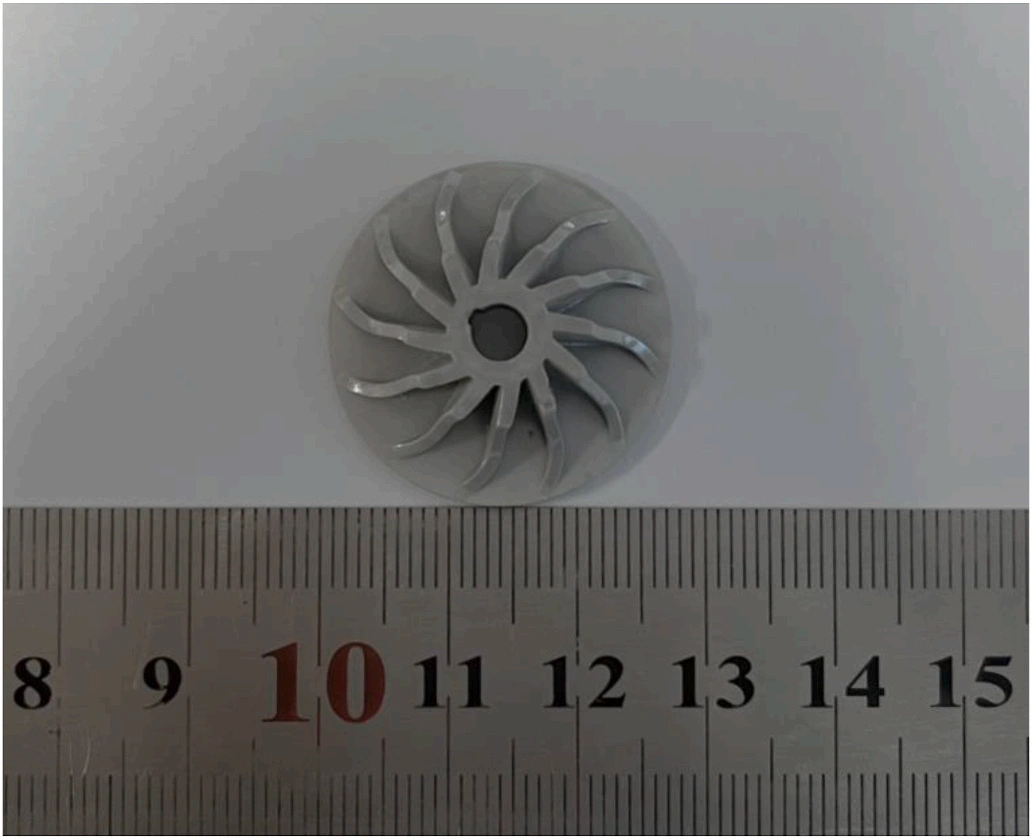
△ Fig. 6, scaled sample of silicon nitride ceramic impeller.
Conclusion
The particle gradation significantly improves the performance of Si3N4 slurry and its sintered body. When the grading ratio of fine powder to coarse powder is 7:3, the slurry has low viscosity and appropriate curing thickness, and the relative density and porosity of the sintered body are 95.63 and 3.85, respectively. The sintered body exhibits a bending strength of 679 MPa, which is 26.92% higher than that of a single coarse powder. At the same time, its elastic modulus, Vickers hardness and fracture toughness are also significantly improved. These results provide an important reference for DLP printing of high strength complex shape Si3N4 ceramics.