
Aluminum nitride (AlN) is attracting increasing attention in DLP 3D Printing research because its high thermal conductivity and electrical insulation make it suitable for advanced thermal management applications. In a recent study, Tang et al. investigated how solid loading influences the printing behaviour, microstructure, and thermal conductivity of DLP-printed AlN ceramics. In this research paper interpretation, we examine the study in detail, from slurry formulation and rheology to sintering, grain-boundary evolution, and the performance of a 150 W laser diode heat sink. The paper provides a useful example of how a seemingly simple slurry parameter can influence the final properties of a functional ceramic component.
Why Solid Loading Matters in DLP 3D Printing of AlN
DLP ceramic 3D printing requires a photocurable slurry containing ceramic powder, resin, photoinitiator, and other processing additives. The ceramic powder must remain sufficiently dispersed while the slurry also needs to flow during recoating and cure accurately under UV exposure.
Solid loading plays an important role in this balance.
Increasing the ceramic volume fraction generally increases slurry viscosity. At the same time, a higher ceramic content reduces the amount of organic material that must be removed during debinding and can increase the packing density of the ceramic particles before sintering.
For AlN, these effects are particularly important because the final thermal conductivity depends not only on density but also on defects, grain boundaries, secondary phases, and the microstructure formed during sintering.
The study therefore treated solid loading as more than a printing parameter. It examined solid loading as a process–structure–property variable connecting slurry behaviour with the performance of the final ceramic.
Experimental Approach
The researchers used AlN powder with a particle size of approximately 400–500 nm and Y₂O₃ as a sintering aid. The photocurable resin consisted of ethoxylated trimethylolpropane triacrylate (ETPTA), ethoxylated pentaerythritol tetraacrylate (PPTTA), and 1,6-hexanediol diacrylate (HDDA).
The powders were dispersed into the resin through planetary ball milling. Before studying solid loading, the researchers first optimized the dispersant and photoinitiator concentrations.
For the DLP printing experiments, the study used an ADMAFLEX 130 system with a 20 μm layer thickness. The reported printing conditions included a light intensity of 60 mW/cm² and an exposure time of 12 s.
After printing, the green bodies underwent thermal debinding followed by high-temperature sintering at 1720 °C under a nitrogen atmosphere.
The solid loading was varied between:
- 47.7 vol%
- 49.0 vol%
- 50.4 vol%
- 52.5 vol%
This range allowed the researchers to examine how relatively small changes in ceramic concentration affected the final material.
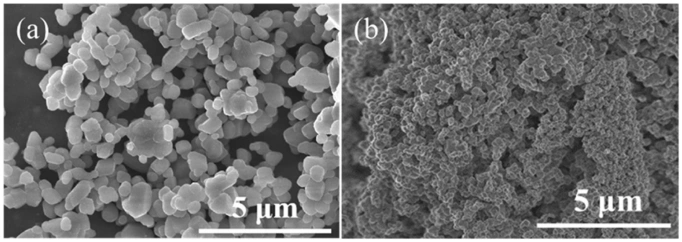
SEM images of the AlN and Y₂O₃ powders used in the DLP printing slurry.
Optimizing the AlN Ceramic Slurry
Before changing the solid loading, the researchers examined two parameters that directly influence DLP printability: dispersant concentration and photoinitiator concentration.
Dispersant Concentration
Five dispersant concentrations were evaluated at 52.5 vol% solid loading.
The slurry exhibited shear-thinning behaviour across the tested formulations. However, viscosity did not decrease continuously with increasing dispersant content. Instead, the lowest viscosity occurred at 2.2 wt% dispersant.
Below this concentration, insufficient dispersion promoted particle agglomeration. At higher concentrations, excess dispersant increased the tendency toward flocculation and caused the viscosity to rise again.
The researchers therefore selected 2.2 wt% dispersant for the subsequent experiments.
This result highlights an important point for ceramic DLP processing: adding more dispersant does not necessarily improve slurry flow. The useful concentration depends on the interaction between the ceramic powder, resin, and dispersant.
Photoinitiator Concentration
The researchers also evaluated TPO concentrations between 0.02 and 0.14 wt%.
At very low photoinitiator concentration, the cure depth was insufficient for reliable layer separation. Increasing the concentration improved curing, but excessive photoinitiator content reduced curing accuracy around the exposed area.
A concentration of 0.05 wt% TPO provided a suitable balance between cure depth and printing accuracy under the tested conditions.
These preliminary experiments established the slurry formulation before the researchers investigated the effect of solid loading.
How Solid Loading Changes Slurry Rheology
Once the dispersant and photoinitiator concentrations had been fixed, the researchers varied the AlN solid loading from 47.7 to 52.5 vol%.
As expected, increasing solid loading increased slurry viscosity.
At a shear rate of 30 s⁻¹, the viscosity increased from approximately 6 Pa·s at 47.7 vol% solid loading to approximately 18 Pa·s at 52.5 vol%.
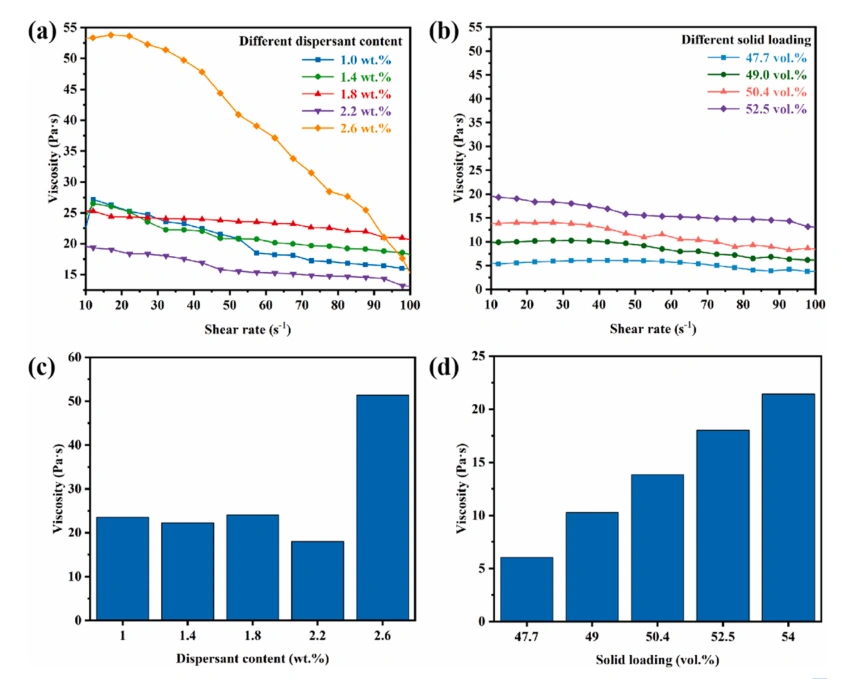
Rheological behaviour of AlN slurries with different solid loadings and dispersant concentrations.
The important observation is that all of the tested slurries maintained shear-thinning behaviour. This behaviour is useful during DLP recoating because the slurry can flow more readily under shear while maintaining a higher viscosity when the shear is removed.
For researchers developing high-solid-loading ceramic slurries, this provides a practical balance to consider: increasing solid loading can improve particle packing and reduce organic content, but excessive viscosity can make recoating and slurry handling more difficult.
From Solid Loading to Shrinkage and Density
The influence of solid loading continued after printing.
During debinding and sintering, the organic components of the green body are removed and the ceramic particles densify. A higher initial ceramic fraction means that less organic material must be removed and the particles start from a more closely packed configuration.
The study observed a reduction in linear shrinkage as solid loading increased.
Bulk density also increased. The measured density rose from approximately 3.30 g/cm³ at 47.7 vol% to 3.33 g/cm³ at 52.5 vol%.
The corresponding relative density increased to approximately 99.7% of theoretical density at the highest solid loading.
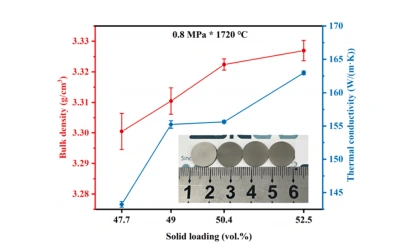
Bulk density and thermal conductivity of DLP-printed AlN ceramics at different solid loadings.
The density difference appears relatively small. However, the change in thermal conductivity was considerably larger.
This suggests that density alone does not fully explain the improvement in thermal performance.
Why Thermal Conductivity Increased
The thermal conductivity increased from approximately 143 W/(m·K) at 47.7 vol% solid loading to 163 W/(m·K) at 52.5 vol%.
That represents an increase of roughly 14% across the tested solid-loading range.
For AlN, thermal transport depends strongly on phonon scattering. Porosity, lattice defects, oxygen-related defects, grain boundaries, and secondary phases can all affect phonon transport.
The researchers therefore examined the microstructure of the sintered ceramics to understand why the increase in solid loading produced a larger improvement in thermal conductivity than the density change alone would suggest.
This is one of the most useful aspects of the study: it connects the macroscopic thermal property to changes occurring at the grain-boundary level.
Grain Boundary Phases Play an Important Role
Y₂O₃ was introduced as a sintering aid. During high-temperature sintering, it reacted with oxide species associated with the AlN powder and formed secondary phases including YAP and YAG.
The distribution of these phases changed with solid loading.
At lower solid loading, the secondary phases were more widely distributed along AlN grain boundaries. At higher solid loading, they were more concentrated around the triple junctions between AlN grains.
This difference matters because secondary phases can interrupt direct AlN–AlN grain contact.
When a secondary phase forms a more continuous layer between AlN grains, heat transport encounters more interfaces with lower thermal conductivity. When the secondary phase becomes concentrated at triple junctions, more AlN grains remain in direct contact.
The resulting microstructure therefore provides a possible explanation for the increase in thermal conductivity from 143 to 163 W/(m·K).
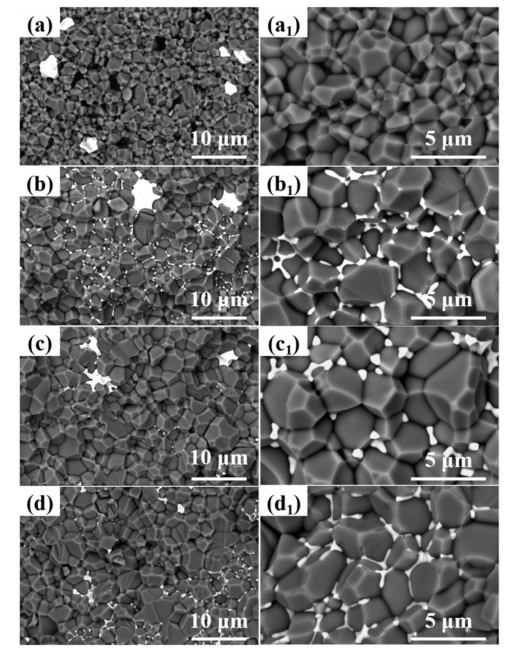
Microstructural evolution of DLP-printed AlN ceramics as solid loading increases.
The result illustrates an important principle for ceramic additive manufacturing: the printing slurry does not simply determine whether a part can be printed. Its formulation can influence the microstructure and functional properties of the final sintered component.
The Study Goes Beyond Material Characterization
The researchers also evaluated whether the DLP-printed AlN could function as a thermal management component.
They designed an AlN heat sink measuring approximately 29 × 35 mm with an internal serpentine channel approximately 2 mm in diameter.
The geometry demonstrates one of the main reasons to investigate additive manufacturing for technical ceramics. Internal channels can be incorporated directly into the component during the forming process, reducing the need for machining after sintering.
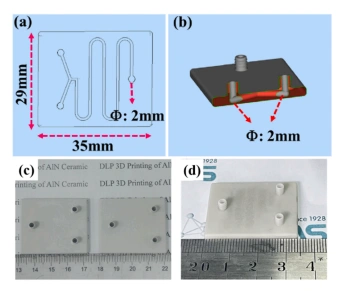
DLP-printed AlN heat sink with internal mini-channels before and after sintering.
The heat sink was first evaluated under controlled heating conditions.
Without coolant, the heat source caused the surface temperature to rise substantially. When deionized water flowed through the internal channel at 50 mL/min, the measured temperature decreased significantly.
The researchers also varied the coolant flow rate. At a lower flow rate of 10 mL/min, the heat sink reached higher temperatures than under the 50 mL/min condition.
These experiments show that the internal channel geometry can be used to actively remove heat from the ceramic component.
Demonstration with a 150 W Laser Diode Module
The final experiment connected the material development work with a functional thermal management application.
The AlN heat sink was integrated with a 150 W high-power laser diode module.
At a coolant flow rate of 50 mL/min, the laser diode temperature stabilized at approximately 55 °C under full load. The reported thermal resistance of the package reached approximately 0.17 °C/W above a driving power of 50 W.
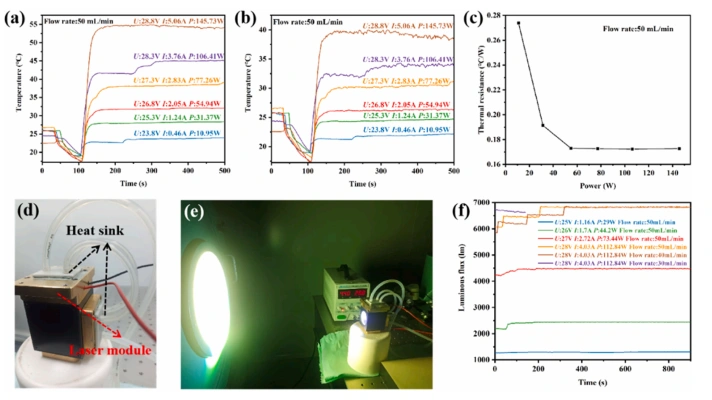
Thermal management performance of the DLP-printed AlN heat sink integrated with a 150 W laser diode module.
The experiment also demonstrated the importance of coolant flow rate. At higher driving power, reducing the flow rate caused the luminous flux to decrease as the thermal load increased.
For thermal management researchers, this part of the study is particularly relevant because it moves the discussion beyond material properties. The AlN ceramic was not evaluated only as a sintered test specimen; the researchers incorporated it into a working thermal management system.
What Researchers Can Learn from This Study
The study provides several useful points for researchers working with DLP 3D printing of technical ceramics.
1. Solid loading affects more than slurry viscosity
Increasing solid loading changes the rheological behaviour of the slurry, but its influence continues through debinding and sintering. Shrinkage, density, microstructure, and thermal conductivity can all be affected.
2. Higher density does not fully explain higher thermal conductivity
The increase in density was relatively modest, while thermal conductivity increased by approximately 14%. The microstructural analysis suggests that the distribution of secondary phases and the resulting AlN grain contact also contribute to the thermal performance.
3. Slurry development should consider the complete process
A formulation that prints well is not necessarily the formulation that produces the best final ceramic properties. For functional ceramics, researchers need to consider printing, debinding, sintering, microstructure, and final performance as one connected process.
4. DLP can connect material development with functional geometry
The heat sink demonstration is significant because the same DLP process used to fabricate test specimens can also produce internal cooling channels. This provides researchers with an opportunity to investigate both material composition and component geometry within the same additive manufacturing workflow.
Why This Matters for DLP Ceramic 3D Printing Research
The work by Tang et al. is valuable not because it identifies a single optimum solid loading for every AlN slurry. The reported optimum depends on the specific powder, resin, additives, and processing conditions used in the study.
The more transferable result is the optimization approach.
Researchers developing a new DLP ceramic system can treat solid loading as an experimental variable and examine its effect across several levels. Rheology can then be evaluated together with cure behaviour, shrinkage, density, microstructure, and final functional properties.
For AlN, this approach is particularly relevant to thermal management applications where the ceramic must combine high density, controlled microstructure, electrical insulation, and complex geometry.
The same process–structure–property relationship can also provide a useful framework for investigating other advanced ceramics, although the optimum formulation and sintering conditions will depend on the material system.
Conclusion
The study by Tang and colleagues demonstrates how a relatively simple slurry parameter can influence the performance of a DLP-printed technical ceramic across multiple stages of processing.
Increasing AlN solid loading from 47.7 to 52.5 vol% increased slurry viscosity while reducing shrinkage and improving density. More importantly, thermal conductivity increased from approximately 143 to 163 W/(m·K). The microstructural analysis linked this improvement not only to densification but also to the distribution of YAP and YAG secondary phases at AlN grain boundaries and triple junctions.
The functional demonstration further showed that the DLP-printed AlN could be incorporated into a mini-channel heat sink for a 150 W laser diode module.
For researchers, the main takeaway is therefore not simply the value of 52.5 vol% solid loading. It is the relationship between slurry formulation, printing behaviour, sintering evolution, microstructure, and final performance.
This is one of the key opportunities offered by DLP ceramic 3D printing: process parameters can be studied not only in terms of print quality, but also in terms of how they influence the properties and functions of the final ceramic component.
Reference
Explore DLP Ceramic 3D Printing
ADT develops ceramic additive manufacturing systems for research and development in technical ceramics. If you are investigating DLP 3D printing of AlN, Al₂O₃, ZrO₂, SiC, or other advanced ceramic materials, our platform provides a route for studying the relationship between material formulation, printing parameters, post-processing, and final ceramic performance.