
Barium strontium titanate (BST) makes an excellent dielectric ceramic, and more research labs are now turning to DLP 3D ceramic printing to form it into working parts. By swapping strontium into the crystal lattice, researchers can pull its Curie temperature down to room temperature — which gives the material a high dielectric constant and very low loss exactly where most devices operate. That combination matters for high-frequency electronics, sensors, and energy-storage capacitors.
Yet BST has fought back against DLP 3D printing. The material absorbs ultraviolet light and scatters it heavily, so the light cannot reach the bottom of each printed layer. Cure depth drops, layers fail to form, and the build collapses. The literature documents this problem repeatedly, but most fixes attack it from the outside — by tuning the furnace, not the formula.
A team at NED University in Pakistan took a different route. In a March 2026 paper in Ceramics International, they show that the amount of photoinitiator — specifically TPO, a phosphine-oxide type — sets the stage for success or failure long before sintering begins. Their BST parts reached 94% relative density, a dielectric constant near 5,900 at 1 MHz, loss below 1%, and a piezoelectric coefficient of 61 pC/N.
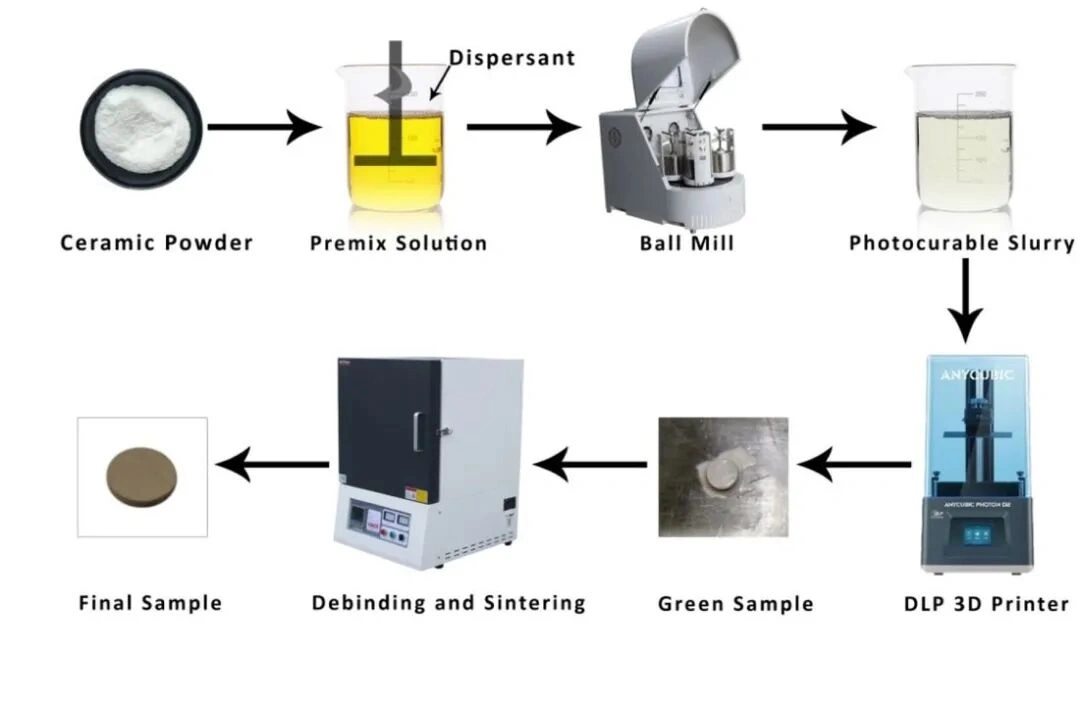
The interesting part is not the final numbers. It is how they got there.
Slurry, Printing, and the TPO Effect
DLP ceramic printing builds parts from a light-cured slurry. A photoinitiator sits inside that slurry and releases radicals when UV light hits it; those radicals harden the polymer binder that holds the ceramic powder together. More photoinitiator means more radicals, a tighter polymer network, and more organic material left in the green part.
The NED team tested TPO at 1, 2, and 4 weight percent. The results split sharply.
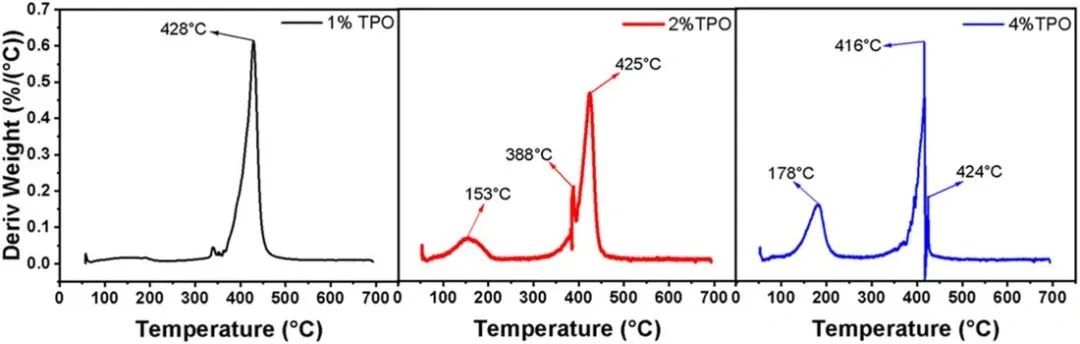
At 1 wt% TPO, the thermogravimetric curve showed the smallest total weight loss and the gentlest early-stage loss, which means the green body stayed stable as debinding began. Its derivative curve produced a single broad peak near 428 °C. The organics burned off in one orderly step, gas escaped slowly, and pressure never built up inside the part.
At 4 wt% TPO, the story changed. The derivative curve split into several sharp, overlapping peaks. Total weight loss grew, gas generation spiked, and internal pressure rose fast. After debinding at 310 °C, those samples showed clear cracks and warping.
Why more photoinitiator backfires
Why does extra photoinitiator hurt? The chain runs like this: extra TPO creates extra radicals, which raises crosslink density, which adds organic content, which releases more gas during debinding, which raises pore pressure, which drives cracking. One weight percent landed the sweet spot — enough curing power, minimal organics.
Curing speed tells the same story from the other side. The 1 wt% formula fully cured a 50 µm layer in about 10 seconds. The 4 wt% formula did it in 5 seconds, and 2 wt% in 8 seconds. Faster is not better here; the 1 wt% part cured slowly enough yet still performed well, while carrying the least organic load.
With the formula settled, the team moved to heat.
Sintering and Microstructure
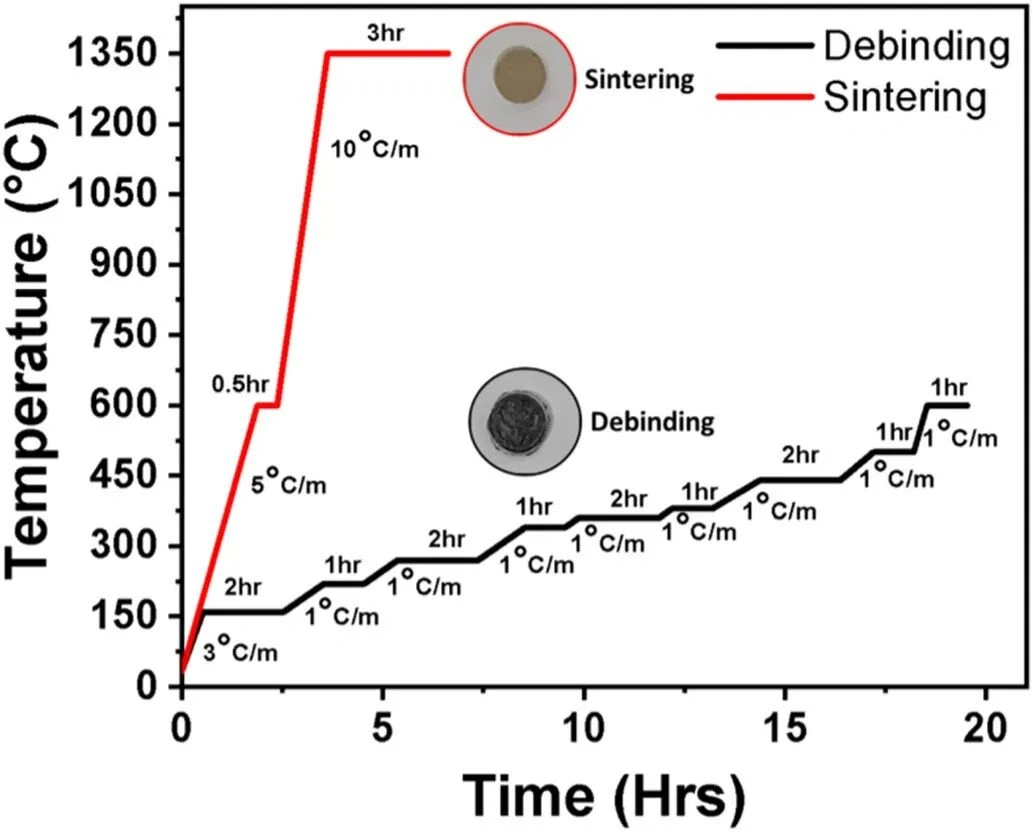
Debinding ran in air through a careful multi-step ramp: 3 °C/min to 160 °C (hold 2 h), then 1 °C/min to 500 °C, then 5 °C/min to 600 °C (hold 0.5 h), then 10 °C/min to 1350 °C with a 3 h soak. The final bodies reached 5.41 g/cm³ — about 94% of theoretical density — with roughly 6% porosity (3.7% open, 2.3% closed).
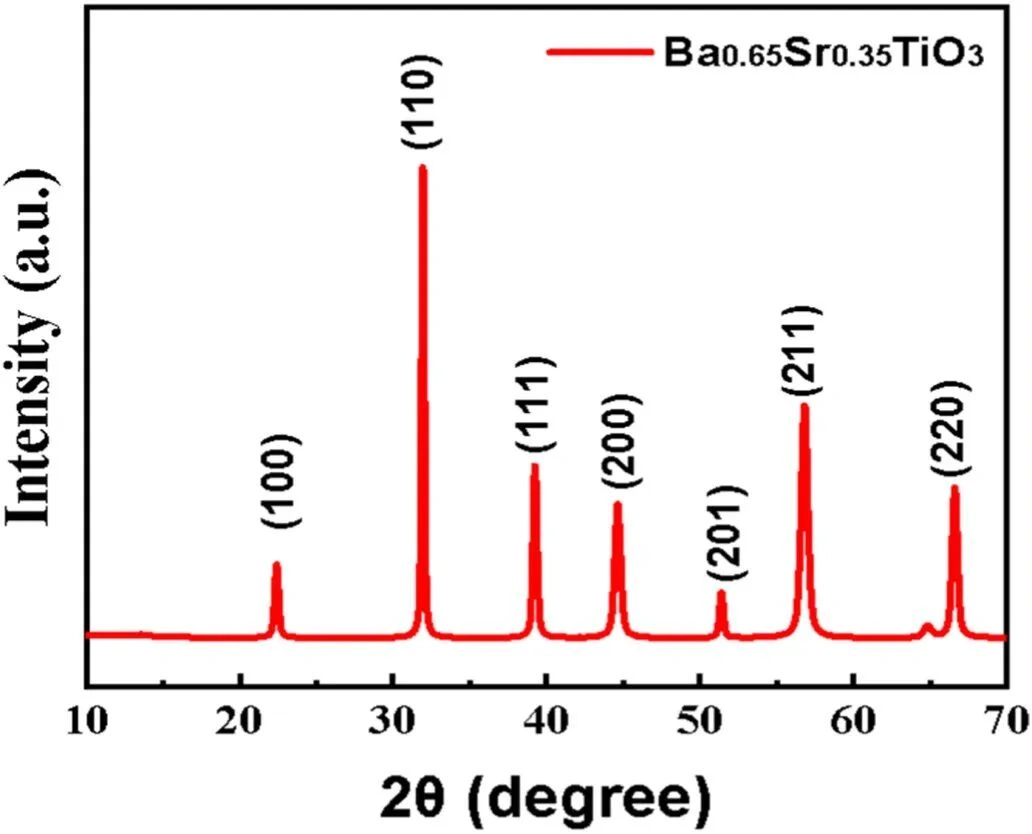
X-ray diffraction confirmed a single perovskite phase. The structure read as tetragonal with c/a ≈ 0.999, so close to cubic that the distinction barely matters.
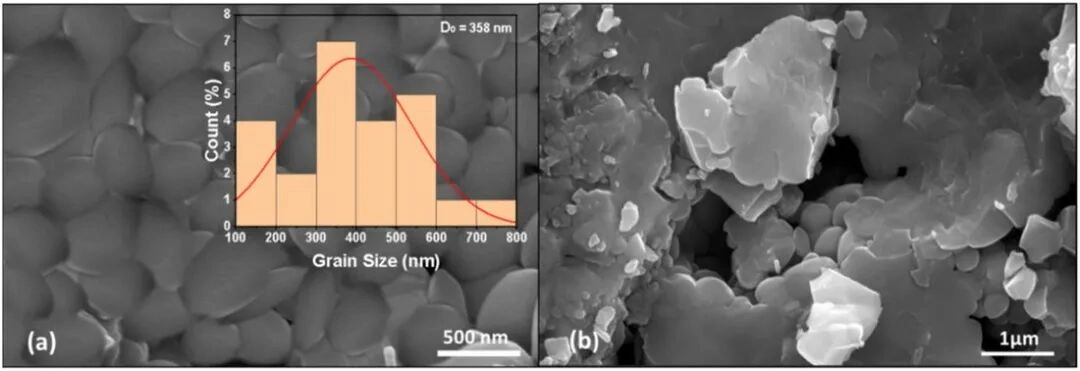
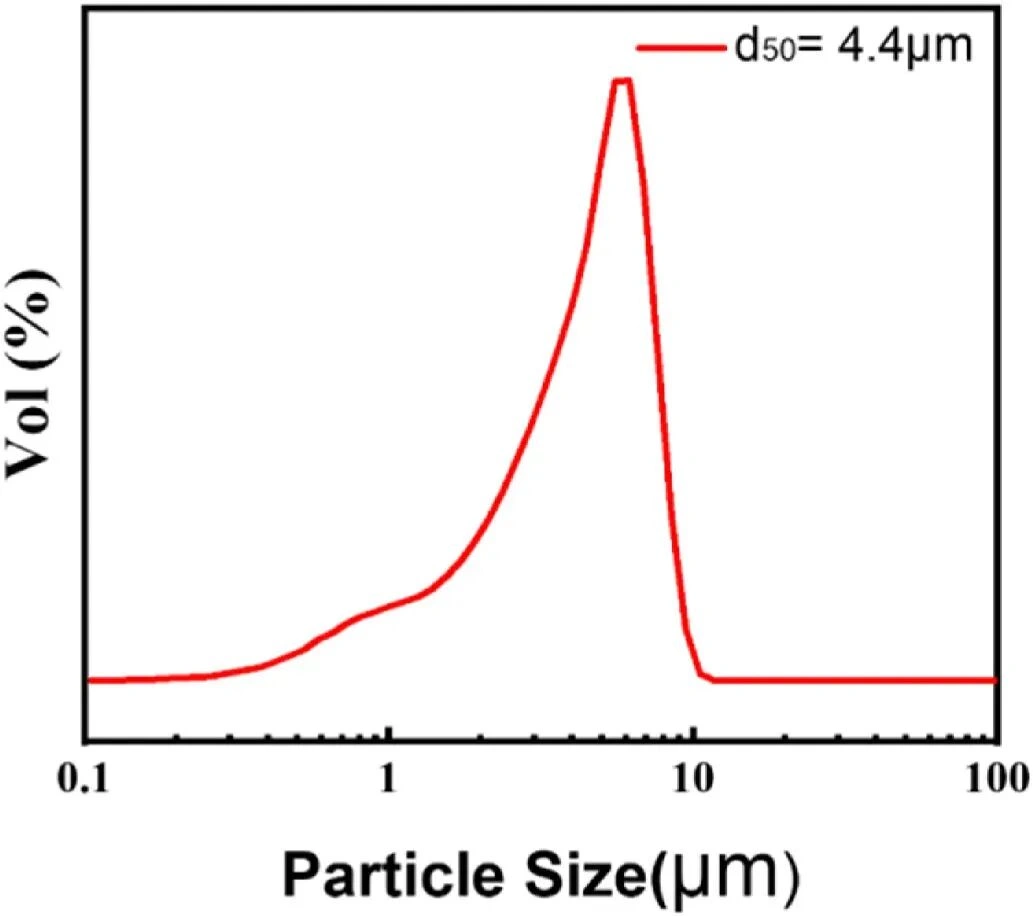
Microscopy told the rest. Grains looked non-spherical and ranged from about 100 nm to over 600 nm; across 45 measured grains the average sat near 358 nm with a standard deviation of 150 nm. Fracture surfaces showed mostly intergranular failure — grains pulled out, grain boundaries cracked. Both the residual porosity and the spread in grain size trace back to the combined effects of DLP processing and the sintering schedule.
Dielectric and Piezoelectric Performance
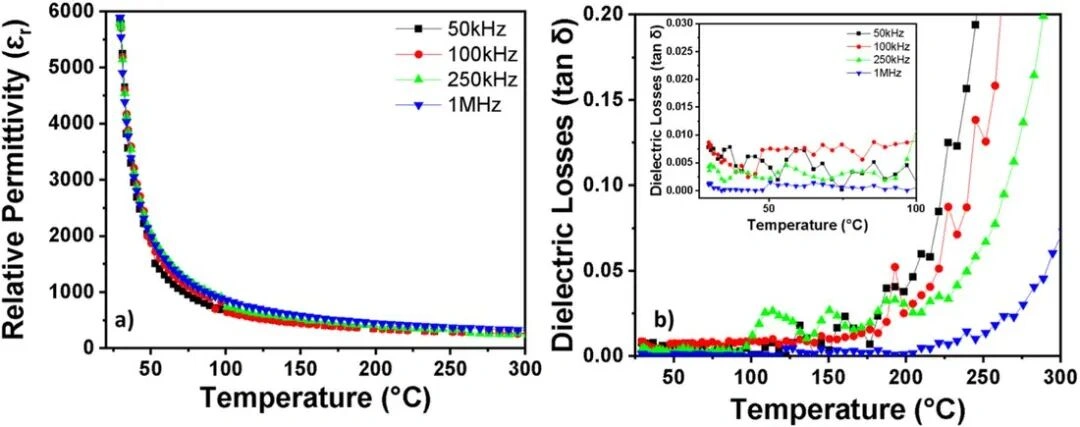
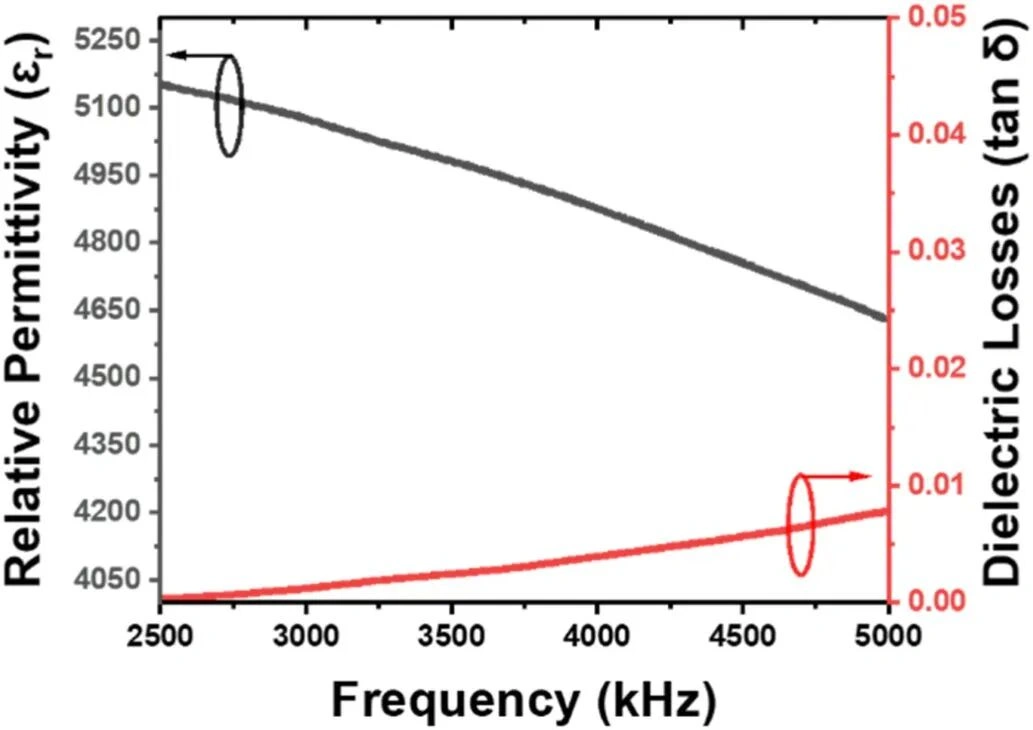
The electrical results stand out. At room temperature and 1 MHz, the ceramic showed a dielectric constant of about 5,888 and a loss tangent near 0.00132 (0.132%). That loss sits far below most reported BST values, which usually run above 1%. The piezoelectric coefficient reached 61 pC/N — a bit below some barium titanate reports, mostly because the 6% residual porosity lowered polarization efficiency.
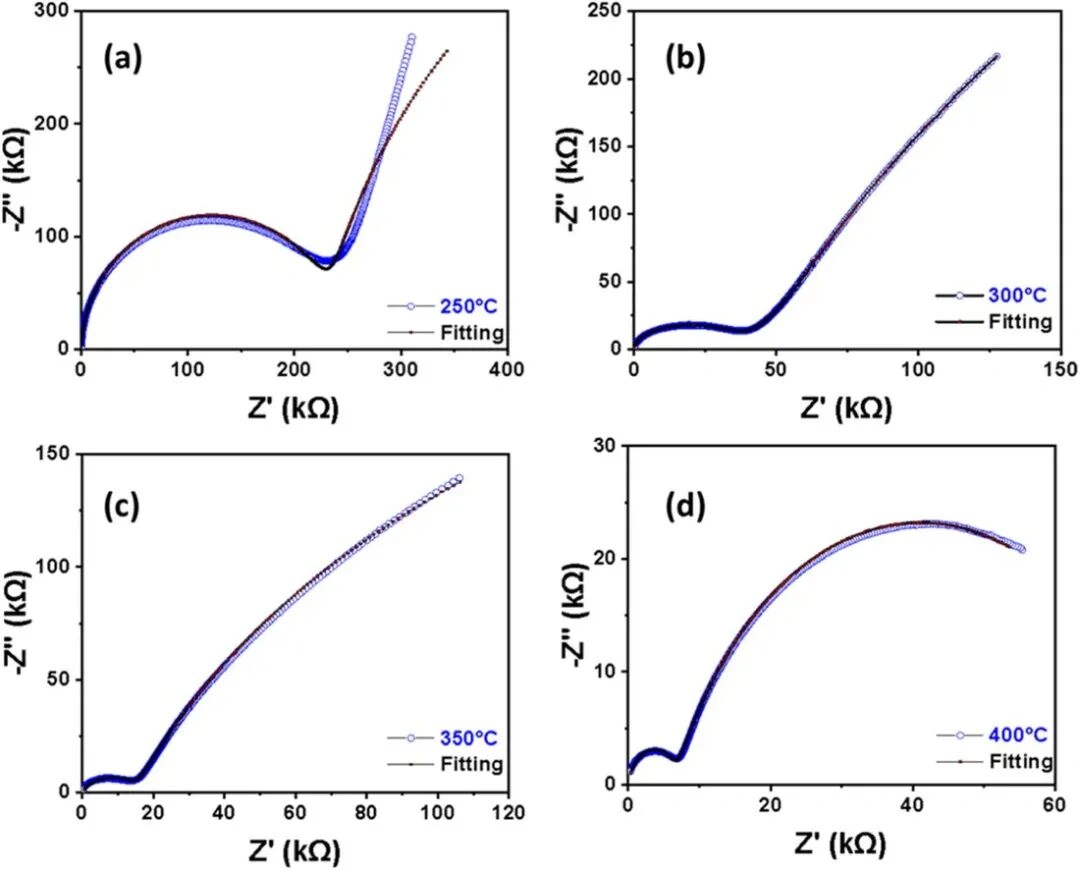
Impedance spectroscopy explained the low loss. The team modeled grain, grain-boundary, and pore contributions separately. Grain resistance measured far below grain-boundary resistance, so charge transport met its main barrier at the boundaries. Grain capacitance landed near 10⁻¹¹–10⁻¹⁰ F while boundary capacitance reached 10⁻⁹–10⁻⁸ F.
That gap drove strong Maxwell–Wagner interfacial polarization, which contributed roughly 5,400 to the dielectric constant at 25 kHz. At the same time, the near-ideal grain capacitance (n ≈ 0.92) and the high boundary resistance blocked long-range current, keeping loss low.
Photoinitiator: The Internal Lever for Debinding
The paper’s real contribution is a shift in thinking. Past work tuned DLP ceramic debinding through external heat parameters — ramp rate, hold time, peak temperature, atmosphere. Those factors act from outside, and teams apply them only after the part already exists. This study shows that photoinitiator content acts as an inside lever: it fixes the total organic load and crosslink density during printing, and those choices then govern how gas releases and where stress appears during debinding.
One weight percent worked best because it balanced two needs — enough curing and limited organics. For anyone printing functional oxide ceramics such as BaTiO₃, BST, or PZT, the lesson is direct: treat photoinitiator content as the first variable to optimize, not the last.
We suggest building slurry development around the chain TPO content → organic total → debinding behavior, and adopting a “cure–debinding coupling” mindset. When you pick a starting formula, accept slightly weaker curing (compensate with longer exposure) rather than let TPO overrun and load the part with organics. In dielectric ceramic DLP printing, the floor on performance usually comes from debinding defects, not from sintering.
Limitations and How It Compares
We should stay honest about the trade-offs. The 61 pC/N figure trails literature values for barium titanate (168 and 201 pC/N) for good reasons — the 6% porosity and the relatively large 358 nm grains both suppress piezoelectric response, since finer grains typically help. For dielectric use, though, the pair of εr ≈ 5,888 and tan δ < 0.2% already ranks as excellent, and BST adds the rare advantage of a Curie temperature parked near room temperature.
Reference
Jamal M. U., Hussain F., Sohail M. (2026). Optimized slurry and digital light processing (DLP) type 3D printing of Ba₀.₆₅Sr₀.₃₅TiO₃ (BST) functional ceramics. Ceramics International, 52, 23958–23966. DOI: 10.1016/j.ceramint.2026.03.436.
Corresponding authors: Muhammad Umair Jamal (umairjamal@neduet.edu.pk), Fayaz Hussain (fhussain@neduet.edu.pk).