
New research reveals that cleaning and secondary UV curing may be the missing link between high-precision DLP 3D printing and high-performance zirconia ceramics.
Introduction
For many years, DLP 3D printing has been recognized as one of the most promising technologies for manufacturing complex ceramic components.
It offers excellent dimensional accuracy, high productivity, and the freedom to create geometries that are difficult or impossible to produce using conventional ceramic forming methods.
Yet one challenge has remained difficult to overcome: mechanical performance.
Although DLP-printed zirconia parts often show outstanding geometric precision, their strength has typically lagged behind conventionally pressed ceramics. Many researchers have focused on slurry formulation, printing parameters, and sintering schedules, but a recent study published in Ceramics International suggests that the real breakthrough may come from a stage that receives far less attention—post-processing.
The researchers demonstrated that a carefully designed combination of solvent cleaning and secondary UV curing significantly improved the quality and strength of DLP-printed zirconia. The optimized process achieved flexural strengths exceeding 1000 MPa, with a peak value of 1074 MPa, while more than doubling the defect-free yield rate.
Why DLP Printed Zirconia Often Develops Cracks
To understand the significance of this work, it is important to look at how DLP ceramic printing works.
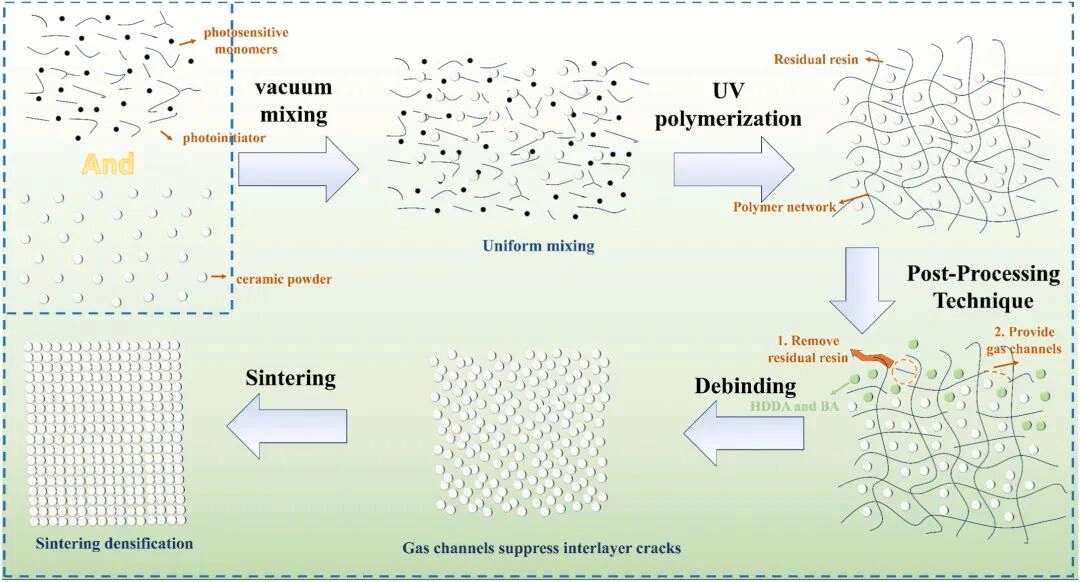
In DLP printing, layers of ceramic-filled photopolymer slurry are selectively cured by projected light. After printing, the green body undergoes debinding and sintering to form a dense ceramic component.
This layer-by-layer approach creates a hidden challenge.
Each printed layer introduces an interface where bonding may be weaker than within the layer itself. During debinding, organic materials decompose and release gases. If these gases become trapped around interlayer regions, internal pressure builds up and cracks can form.
At the same time, differences in local density can generate uneven shrinkage during sintering, creating stress concentrations that further increase the risk of failure.
As a result, many DLP-printed zirconia parts suffer from:
- Interlayer cracking
- Internal defects
- Reduced flexural strength
- Low production yield
Traditionally, researchers have attempted to solve these issues by optimizing printing parameters. This study instead focused on what happens after printing but before debinding, a stage that is often overlooked.
A Different Approach: Improving the Green Body Before Sintering
The research team prepared a high-solid-loading zirconia slurry containing 82 wt% ceramic powder and fabricated test samples using DLP 3D printing.
After printing, the green bodies were cleaned using four different solvents:
- 5% neutral detergent solution (5NDS)
- Polyethylene glycol 400 (PEG400)
- HB cleaning solution
- 75% ethanol-water solution
Following cleaning, each group was divided into two categories:
- Without additional UV curing
- With secondary UV curing (405 nm, 40 W, 5 minutes)
The objective was simple: determine whether post-processing could influence crack formation and final mechanical performance.
The results were striking.
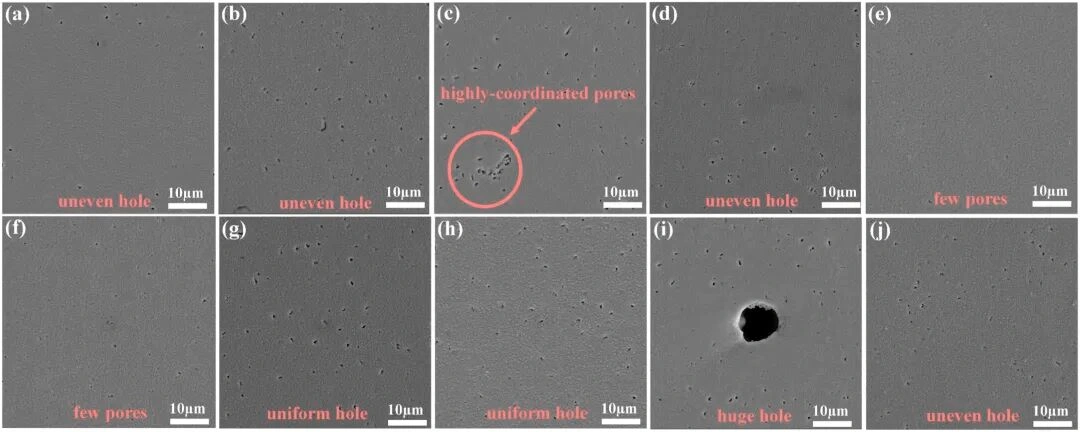
Only the combination of HB cleaning solution and secondary UV exposure consistently prevented crack formation after sintering. Samples treated with the other cleaning methods still exhibited varying levels of surface or internal cracking.
Why the HB Cleaning Solution Worked
The effectiveness of the HB solution was closely related to its chemical composition.
The cleaning solution contained:
- 20 wt% 1,6-Hexanediol Diacrylate (HDDA)
- 80 wt% Butyl Acrylate
During ultrasonic cleaning, the solution penetrated into interlayer regions and removed residual uncured monomers and oligomers without damaging the already cured polymer framework.
The secondary UV curing step then activated remaining reactive species, promoting additional crosslinking throughout the green body.
This process delivered two important benefits.
1. Reduced Gas Generation During Debinding
Residual liquid resin trapped between layers can decompose and release gases during thermal treatment.
Cleaning removed much of this material before debinding, reducing internal pressure and lowering the likelihood of crack formation.
2. Stronger Interlayer Bonding
Secondary UV curing strengthened polymer networks across layer interfaces.
As a result, the green body became more mechanically stable and better able to withstand thermal stresses during debinding and sintering.
Rather than simply cleaning the surface, the process effectively improved the internal structure of the printed component.
Mechanical Performance Exceeded 1000 MPa
The impact on mechanical properties was significant.
After sintering at 1525°C for 4 hours, the optimized post-processing route achieved:
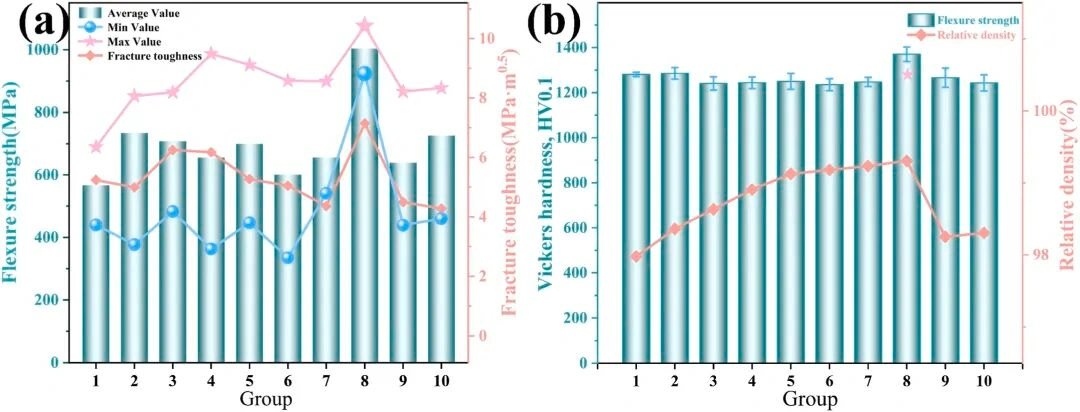
- Average flexural strength: 1004 MPa
- Maximum flexural strength: 1074 MPa
- Defect-free yield rate: 62.5%
In comparison, untreated samples showed:
- Flexural strength below 600 MPa
- Yield rates below 30%
These results represent a substantial improvement in both reliability and performance.
The study also compared the results with previously reported DLP-printed zirconia ceramics. Many published studies reported strengths around:
- 821 MPa
- 832 MPa
- 911 MPa
The optimized post-processing strategy surpassed these values and moved DLP-printed zirconia much closer to the performance level of conventionally manufactured zirconia ceramics, which typically achieve approximately 1100–1200 MPa.
The Role of Sintering Temperature
Post-processing was not the only factor influencing performance.
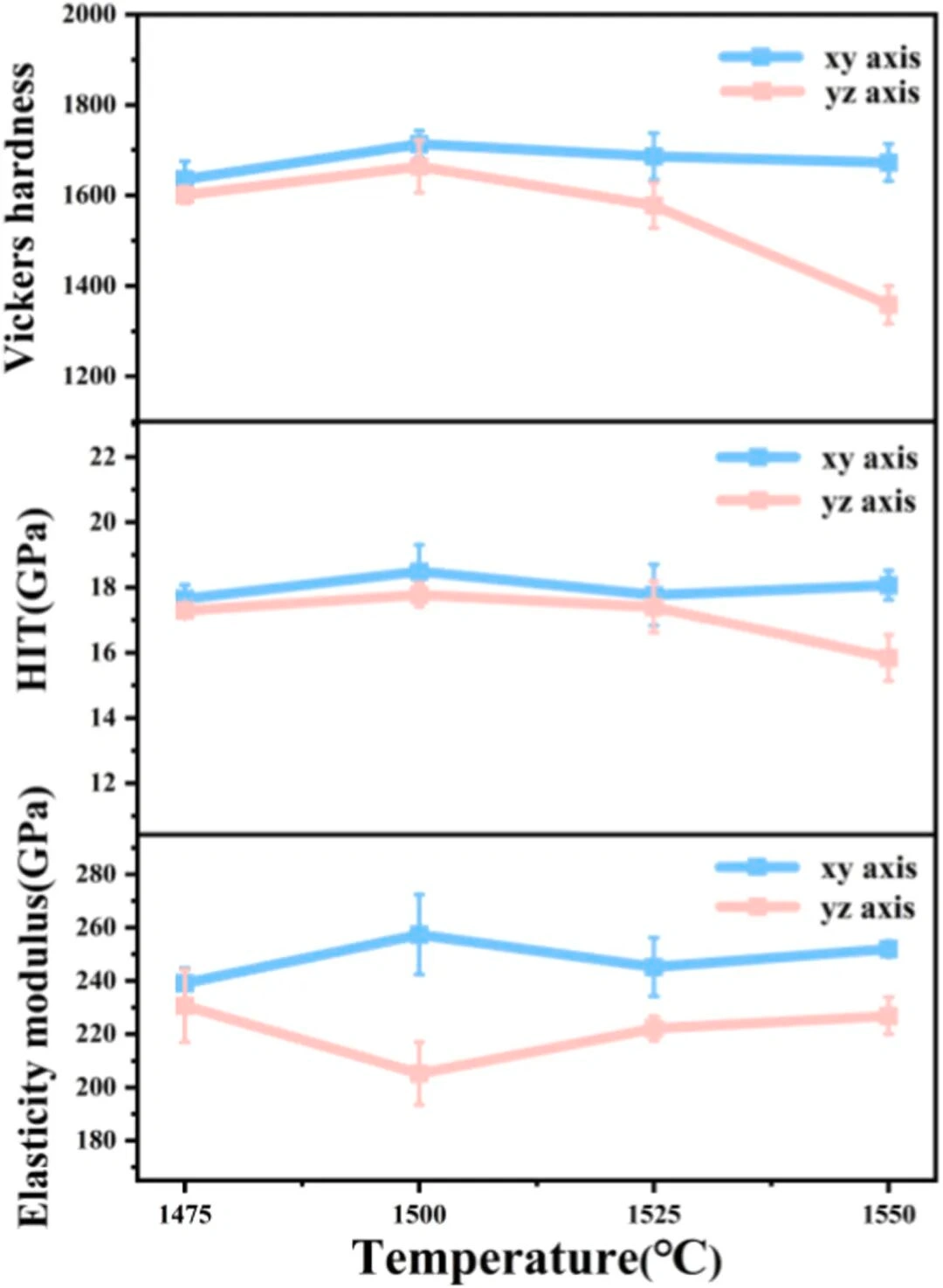
The researchers also evaluated different sintering conditions and found that the strongest samples were obtained at 1525°C.
However, components sintered at 1500°C for 4 hours displayed a particularly balanced combination of properties.
Microstructural analysis revealed:
- Fewer residual cracks
- More uniform grain distribution
- Controlled grain growth
- Improved structural consistency
This finding highlights an important principle for ceramic additive manufacturing:
Post-processing and sintering should be optimized together rather than independently.
Even the best cleaning strategy cannot fully compensate for an unsuitable sintering profile.
Understanding the Crack Formation Mechanism
To better explain the results, the researchers performed microstructural characterization and thermodynamic analysis.
They identified two primary causes of crack formation.
Gas Pressure During Debinding
Uncured monomers and oligomers decompose at elevated temperatures and generate gases.
If these gases become trapped inside weak interlayer regions, localized pressure increases and cracks can develop.
Stress Concentration During Sintering
Interfaces with lower polymer density create uneven shrinkage behavior.
As the ceramic densifies, these regions experience higher stress concentrations, making them susceptible to crack initiation.
The combined cleaning and UV curing strategy addressed both mechanisms simultaneously.
Cleaning reduced the amount of gas-producing material, while secondary curing reinforced the interlayer structure.
This dual-action approach significantly improved the survival rate of printed parts throughout thermal processing.
What This Means for the Future of Ceramic 3D Printing
One of the most valuable insights from this study is that the performance limitations of DLP-printed ceramics may not originate from the printing process itself.
Instead, they can often be traced back to the condition of the green body before thermal treatment.
For manufacturers and researchers working with:
- Zirconia (ZrO₂)
- Alumina (Al₂O₃)
- Silicon Nitride (Si₃N₄)
- Other photopolymer-based ceramic systems
post-processing deserves the same level of attention as printing parameters and material formulation.
The concept demonstrated in this work could potentially be adapted to other ceramic materials, leading to higher yields, fewer defects, and improved mechanical reliability across a wide range of applications.
As ceramic additive manufacturing moves toward industrial-scale production, understanding and controlling post-processing may become one of the most important factors in achieving consistent quality.
Further Research and Collaboration in DLP Ceramic Printing
This study highlights how post-processing can significantly influence the microstructure and mechanical performance of DLP-printed zirconia ceramics. For researchers working in ceramic additive manufacturing, these findings may provide useful insights for studying interlayer behavior, debinding mechanisms, and strength development.
ADT supports ongoing research in DLP 3D printing of advanced ceramics, including zirconia, alumina, and other functional ceramic systems. We collaborate with academic and industrial R&D teams on process evaluation, material testing, and application-oriented development.
If you are conducting research in this area or exploring similar mechanisms in ceramic additive manufacturing, you are welcome to arrange an online discussion with our engineering team to further explore your research needs and experimental setup.
Reference
Huang, J.R., Liu, F., Liu, S.J., et al. Tailoring Microstructure and Mechanical Performance of DLP-Printed ZrO₂ Ceramics: Critical Roles of Post-Processing Techniques. Ceramics International, 2026. DOI: 10.1016/j.ceramint.2026.03.037.