DLP Ceramic 3D Printing: Evaluation of Microbial Adhesion on Zirconia Surfaces
How do DLP ceramic 3D printing angles and layer thickness affect the surface characteristics and initial microbial adhesion of zirconia?
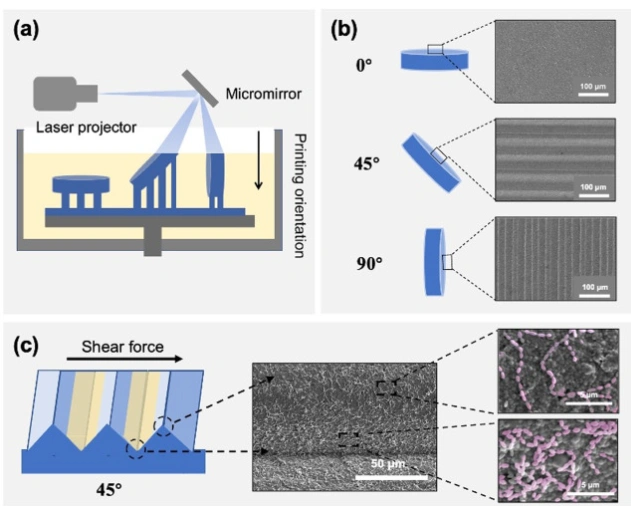
Appropriate build angles and layer thickness are crucial for optimizing the surface morphology and roughness of 3D-printed zirconia, as they influence microbial adhesion. Optimal zirconia applications, especially on transmucosal surfaces, can be achieved by using a 0° printing angle and minimizing layer thickness, thereby improving clinical outcomes. Recently, Professor Li Ping and his team from the Affiliated Stomatological Hospital of Guangzhou Medical University, in collaboration with Dr. Zhu Pengfei from Adventure Technology, published a study in the *Journal of Dentistry* titled “Evaluation of microbial adhesion on 3D-printed zirconia surfaces: Effects of printing angle and layer thickness.” They investigated how printing angle and layer thickness affect the surface characteristics and initial microbial adhesion of zirconia manufactured via digital light processing (DLP).
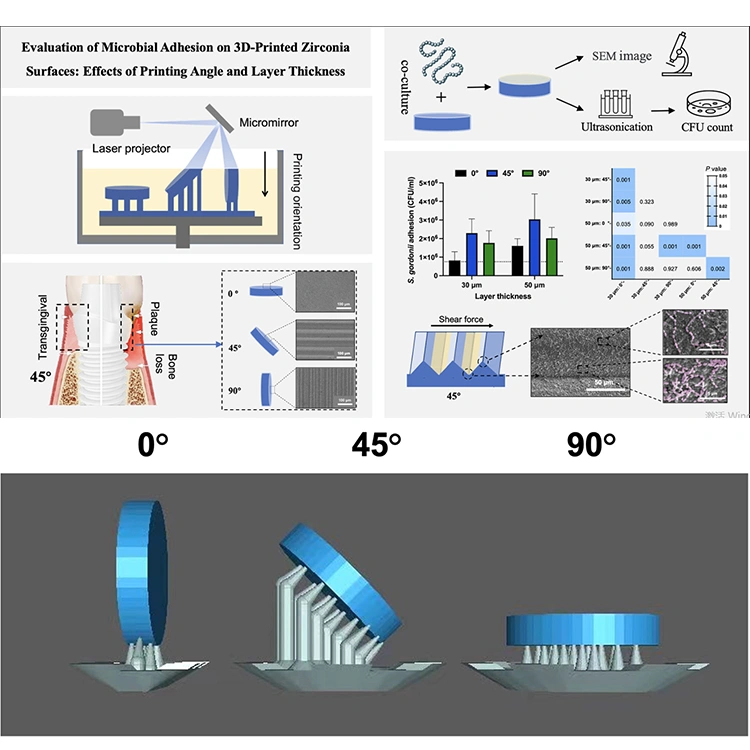
Original article link: https://doi.org/10.1016/j.jdent.2025.105855
Research Findings on Microbial Adhesion on DLP Ceramic 3D Printed Zirconia Surfaces
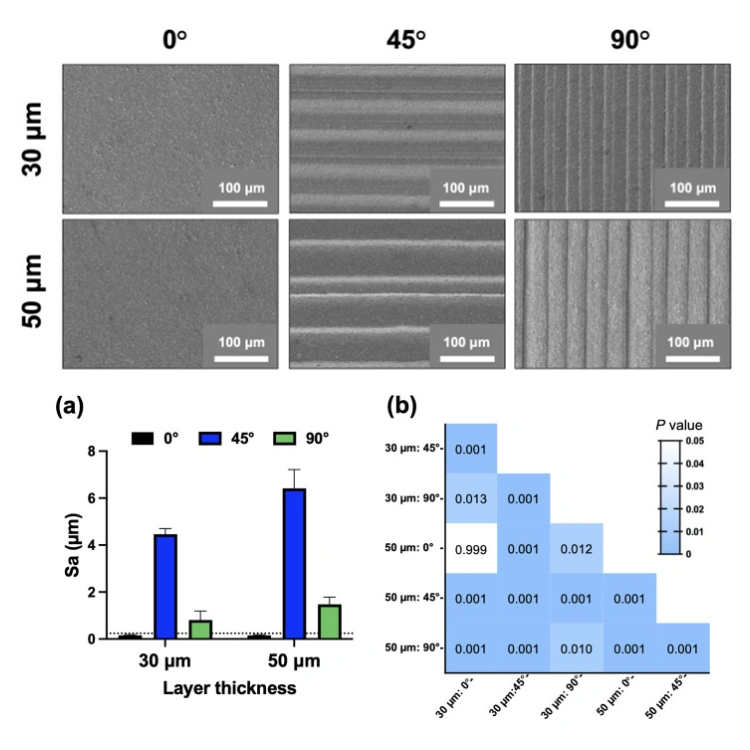
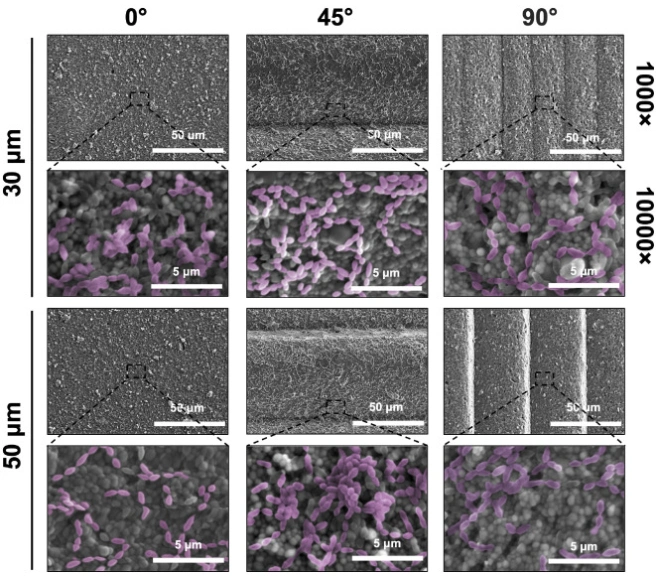
A total of 156 zirconia samples were prepared and divided into six groups based on two layer thicknesses (30 and 50 μm) and three build angles (0°, 45°, and 90°). Surface morphology and roughness were analyzed using scanning electron microscopy and laser scanning microscopy, respectively. Surface wettability was assessed by water contact angle measurement. The initial adhesion of *Streptococcus gordonii* (n = 6) was evaluated by colony-forming unit counting. Two samples from each group were fixed, dehydrated, and observed for biofilm formation using scanning electron microscopy. Two-way ANOVA and Tukey’s multiple comparison tests were performed. Statistical significance was set at p < 0.05. The following are the research methods and data from the article:
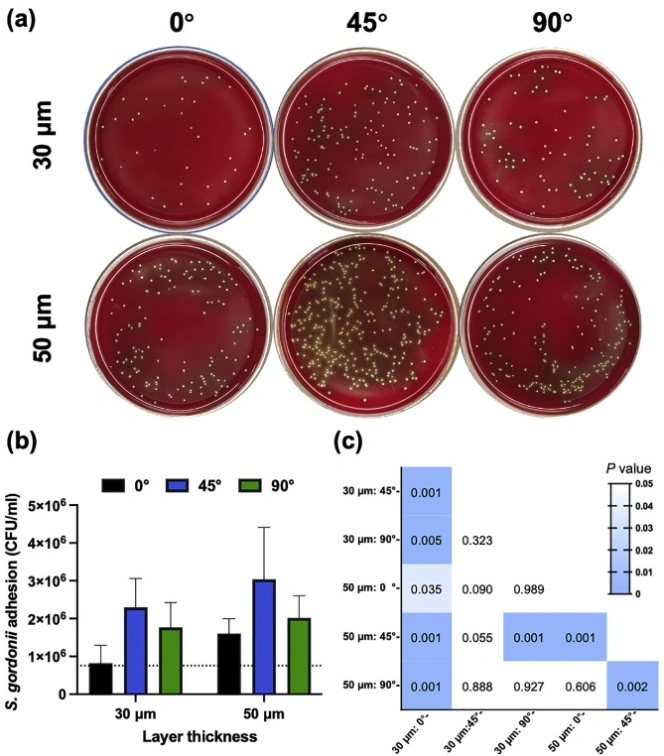
Given the limitations of this study, the following conclusions can be drawn:
- Printing layer thickness and build angle significantly affect the surface roughness and water contact angle of DLP-printed zirconia.
- Surface morphology is primarily determined by the build angle rather than the layer thickness. 3. Printing angle and layer thickness significantly affected the adhesion of S. gordonii to the DLP-printed zirconia surface.
- Printing at a 45° angle should be avoided to reduce S. gordonii adhesion.