
Cubic garnet-type crystal-structured complex oxides hold a unique position among oxide materials due to their exceptional thermal, mechanical, and optical properties.
In a recent study published in Optical Materials, Prof. Petr S. Sokolov and his research team from the National Research Center "Kurchatov Institute" in Moscow, Russia, have proposed a novel and efficient formulation based on mono- and tri-functional acrylic monomers.
This breakthrough enables the production of photosensitive resins specifically designed for high-resolution digital light processing (DLP) 3D printing of garnet ceramics.
Research Methods
This study employed a multi-step fabrication approach: Fine garnet powder was synthesized through co-precipitation followed by thermal treatment. Photosensitive resin was then formulated using a mixture of mono- and tri-functional acrylic monomers.
A cost-effective DLP 3D printing technique combined with sintering processes enabled the creation of precise ceramic lattice structures.
The optical properties of these engineered materials were systematically investigated.
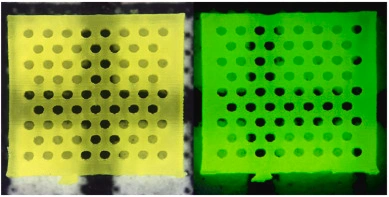
Figure 1. Optical characterization of GYAGG:Ce + 5% Y₂O₃ ceramics sintered at 1720°C in oxygen atmosphere: (left) diffuse daylight illumination, (right) UV excitation at 360 nm. Specimens remain unpolished post-sintering.
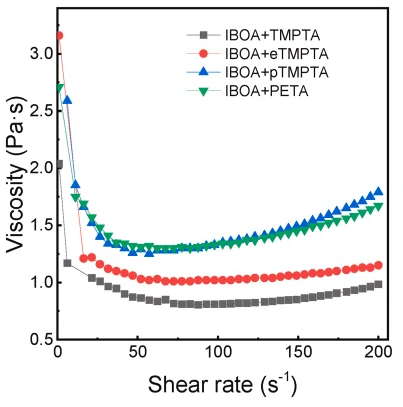
Figure 2. Viscosity-shear rate profile of the GYAGG:Ce suspension formulated with an IBOA-based mixture at 20.0°C. A consistent solid loading of 35 vol% (∼76 wt%) was maintained across all experimental conditions.
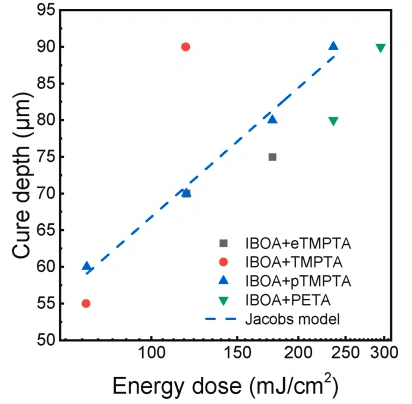
Figure 3. Curing depth (layer thickness) dependence on energy dose for the photocurable GYAGG:Ce suspension formulated with an IBOA-based mixture.
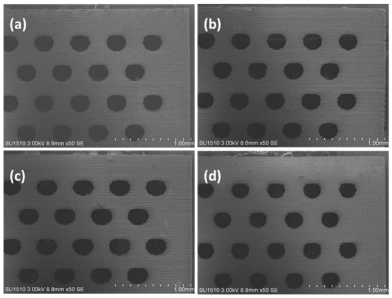
Figure 4. SEM images of 3D-printed green bodies fabricated from suspensions containing (a) IBOA + TMPTA, (b) IBOA + eTMPTA, (c) IBOA + pTMPTA-9, and (d) IBOA + PETA monomer mixtures.
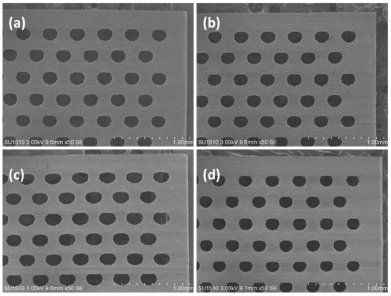
Figure 5. SEM micrographs of GYAGG:Ce ceramics sintered at 1650°C under air atmosphere, derived from (a) IBOA + TMPTA, (b) IBOA + eTMPTA, (c) IBOA + pTMPTA-9, and (d) IBOA + PETA formulations.
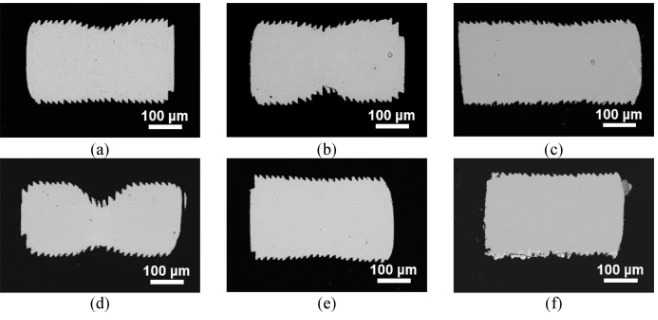
Figure 6. Cross-sectional SEM analysis of 3D-printed GYAGG:Ce + 5% Y₂O₃ ceramics sintered under varying conditions:Air atmosphere: (a) 1600°C, (b) 1650°C, (c) 1720°C; Oxygen atmosphere: (d) 1600°C, (e)1650°C, (f) 1720°C; Magnification: ×200.
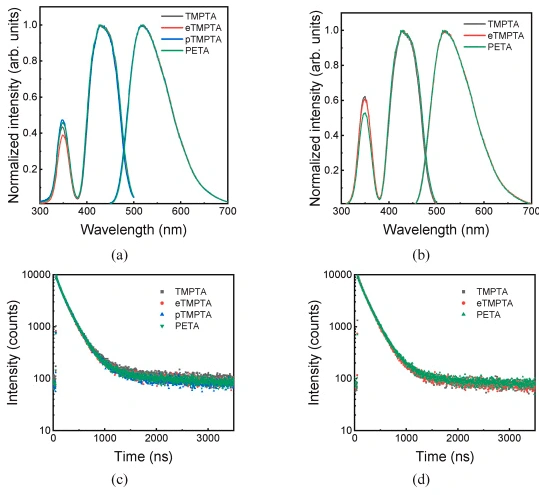
Figure 7. Room-temperature photoluminescence properties of GYAGG:Ce ceramics sintered under different conditions:
Optical spectra: Normalized emission (λex = 430 nm) and excitation (λreg = 520 nm) profiles;
PL kinetics: Comparison between (a,c) air-sintered and (b,d) oxygen-sintered specimens at 1650°C (2 hr);
Average decay times (ns):
Air-sintered: 67.9, 64.2, 70.8, 68.2;
Oxygen-sintered: 75.1, 61.7,62.6,65.3
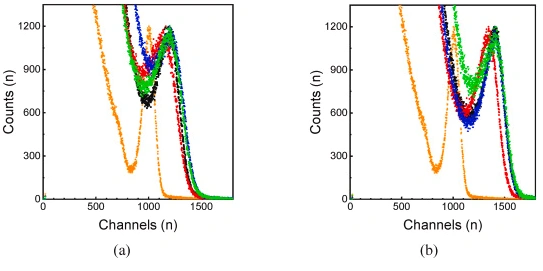
Figure 8. Pulse-height spectra of 3D-printed GYAGG:Ce ceramics measured under γ-ray irradiation, with reference GYAGG:Ce single crystals indicated by orange asterisks. Specimens were sintered at 1650°C for 2 hours under (a) air and (b) oxygen atmospheres. Data markers denote ceramics derived from different resin formulations:
Black squares: IBOA-TMPTA
Red circles: IBOA-eTMPTA
Blue triangles: IBOA-pTMPTA
Green triangles: IBOA-PETA
Conclusions
The study demonstrates that the novel formulation incorporating isobornyl acrylate and tri-functional acrylic monomers exhibits exceptional rheological properties and photocuring characteristics. The photosensitive suspension displayed optimal curing depth for DLP 3D printing, enabling the fabrication of objects with 25 μm layer resolution, excellent interlayer adhesion, and superior surface finish.
DLP-based ceramic 3D printing of compacted green bodies successfully produced versatile garnet-type GYAGG:Ce ceramics. Subsequent binder removal and pressureless sintering in air or oxygen atmospheres yielded translucent ceramics. Notably, oxygen-sintered specimens achieved remarkable optical transparency and structural perfection, with porosity levels substantially reduced by increasing sintering temperatures from 1600°C to 1720°C. Crucially, the photoluminescent and scintillation properties of 3D-printed GYAGG:Ce ceramics were found to correlate with organic binder composition.