
Recently, Associate Professor Xia Min from the School of Materials Science and Engineering, University of Science and Technology Beijing, published a research article titled “High-precision printing of intricately shaped kaolin ceramics by digital light processing: Impact of solid content on microstructure and densification” in the Journal of Materials Research and Technology. The study demonstrates the fabrication of high-precision and complex-shaped kaolin ceramics using digital light processing (DLP) technology and investigates the effect of solid content on their microstructure and densification.
Original article:https://doi.org/10.1016/j.jmrt.2024.03.227
Research Content
High-precision fabrication of ceramic materials with complex geometries and customizable properties has attracted considerable attention in recent years; however, maintaining dimensional accuracy remains a major challenge. In this study, an innovative digital light processing (DLP) 3D printing technique was employed to fabricate kaolin ceramics with intricate structures, achieving both high precision and high densification.
The DLP 3D printing process for kaolin ceramics is illustrated in Figure 1A, which depicts the overall fabrication workflow. The morphology and particle size distribution of kaolin ceramic powders, along with the viscosity of the formulated slurry, are shown in Figure 1B. Figure 1E presents the slurry preparation process, printability analysis, and thermal decomposition behavior during the printing workflow.
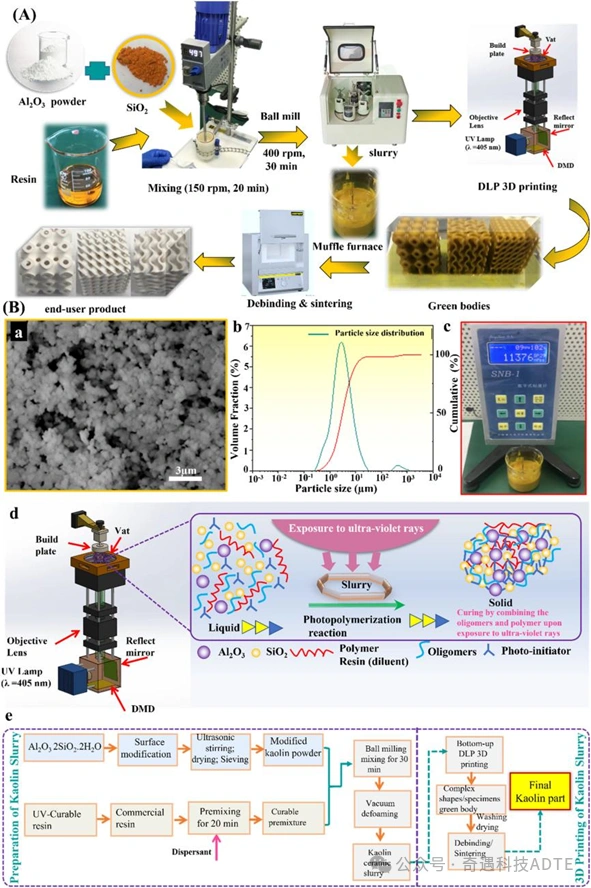
Figure 1. (A) Schematic overview of the fabrication process of high-quality kaolin ceramics via vat photopolymerization. (B) Material characterization and slurry preparation mechanism.
According to the TG–DSC analysis, maintaining the temperature at 1200 °C for 1 h effectively minimizes defects such as pores and cracks while reducing shrinkage. The debinding process was carried out in an air atmosphere to ensure the complete removal of organic binders and resin (Figure 2). The use of air atmosphere facilitates the efficient elimination of residual resin within the ceramic green body, which is crucial for reducing porosity and enhancing the mechanical properties of the final ceramic samples.
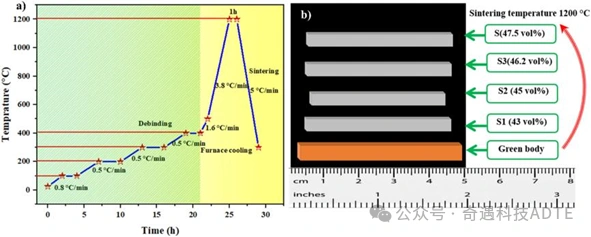
Figure 2. (a) Heating curve of the debinding and sintering processes. (b) DLP 3D-printed samples with different solid contents before and after sintering.
As shown in Figure 3, high-magnification SEM images of the kaolin ceramic specimens reveal the printed layer thickness. In particular, the samples printed along the Z-axis exhibit interlayer spacing (Figure 3a) and form a dense microstructure, which can be attributed to the layer-by-layer deposition during the 3D printing and sintering processes. The surface of the samples fabricated by the DLP process displays a multilayered structure with large grains, interlayer gaps, and a few microcracks (Figure 3b).
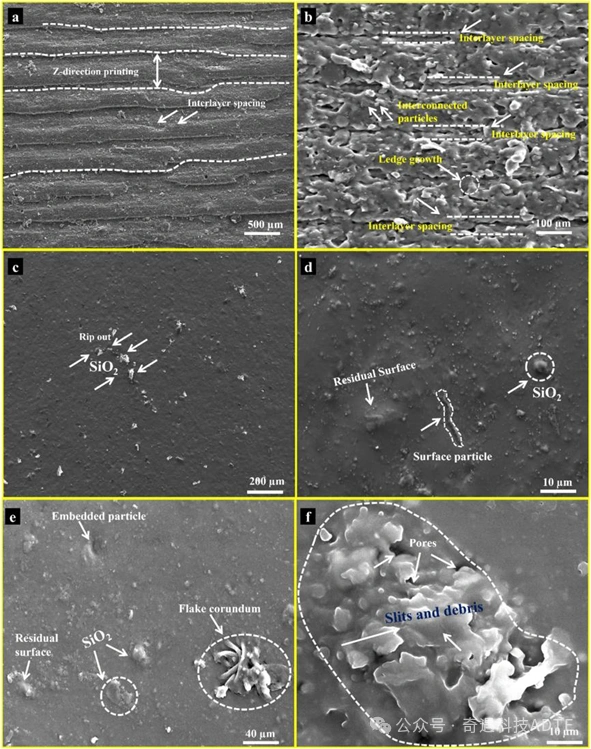
Figure 3. SEM images of alumina ceramics fabricated by DLP additive manufacturing.
The shrinkage, density, porosity, and water absorption of kaolin ceramics with different solid contents are presented in Figure 4. A detailed comparison was conducted for DLP-printed samples with various curing times (8 s, 10 s, and 12 s). As shown in Figure 4a, the shrinkage rates of samples with four different solid contents at various curing depths were analyzed. The results indicate that shrinkage along the Z-axis is greater than that along the XY plane. At 1200 °C, the shrinkage rates in the Z-axis (19.11%), X-axis (12.81%), and Y-axis (12.83%) directions reached their lowest values at a solid content of 47.5 vol%. Notably, the sample with a solid content of 45.3 vol% exhibited the highest shrinkage rate and the lowest density.
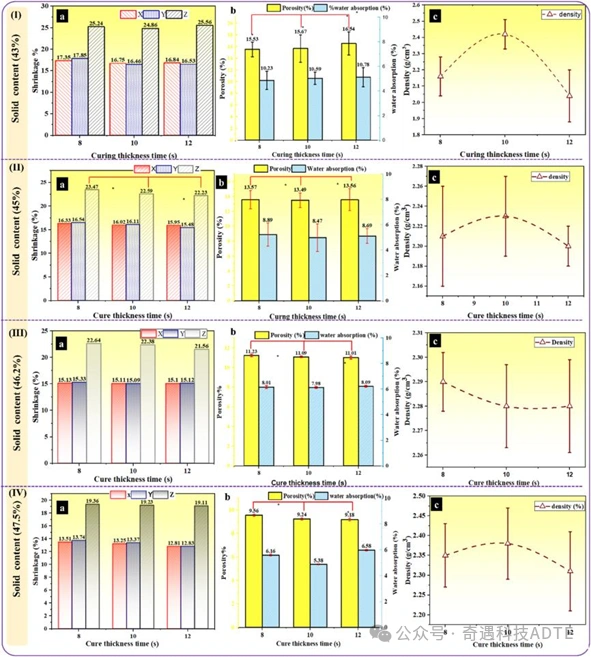
Figure 4. Evaluation of physical properties: (a) Shrinkage rates corresponding to curing depths for samples with different solid contents ranging from 43 vol% to 47.5 vol%; (b) Porosity and water absorption at various solid contents; (c) Comparison of sample densities under different curing times (s).
As shown in Figure 5a, the flexural strength of DLP 3D-printed kaolin samples with different solid contents ranged from 28.98 to 71.60 MPa after sintering at 1200 °C, while the compressive strength of the porous structures reached 6.66 MPa (Figure 5b). The improvement in the flexural strength of sintered samples is primarily attributed to the increase in solid content, which enhances particle bonding and promotes grain growth during the sintering process.
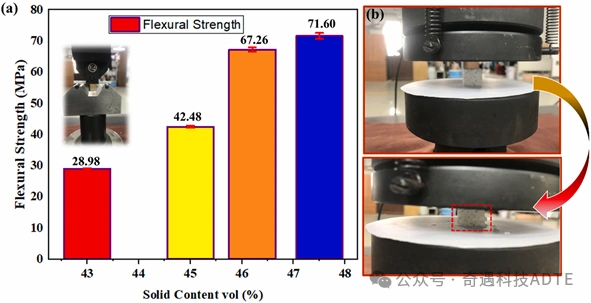
Figure 5. (a) Flexural strength of samples with different solid contents. (b) Compressive strength of porous structures.
Research Conclusion
In this study, high-precision kaolin ceramics with complex geometries and varying solid contents were fabricated using digital light processing (DLP) technology to achieve high densification. The adjustment of solid content and exposure time played a crucial role in enhancing both the physical and mechanical properties of the printed ceramics. The applied DLP printing parameters—layer thickness, light intensity, and exposure time—were found to significantly influence the morphological features and flexural strength of the samples. After sintering at 1200 °C, the sample with a solid content of 47.5 vol% exhibited the lowest shrinkage, lowest porosity, highest densification, and superior flexural strength.