
Digital Light Processing (DLP) ceramic 3D printing has emerged as a transformative manufacturing technology that enables high-precision fabrication of advanced ceramic components with complex geometries and tailored functions. Using projected UV light to cure photosensitive ceramic slurries layer by layer, DLP delivers exceptional dimensional accuracy, fast throughput, and fine surface finish — advantages that are essential in high-value industries such as aerospace, biomedical engineering, and electronics.
What is DLP Ceramic 3D Printing?
DLP (Digital Light Processing) ceramic 3D printing is an additive manufacturing approach in which a digital projector exposes entire layers of a ceramic slurry at once, rapidly polymerizing the material into solid layers. Unlike point-by-point laser systems, DLP projects full-area UV images, enabling faster build rates while maintaining resolutions suitable for micron-scale features such as intricate internal channels and lattice structures.
Key advantages of the DLP method for ceramic processing include:
-
Micron-scale precision: Typical layer thicknesses between 10–50 µm.
-
Complex geometry capability: Ideal for internal channels, lattice networks, and non-standard architectures.
-
Material versatility: Supports a broad range of advanced ceramic systems including structural, bioceramic, and functional materials.
-
Efficient development cycles: Reduced need for tooling shortens design-to-prototype timelines.
Zirconia Ceramics: Structural Performance with Precision
Zirconia (ZrO₂) is one of the most widely used structural ceramics in additive manufacturing due to its superior combination of mechanical toughness, wear resistance, thermal stability, and biocompatibility.
In DLP ceramic 3D printing:
-
High mechanical performance: Zirconia parts are suited for load-bearing aerospace, automotive, and industrial applications due to their excellent fracture toughness.
-
Biocompatibility: Excellent compatibility with living tissue makes this material suitable for dental implants and orthopedic components that require patient-specific customization.
-
Repeatability of complex shapes: DLP enables production of highly repeatable, precision shapes that would otherwise be difficult or expensive to machine.
In practice, zirconia slurries are cured into a green body by the DLP process and then undergo debinding and high-temperature sintering to form densely packed, high-strength ceramics.
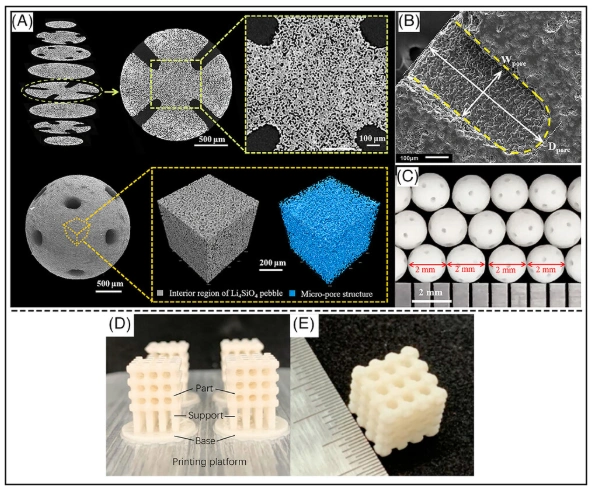
Hydroxyapatite (HA): Bioceramics for Medical Innovation
Hydroxyapatite (HA), a bioactive ceramic closely resembling the mineral phase of bone, plays a pivotal role in orthopedic and craniofacial applications because of its exceptional biocompatibility and osteoconductivity.
DLP enables fabrication of porous hydroxyapatite structures with controlled architectures that can:
-
Promote tissue integration: Gradient pores and interconnected networks facilitate vascularization and bone ingrowth.
-
Improve clinical outcomes: Custom scaffolds for bone defect repair or patient-specific implants enhance surgical efficacy and healing.
-
Support drug delivery: Precision control over porosity allows HA scaffolds to act as carriers for controlled release therapeutics.
This capability positions DLP printing as an enabling technology for next-generation biomedical devices based on advanced ceramic materials.
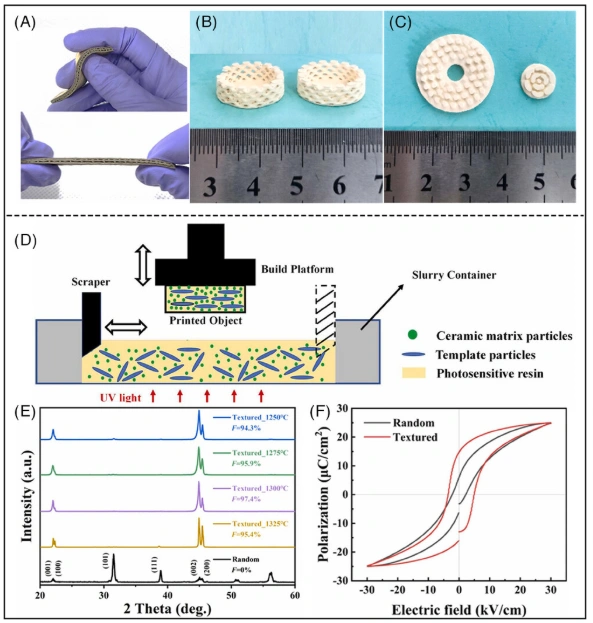
Piezoelectric Ceramics: Functional Materials Beyond Structure
Beyond structural and bioceramic applications, DLP 3D printing is breaking new ground in functional materials — particularly piezoelectric ceramics such as barium titanate (BaTiO₃) and other ferroelectric systems.
Piezoelectric ceramics exhibit electromechanical coupling, generating electrical signals in response to mechanical stress. In additive manufacturing, this opens up possibilities in:
-
Sensors and actuators: Precise, miniaturized components for automotive, industrial and consumer electronics.
-
Ultrasonic transducers: Complex geometries for acoustic imaging and industrial non-destructive testing.
-
Energy harvesting: Devices that convert ambient mechanical energy into electrical power.
Although optimizing solid loading and particle dispersion remains a technical challenge for functional feedstocks, advances in materials science and print process controls are rapidly expanding the adoption of piezoelectric ceramics in additive manufacturing.
Looking Forward: Trends and Opportunities
The evolution of DLP ceramic additive manufacturing continues to accelerate across multiple fronts:
-
Multi-material processes: Integrating structural and functional ceramics in a single build.
-
AI-assisted design and process optimization: Enhancing precision and predictability of prints.
-
Expanded application ecosystems: From aerospace parts to personalized medical implants and embedded functional devices.
As DLP technology matures, its integration with high-performance ceramic material systems is redefining what’s possible in precision manufacturing — enabling both lightweight structural components and smart functional devices at commercial scale.