
As the ceramic additive manufacturing industry scales up, the question of sustainability becomes increasingly urgent. A new review paper from Politecnico di Torino (Italy) and Fraunhofer IKTS (Germany) published in Open Ceramics (2026) provides the first comprehensive roadmap for implementing circular economy principles in ceramic 3D printing.
This article summarizes the key findings and their implications for manufacturers, researchers, and equipment developers.
Key Takeaways
- Recycling is the most immediately actionable circular economy strategy for ceramic additive manufacturing.
- CO₂ emissions vary significantly by technology: VPP produces 616 kg CO₂/kg ceramic, while binder jetting produces 3,086 kg CO₂/kg.
- Four ceramic AM technologies (BJT, MEX, MJT, VPP) offer different opportunities and challenges for circularity.
- Recycling opportunities exist throughout the manufacturing process, including green body, brown body, and sintered body stages.
- The Italian ceramic tile industry has achieved 100% waste reintegration into production.
- Technical ceramics remain a key research gap in circular economy development.
Why Circular Economy Matters for Ceramic 3D Printing
Ceramic additive manufacturing, also known as ceramic 3D printing or ceramic AM, is transforming how industries produce complex ceramic components. From aerospace to biomedical, from electronics to energy, 3D printed ceramics enable designs that are impossible with conventional shaping methods. However, this technological revolution comes with an environmental cost that cannot be ignored.
The European ceramic industry alone generates 19 million tonnes of CO2 emissions annually. Particulate matter from ceramic production accounts for approximately 20% of global black carbon emissions. These figures highlight why sustainability must be a core consideration for the future of ceramic 3D printing technology, not an afterthought.
The paper by Aronne et al. takes a systematic approach to analyzing how circular economy (CE) principles can be integrated into ceramic AM workflows. The authors define CE as “a regenerative economic system which aims to promote value maintenance and sustainable development, creating environmental quality, economic development and social equity, to the benefit of current and future generations.” For ceramic 3D printing practitioners, this means rethinking every stage of the production chain.
The 5R Framework: A Practical Guide for Ceramic AM Sustainability
The review paper organizes circular economy strategies around the 5R principle, which provides a practical framework for evaluating sustainability actions in ceramic additive manufacturing:
Four Ceramic AM Technologies and Their Circular Economy Potential
The review systematically analyzes four major ceramic 3D printing technologies according to the ISO/ASTM 52900:2021 classification, evaluating each technology’s strengths, limitations, and circular economy potential.
Binder Jetting (CerAM BJT)
Binder jetting is valued for its ability to produce large parts with high design flexibility, no support structures, and high throughput. In the context of circular economy, the unprinted powder in the bed can be directly reused in subsequent builds, making it inherently more material-efficient than many other processes. However, the technology suffers from low surface quality and high porosity, requiring additional infiltration steps for dense parts. The CO2 emissions for binder jetting are significant — approximately 3,086 kg of equivalent CO2 per kg of ceramic, making it the most carbon-intensive of the evaluated technologies.
Material Extrusion (CerAM MEX / FFF / DIW)
Material extrusion encompasses both fused filament fabrication (FFF) and direct ink writing (DIW). These technologies offer low equipment costs, multi-material capability, and wide community adoption. For circular economy applications, the thermoplastic feedstock in FFF can potentially be recycled and re-extruded. DIW, being a suspension-based process, offers similar recycling potential for unused paste material. The main recycling challenge for FFF lies in the polymer matrix, which requires separation from ceramic powder before reprocessing.
Material Jetting (CerAM MJT)
Material jetting, particularly multi-material jetting (MMJ), achieves high accuracy and low surface roughness. The feedstock consists of thermoplastic systems (paraffin and/or beeswax) with dispersed ceramic powder. For circular economy, the wax-based feedstock presents unique challenges: rheological properties change over time, potentially affecting print quality. However, unused feedstock can be remelted and reprocessed in the homogenizer, offering a closed-loop opportunity for ceramic 3D printing materials management.
Vat Photopolymerization (CerAM VPP / DLP)
Vat photopolymerization, including digital light processing (DLP) and stereolithography (SLA), represents one of the most promising ceramic 3D printing technologies for achieving high resolution and complex geometries. The technology relies on photocurable resins containing ceramic powder, with parameters including viscosity, dispersion stability, and curing properties as critical process controls. For circular economy implementation, the review highlights several promising avenues: unused resin can potentially be recovered, and failed green bodies can be ground to recover ceramic powder after thermal treatment to remove residual polymer. However, resin composition and photoinitiator degradation are important factors that must be evaluated before reintegration. The CO2 emissions for vat photopolymerization are approximately 616 kg CO2 per kg of ceramic — significantly lower than binder jetting, though still substantial. For DLP ceramic 3D printer operators, this data underscores the importance of process optimization and waste minimization strategies.
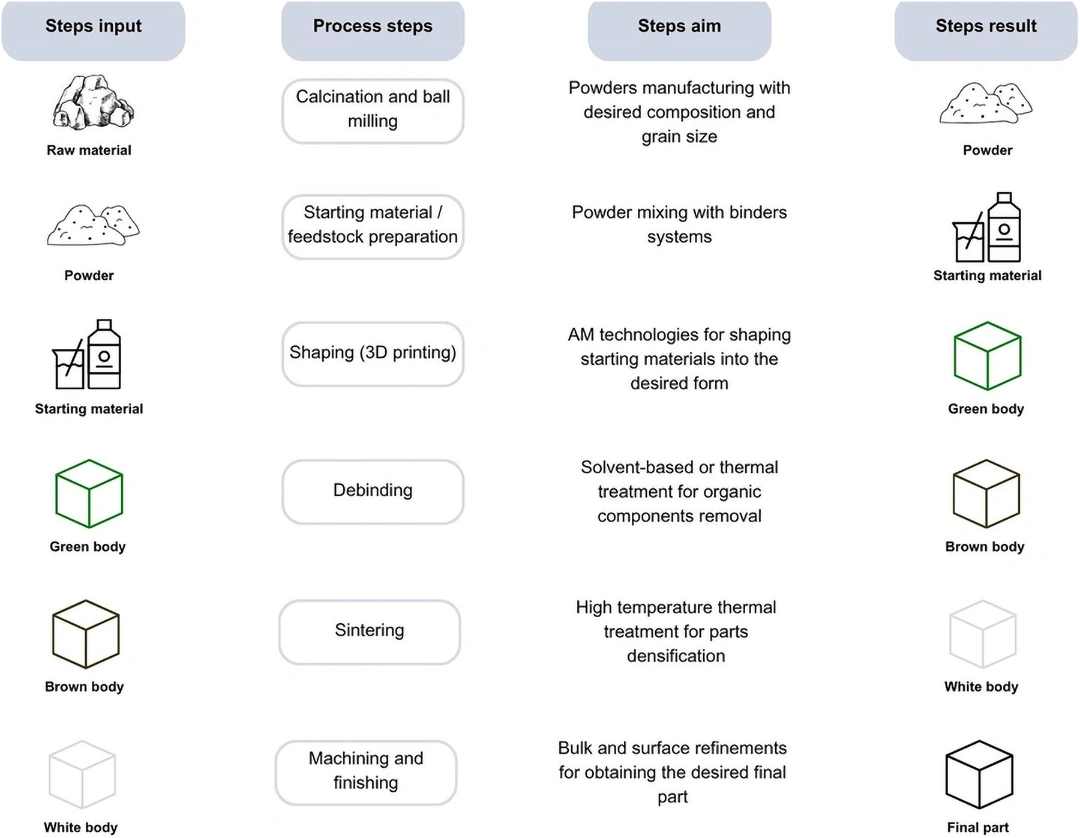
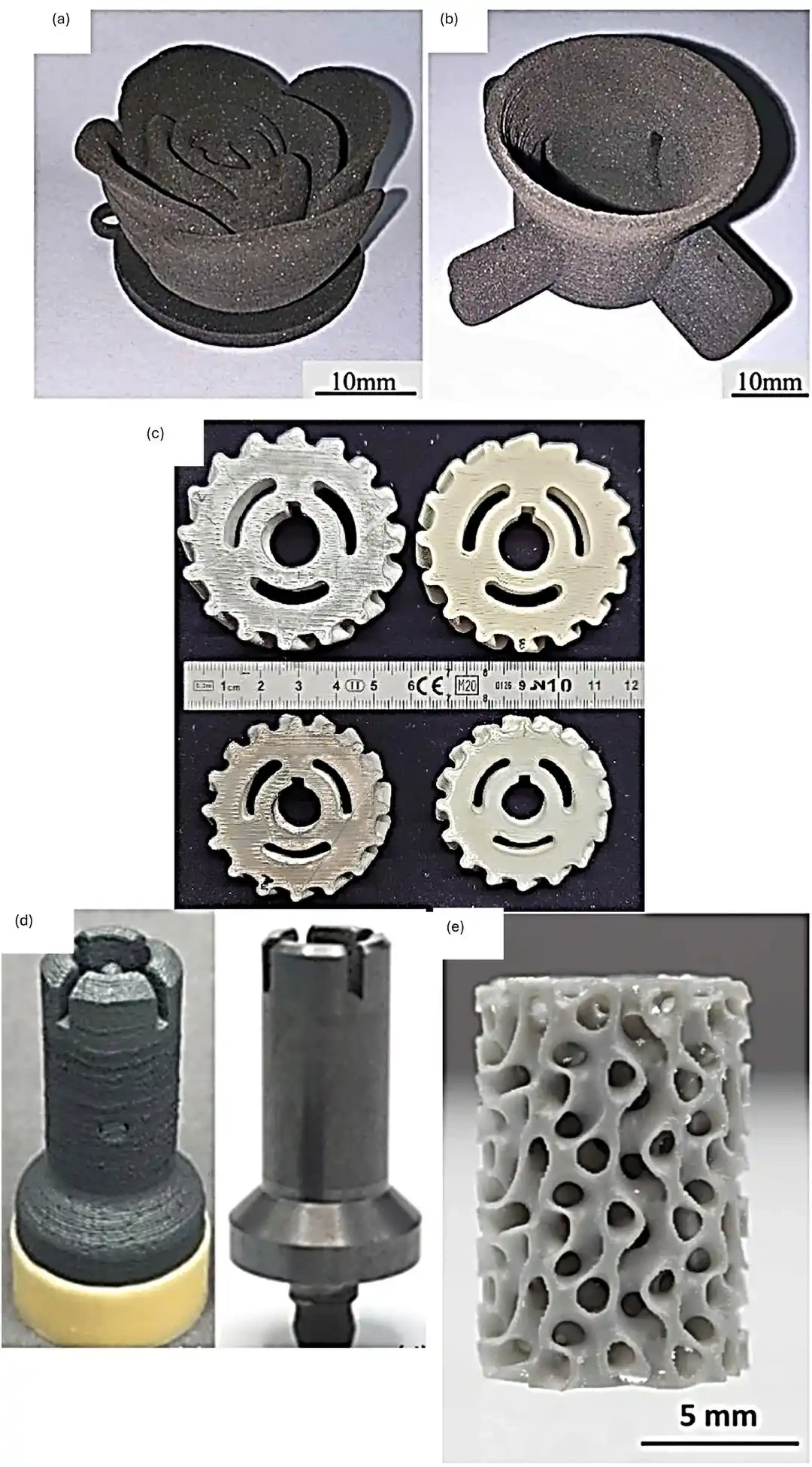
Figure 2. Examples of ceramic AM printed objects: (a-b) Al2O3 structures via binder jetting; (c) SiC and Si3N4 gears via material extrusion; (d) ceramic plasma plug via multi-material jetting; (e) Si3N4 lattice structure via vat photopolymerization. (Adapted from Aronne et al., Open Ceramics, 2026)
Recycling Opportunities at Every Stage of the Production Chain
One of the most valuable contributions of this review is the stage-by-stage analysis of recycling possibilities across the entire ceramic 3D printing workflow. Rather than treating recycling as a single end-of-life action, the authors identify specific opportunities at each processing stage.
Green Body Recycling
At the green body stage, the object still contains the full organic binder/polymer matrix. The review identifies that recycling at this stage is theoretically possible but requires careful consideration. For vat photopolymerization-based green bodies, the resin can be burned away, but some polymeric residues may remain in the ceramic powder. Grinding and reprocessing would require additional thermal treatment to ensure complete removal of organic components. For silicon nitride 3D printing and other advanced ceramics, contamination control is particularly critical due to the sensitivity of these materials to impurities.
Brown Body Recycling
After debinding, the brown body consists primarily of ceramic particles with reduced but potentially non-zero polymer content. For binder jetting, the brown body represents an opportunity to recover powder after grinding, though the authors note that a second thermal treatment may be needed to remove residual binder. For material extrusion (FFF), the debinding process typically involves solvent extraction followed by thermal treatment, which can introduce defects (bubbles, bloating) that complicate recycling efforts. Direct ink writing (DIW) and other suspension-based processes may offer advantages here because the binder content is typically lower than in FFF feedstocks.
Sintered Body Recycling
At the fully sintered stage, the ceramic part has achieved its final density and microstructure. Recycling here requires mechanical grinding to reduce the part to powder form. The feasibility depends on the material: fully dense oxide ceramics (such as alumina 3D printing and zirconia 3D printing parts) can be more readily ground and reprocessed than nitride or carbide ceramics, where the sintering chemistry and phase formation may make powder recovery more complex. The review emphasizes that recovered powder must be characterized for particle size distribution, contamination, and phase purity before reintroduction into the production cycle.
Feedstock Material Recycling
The most immediately actionable recycling opportunity identified by the authors is the recovery of unused feedstock material. For DLP ceramic 3D printing resins, unused material in the vat can potentially be filtered and reused. For DIW suspensions, material that has not been deposited during printing can be collected and reprocessed. For MJT feedstocks, material left in the cartridge or forming agglomerates can be remixed in the homogenizer. The key challenge is characterizing whether chemical or rheological changes have occurred during the initial processing period.
CO2 Emissions: Quantifying the Environmental Cost
The review provides one of the most comprehensive comparisons to date of CO2 emissions across ceramic 3D printing technologies. The data, drawn from life cycle assessment (LCA) studies, reveals significant differences between approaches:
| Technology | CO₂ Emissions (kg CO₂/kg ceramic) |
Key Factor |
|---|---|---|
| CerAM VPP (DLP/SLA) |
616.40 |
Resin pyrolysis and binder burnout |
| CerAM BJT | 3,086.13 |
High energy consumption, powder processing |
| Precursor-based ceramics |
2.23 |
No carbon pyrolysis required |
Table 1. CO₂ emissions comparison across ceramic AM technologies
(Data source: Liu et al., ACS Sustainable Chem. Eng., 2024,
as cited in Aronne et al.)
These numbers are striking. The vat photopolymerization approach produces roughly one-fifth the CO2 emissions of binder jetting, while precursor-based ceramics (such as polymer-derived ceramics) achieve nearly 300-fold lower emissions than binder jetting. For companies evaluating ceramic 3D printing technology for production, these environmental metrics must be weighed alongside resolution, throughput, and material compatibility considerations.
The review also proposes that greenhouse gas emissions could be further reduced to as low as 0.79 kg CO2 per kg of ceramic through process optimization, renewable energy integration, and feedstock reformulation. This represents a potential 99.97% reduction from current binder jetting levels, demonstrating the transformative potential of circular economy thinking in ceramic additive manufacturing.
Quality Requirements for Recycled Ceramic Materials
A critical insight from the review is that recycling is not simply about recovering material — it is about recovering material that meets the quality standards required for the intended application. The authors emphasize that recovered powders must undergo rigorous characterization before reintroduction into the production cycle.
Required characterization for recycled ceramic powders:
- Contamination analysis: Energy-dispersive X-ray spectroscopy (EDS), X-ray diffraction (XRD), or resonance frequency analysis to detect any residual binder or foreign phases
- Particle size and morphology: Scanning electron microscopy (SEM), particle size distribution (PSD) analysis to ensure recovered powder meets the original specifications for the ceramic 3D printing process
- Mechanical validation: Four-point bending tests, thermal conductivity measurements to verify that recycled material produces parts with acceptable performance
- Rheological properties: For suspension-based processes (DIW, VPP), viscosity and shear-thinning behavior must be confirmed
- Curing characteristics: For DLP ceramic 3D printing resins, curing depth and dispersion stability must be re-evaluated
The review explicitly warns that the Italian ceramic tile industry achieves 100% waste reintegration because construction-grade ceramics have relatively forgiving quality tolerances. For technical ceramics 3D printing — where applications in aerospace, biomedical, electronics, and energy demand strict performance standards — the quality requirements for recycled materials are significantly more demanding. This represents one of the key research gaps identified by the authors.
The Research Gap: Technical Ceramics Need Attention
Perhaps the most important finding of the review is the identification of a critical research gap: while extensive work has been done on recycling construction ceramics and traditional ceramic tiles, there is a marked lack of studies on recycling technical ceramics through additive manufacturing routes. This matters because technical ceramics — including alumina, zirconia, silicon carbide, silicon nitride, and piezoelectric ceramics — are precisely the materials that benefit most from ceramic 3D printing‘s design freedom.
The review found only two published examples of ceramic waste recovery specifically for ceramic additive manufacturing: both involved construction applications (rooftop tiles and furniture) rather than technical ceramics. The authors call for urgent research in several areas:
- Development of standardized protocols for recycling ceramic 3D printing materials at each process stage
- Characterization of the impact of recycling on the mechanical, thermal, and electrical properties of technical ceramics
- Economic modeling of recycling costs versus virgin material costs for different ceramic 3D printing technologies
- Integration of renewable energy sources into ceramic AM workflows to further reduce carbon footprint
- Investigation of multi-material recycling strategies, where different ceramic phases must be separated
What This Means for Industry Practitioners
For companies operating in the ceramic 3D printing space — whether as equipment manufacturers, service bureaus, or end users — the review offers several actionable recommendations:
- Start with feedstock recycling: This is the lowest-hanging fruit. Collect unused resin, suspension, or filament and establish procedures for recharacterization and reprocessing. For DLP ceramic 3D printer operators, this means implementing protocols for filtering, degassing, and re-testing unused resin in the vat.
- Document and characterize waste streams: Before recycling can be implemented, companies need to understand what they are throwing away. Green body waste, brown body waste, and sintered scrap should each be inventoried and characterized.
- Invest in process optimization to reduce waste: The most effective sustainability strategy is often to reduce waste generation in the first place. Optimizing print parameters, support structures, and nesting strategies directly reduces material consumption.
- Consider technology choice from a sustainability perspective: When selecting a ceramic 3D printing technology, the CO2 emissions data should be part of the decision matrix. Vat photopolymerization offers lower emissions than binder jetting, though both are significantly higher than precursor-based approaches.
- Engage with academic research: The review identifies multiple gaps where industry-academia collaboration could accelerate progress. Companies with production data on waste generation, recycling trials, and material characterization can contribute valuable real-world data to this emerging field.
AdventureTech’s Commitment to Sustainable Ceramic 3D Printing
At AdventureTech, we recognize that the future of ceramic 3D printing depends not only on technical performance but also on environmental responsibility. Our DLP ceramic 3D printers are designed with process efficiency in mind, helping customers minimize material waste through precise exposure control and optimized layer strategies. By achieving high green body density and reliable debinding, our equipment reduces the scrap rate that would otherwise contribute to the waste stream.
We are actively engaged in research partnerships exploring the recycling of ceramic 3D printing materials, including the recovery of alumina, zirconia, and silicon nitride powders from failed prints. Our technical team works with customers to develop customized ceramic 3D printing workflows that balance performance requirements with material efficiency.
As the field of ceramic additive manufacturing matures, we believe that sustainability will become as important a competitive differentiator as resolution, throughput, and material compatibility. The review by Aronne et al. provides a crucial foundation for this transition, and we are committed to contributing to and benefiting from the research it inspires.
Conclusion: Circular Economy is Not Optional
The review by Aronne, Schwarzer-Fischer, and colleagues provides a comprehensive, evidence-based framework for thinking about circular economy in ceramic 3D printing. Their key conclusions are clear: recycling is the most immediately actionable strategy; CO2 emissions vary dramatically by technology; quality characterization is essential for any recycling program; and technical ceramics represent a critical research gap that demands urgent attention.
For the ceramic additive manufacturing industry, the message is equally clear: the linear “produce-dispose” model is no longer sustainable — economically, environmentally, or socially. The transition to circular production practices is not a distant aspiration but an immediate necessity. Companies that lead this transition will not only reduce their environmental footprint but also gain competitive advantage through reduced material costs, improved resource security, and enhanced brand reputation.
The Italian ceramic tile industry’s achievement of 100% waste reintegration proves that circular economy at scale is possible. The challenge now is to extend this success to the more demanding world of technical ceramics 3D printing, where performance standards are higher and the research base is thinner. The paper by Aronne et al. provides the roadmap; the industry must now provide the execution.
Looking for a Sustainable Ceramic Manufacturing Solution?
Original Paper:
Aronne M, Schwarzer-Fischer E, Bertana V, Mossotti G,
Scheithauer U, Ferrero S, Scaltrito L.
Exploring circularity in ceramic 3D printing:
Possibilities and implementation.
Open Ceramics, 2026, 25:100915.
DOI:
10.1016/j.oceram.2026.100915