
In the rapidly evolving world of ceramic additive manufacturing, the ability to fabricate complex ceramic structures that combine mechanical robustness with broadband microwave absorption is becoming increasingly important. These multifunctional materials are particularly valuable in industries such as aerospace engineering, radar stealth technology, and electromagnetic compatibility (EMC) systems.
At AdventureTech (Shenzhen Adventure Tech Co., Ltd.), a company specializing in high-precision DLP ceramic 3D printing since 2015, researchers and engineers are empowered to produce advanced Gyroid structure 3D printing metamaterials using SiOC-based polymer-derived ceramics (PDCs). By integrating advanced materials science with high-resolution DLP systems, AdventureTech enables the precise fabrication of triply periodic minimal surface (TPMS) architectures with exceptional repeatability.
AdventureTech’s industrial DLP platforms are widely used in leading research institutions including Tsinghua University, Harbin Institute of Technology (HIT), and the Chinese Academy of Sciences (CAS). These systems provide the resolution, material compatibility, and process control necessary for manufacturing intricate gyroid-based ceramic metamaterials. This article explores how combining Gyroid structure 3D printing with SiOC preceramic polymers enables the production of lightweight, high-performance microwave absorbers.
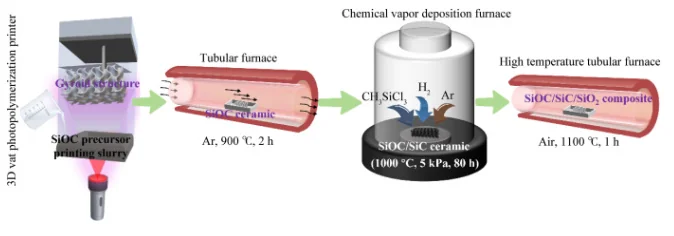
1. Why SiOC is Ideal for Broadband Microwave Absorption
Among polymer-derived ceramics, SiOC (silicon oxycarbide) stands out due to its exceptional combination of electrical, thermal, and structural properties. Produced from polysiloxane-based preceramic polymers, SiOC ceramics exhibit tunable dielectric properties, excellent thermal stability up to 1200–1400 °C, and strong oxidation resistance.
When fabricated using DLP 3D printing ceramics, the resulting amorphous SiOC matrix typically contains dispersed free carbon phases. This microstructure contributes to several electromagnetic loss mechanisms, including:
-
Dielectric polarization loss
-
Electrical conduction loss
-
Interfacial polarization effects
Recent research on SiOC/SiC/SiO₂ composite systems demonstrates that careful control of carbon content and microstructure can significantly enhance electromagnetic wave attenuation. This makes SiOC particularly suitable for lightweight microwave absorbers and architected ceramic structures that are difficult or impossible to fabricate through conventional machining techniques.
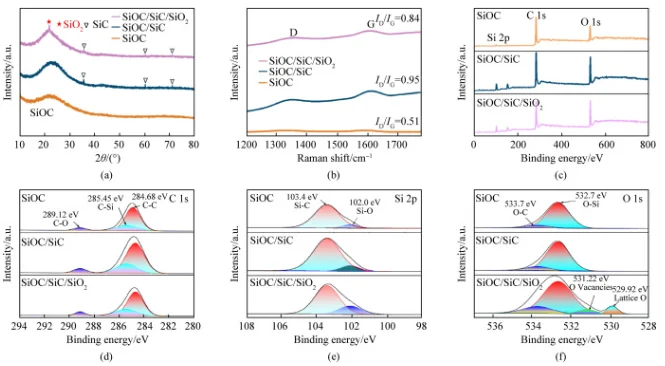
2. DLP 3D Printing Process for Complex Ceramic Structures
AdventureTech’s desktop and industrial DLP ceramic 3D printer systems are designed to process high-solid-content preceramic slurries with high accuracy. These systems can achieve layer resolutions of 25–50 μm, allowing the fabrication of intricate TPMS lattice geometries such as gyroid structures.
The proprietary ADT-Slicer 4D software engine supports efficient one-step formation of complex lattice geometries while maintaining dimensional stability. Additionally, the dual-cylinder sinking-scraping mechanism and automatic filtration system help ensure smooth printing even when working with high-viscosity ceramic resins.
A typical fabrication workflow includes:
-
Preparation of a photosensitive polysiloxane preceramic resin (ceramic yield >76 wt%)
-
High-resolution DLP printing of gyroid TPMS architectures
-
Debinding process at 400–600 °C
-
Pyrolysis under inert atmosphere at 1000–1300 °C
After pyrolysis, the printed parts typically exhibit linear shrinkage around 21.5% while maintaining excellent structural integrity. The final ceramic components generally reach densities between 1.43 and 1.61 g/cm³, making them suitable for lightweight functional applications.
3. Advantages of Gyroid Structure 3D Printing
Among various metamaterial architectures, the gyroid topology is especially attractive for microwave absorption applications. As a triply periodic minimal surface, the gyroid structure features zero mean curvature, continuous channels, and a large internal surface area.
When fabricated through DLP ceramic 3D printing, gyroid structures provide several advantages:
-
Enhanced multiple internal reflections of electromagnetic waves
-
Increased scattering pathways within the structure
-
Gradual impedance matching through interconnected channels
These structural characteristics significantly improve broadband microwave absorption performance compared with conventional lattice geometries.
Electromagnetic simulations performed using CST Microwave Studio indicate that optimized gyroid unit cells — with shell thicknesses of approximately 200–400 μm and cell sizes near 2.5 mm — can achieve effective impedance matching across the X-band and Ku-band frequency ranges. This performance results from the synergistic interaction between the intrinsic dielectric behavior of SiOC materials and the engineered 3D architecture.
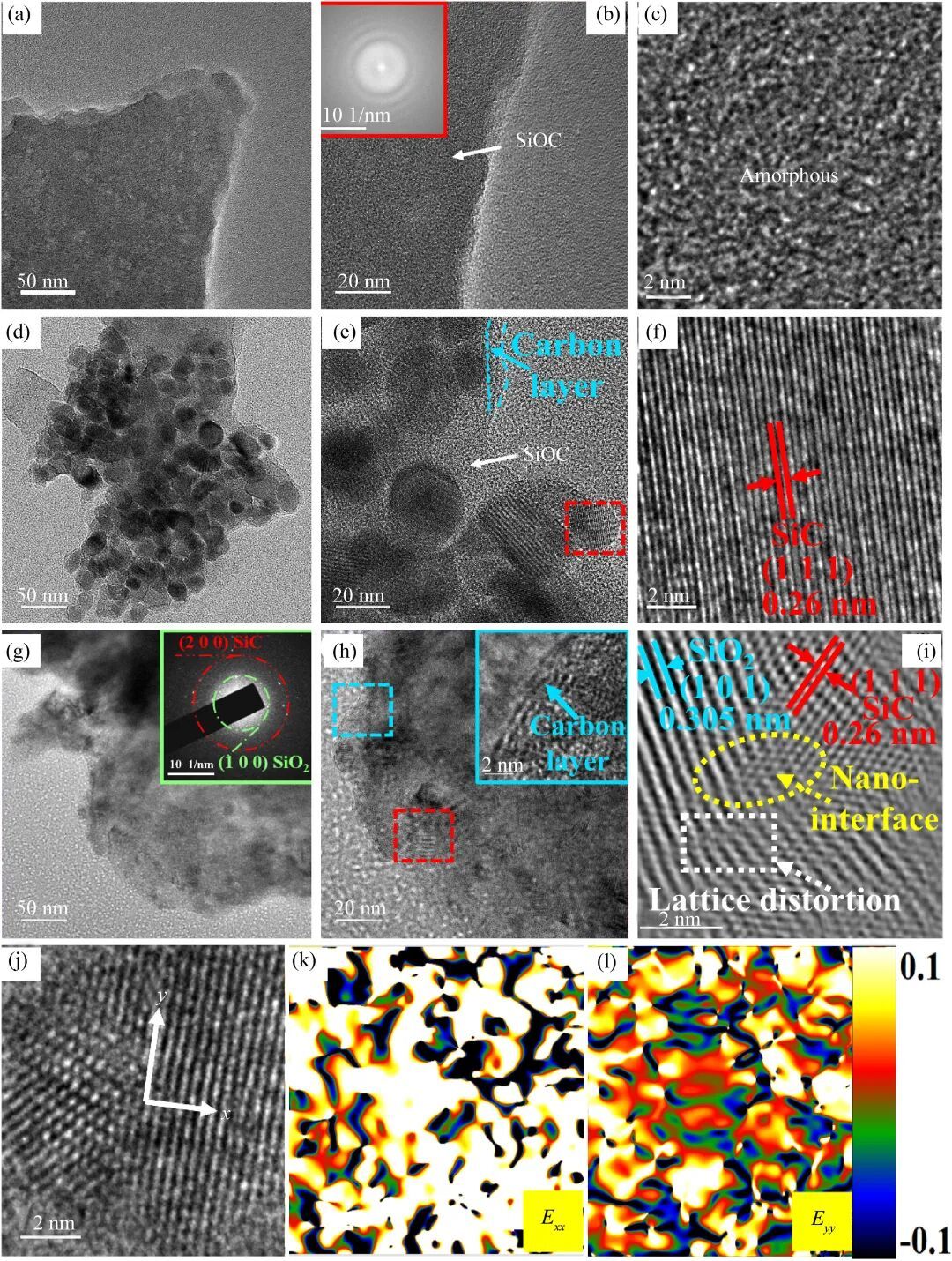
4. High-Performance Broadband Microwave Absorption
Recent experimental studies on gyroid-structured SiOC composites report impressive electromagnetic attenuation performance. Key results include:
-
Minimum reflection loss (RLmin): −62.2 dB at 4.3 mm thickness
-
Effective absorption bandwidth (EAB): up to 8.4–9.82 GHz
-
Coverage of the entire X-band with extension into the Ku-band
These strong absorption characteristics arise from the combined influence of:
-
Dielectric loss within the SiOC matrix
-
Electrical conduction pathways created by free carbon phases
-
Structural resonance and wave interference enabled by the gyroid architecture
In addition to electromagnetic performance, these structures demonstrate excellent mechanical stability. Compressive strengths of approximately 31.6 MPa have been reported, indicating that these materials can function simultaneously as structural and functional components.
5. Why AdventureTech DLP Systems are Ideal for SiOC Gyroid Fabrication
Founded in 2015 by Dr. Pengfei Zhu, a materials scientist trained at the University of Science and Technology of China and former postdoctoral researcher at Tsinghua University, AdventureTech combines advanced materials research with industrial-grade additive manufacturing technologies.
The company has obtained more than 50 patents related to ceramic additive manufacturing and has deployed its systems in numerous universities and research laboratories. AdventureTech provides a complete DLP ceramic printing solution, including hardware, optimized ceramic resins, and controlled thermal processing protocols.
Key advantages of AdventureTech’s systems include:
-
Ultra-efficient material usage, requiring as little as 80 mL resin for experimental builds
-
Peristaltic material feeding and automatic filtration for stable printing of high-viscosity slurries
-
ADT-Slicer 4D software with built-in TPMS support
-
Proven reliability in manufacturing functional ceramics for electronics, aerospace, and electromagnetic applications
These capabilities make AdventureTech’s systems particularly suitable for research and development involving Gyroid structure 3D printing and SiOC ceramic materials.
Unlocking Next-Generation Microwave Absorbing Ceramics
The integration of SiOC polymer-derived ceramics with gyroid metamaterial architectures represents a powerful approach for designing next-generation electromagnetic absorbers. By leveraging high-precision DLP ceramic 3D printing, researchers can translate complex digital designs into functional materials with outstanding performance.
If you are developing high-temperature microwave absorbers, stealth materials, or advanced ceramic metamaterials, AdventureTech’s DLP ceramic printing solutions provide the precision, stability, and materials compatibility required to accelerate innovation.
Learn more about our technology and solutions at https://www.adventure-tech.cn.