
Ceramic 3D Printing for high-temperature ceramic components is increasingly being adopted in research systems, advanced manufacturing lines, and extreme environment testing platforms. In these applications, development engineers and researchers often rely on simulation to design complex geometries, but face a consistent challenge when moving to real fabrication: many of these structures are still difficult to produce using conventional ceramic manufacturing methods such as pressing, casting, or injection molding.
Structures such as internal micro-channels, lattice architectures, and thin-wall thermal components are often simplified during production due to tooling constraints, shrinkage behavior during sintering, and geometric restrictions in molding-based methods.
For research teams and industrial developers, this gap between design intent and manufacturable reality can directly limit experimental accuracy and system performance.
Ceramic 3D Printing provides a different pathway—enabling engineers to fabricate complex ceramic architectures directly from digital models without sacrificing geometric freedom.
We used a ceramic 3D printer, the ADT ceramic-D-L System, to manufacture these samples and study its capabilities in producing high-temperature ceramics.
Alumina Lattice Structure for High-Temperature Joule Heating Systems
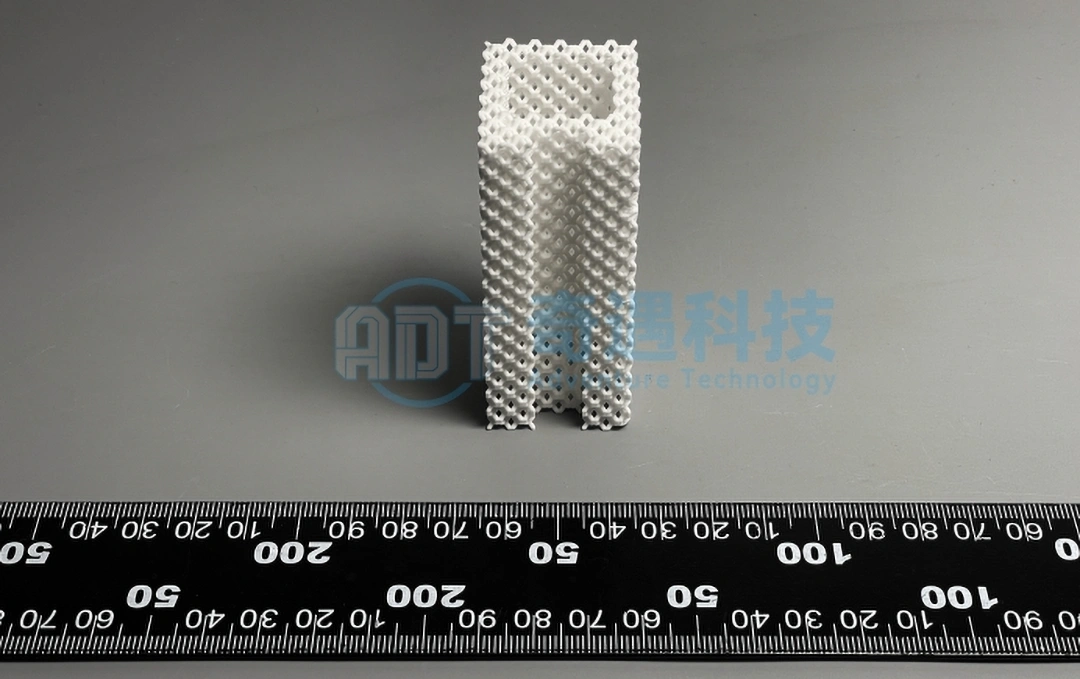
We designed and built this alumina structure using a periodic lattice architecture. The internal architecture reduces weight while maintaining mechanical stability under thermal load.
More importantly, it improves heat distribution and reduces thermal stress during operation.
In real industrial applications, this type of structure is used in:
- Laboratory high-temperature heating platforms, where precise and stable heating zones are required for material testing
- Joule heating systems for rapid thermal processing, where uniform temperature distribution directly affects process accuracy
- Thermal field control equipment in research furnaces, where minimizing heat concentration prevents structural deformation
Compared with solid ceramic blocks, lattice structures increase surface area, which improves heat transfer efficiency and shortens heating response time.
Zirconia Micro-Channel Filter for Molten Metal Purification
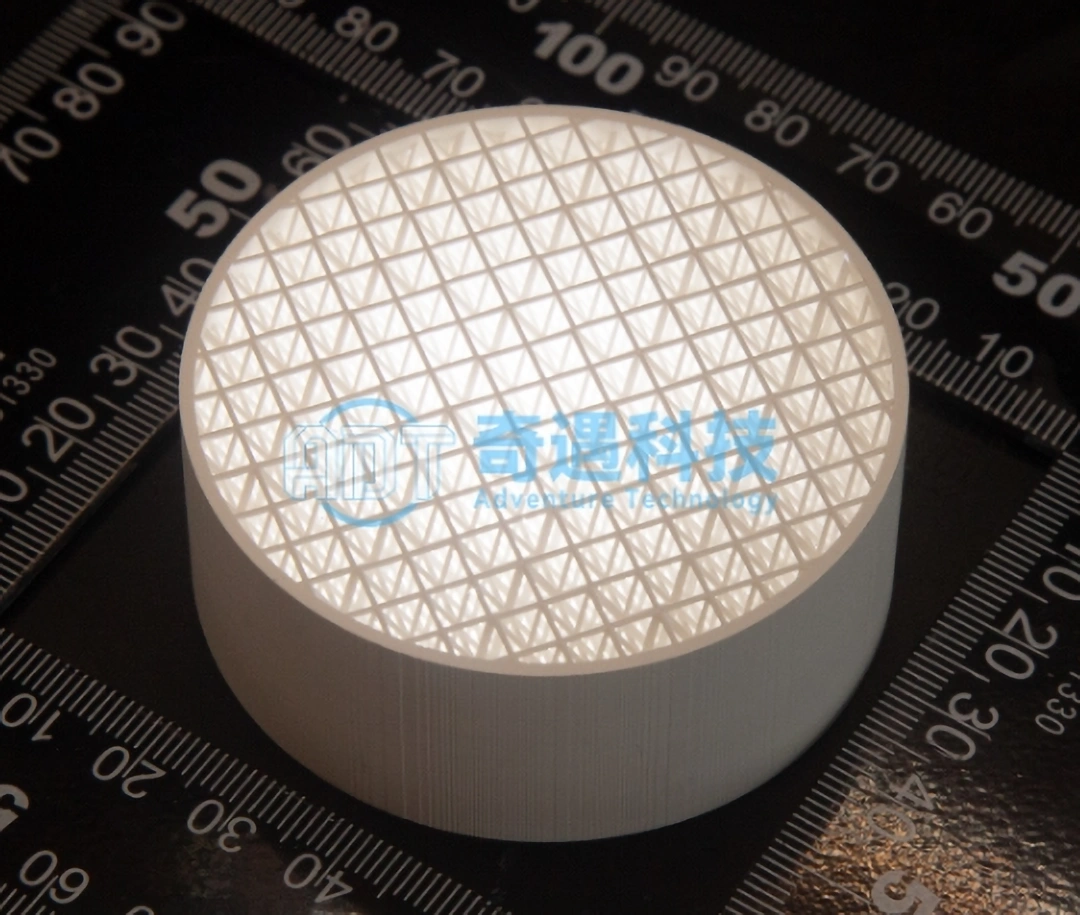
This zirconia filter features a dense network of precisely engineered micro-channels that form a continuous internal flow system.
In real production environments, it is widely used in molten metal filtration systems, especially in high-temperature casting industries.
Typical industrial use cases include:
- Steel casting plants, where the filter is placed in the gating system to remove oxide inclusions and slag before molten steel solidifies
- Aluminum die casting production lines, where it improves melt purity and reduces casting defects such as porosity and surface cracks
- Aerospace precision casting workshops, where cleaner metal flow is required to achieve high fatigue resistance and long-term structural reliability
Because Ceramic 3D Printing allows precise control of pore size and channel geometry, engineers can tune filtration performance according to different molten metal viscosities and process temperatures.
Silicon Carbide Thermal Radiation Plate for High-Temperature Furnaces
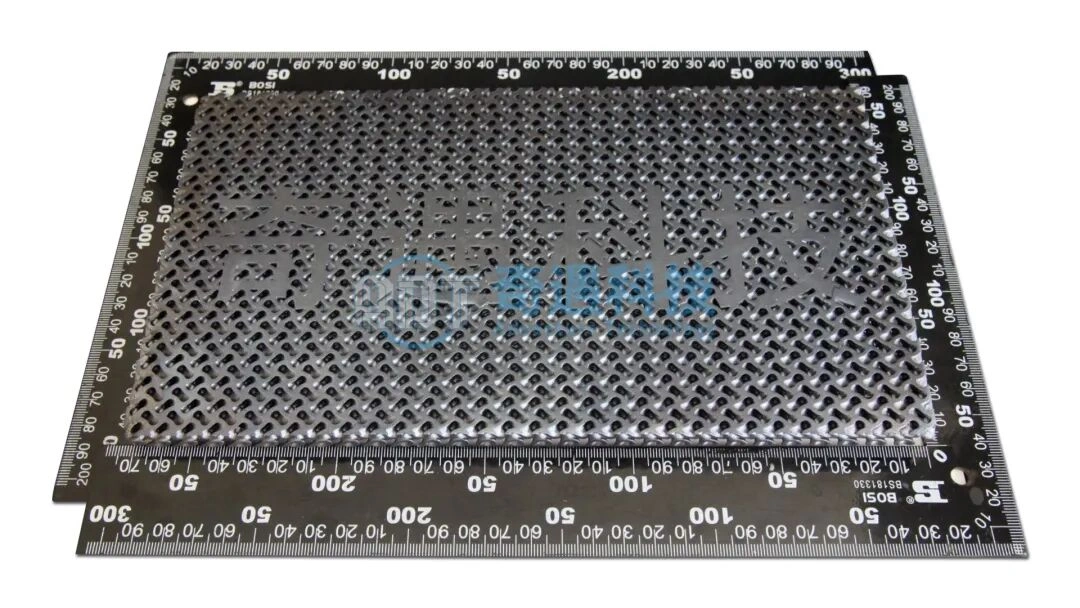
We designed this silicon carbide (SiC) radiation plate as a thin, flat structure with excellent thermal conductivity and stable dimensional behavior under heat.
This component is commonly applied in industrial high-temperature thermal systems where stable heat transfer is critical.
Real-world applications include:
- Industrial sintering furnaces, where uniform heat radiation ensures consistent ceramic or metal part quality
- Semiconductor thermal processing systems, where stable heating directly affects wafer processing accuracy
- High-temperature heat treatment lines, where maintaining flatness at elevated temperatures prevents process deviation
Compared with traditional ceramic plates, SiC printed structures provide faster thermal response and improved energy efficiency in continuous heating cycles.
Silicon Nitride Impeller for High-Speed and High-Temperature Systems
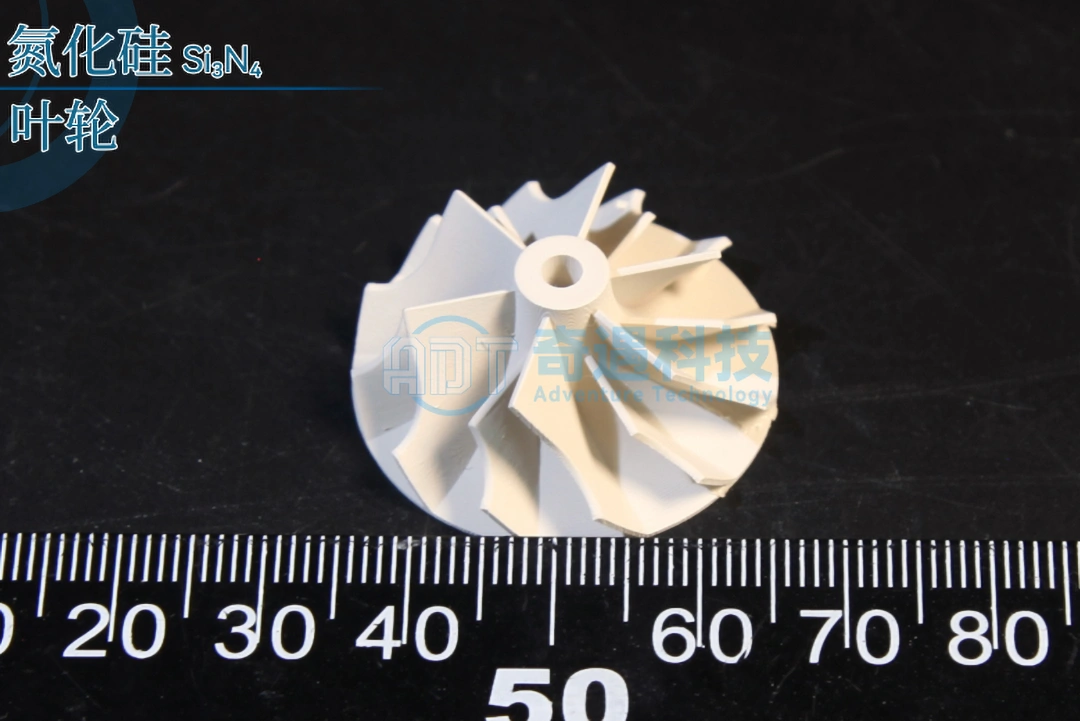
We manufactured this silicon nitride impeller as a fully integrated structure. Internal spiral flow channels and lightweight lattice regions can be designed directly into the component.
In real engineering systems, it is used in:
- High-speed industrial compressors, where reduced rotational inertia improves response speed and energy efficiency
- Aerospace propulsion systems, where lightweight and high-temperature resistance are critical for performance stability
- Advanced energy equipment, such as gas circulation and high-temperature fluid transport systems
Compared to metal impellers, silicon nitride offers lower density, excellent thermal resistance, and strong resistance to oxidation, making it suitable for long-term operation in harsh environments.
Conclusion: Ceramic 3D Printing as a Functional Engineering Tool
Ceramic 3D Printing is no longer just a manufacturing method. It has become a design approach that integrates structure, thermal behavior, and mechanical performance into one system.
From steel melt filtration to industrial furnace components, from laboratory heating systems to aerospace rotating parts, Ceramic 3D Printing enables engineers to directly design for real operating environments.
As the technology continues to develop, high-temperature ceramic components will move toward:
- More complex functional integration
- Lighter and more efficient structures
- Higher performance under extreme thermal and mechanical loads
Ceramic 3D Printing is not just changing how ceramics are made—it is changing how engineers think about designing for extreme environments.