
The charged carrier has unique advantages as an internal heat source for chemical energy conversion processes, however, the current Joule heating catalyst carrier is limited due to the lack of flexibility in design and preparation. Recently, Professor Wen Xiewen of Hong Kong Polytechnic University and Professor Zhou Wei of Xiamen University led a team to publish a research titled "3D Printing of Carbon/Ceramic Conductive Composites as Joule‐heating Catalyst Support for Hydrogen Production" in "Additive Manufacturing". They used DLP 3D Printing technology and carbonization process prepared porous carbon/ceramic composite structures with three-dimensional conductive networks as carriers, and the process parameters affecting the formation of these conductive networks and their electrical properties were systematically analyzed, and the electrical thermal performance of these carriers was evaluated.
Research content
Original link: https://doi.org/10.1016/j.addma.2025.104644
Adventure Technology official website: https://www.adventuretech.cn
If it cannot be opened, please copy the URL to the browser to check it.
This study introduces the design principles and methods for preparing carbon/ceramic conductive composite materials based on 3D printing technology. The author selected carbon materials (such as graphene, carbon nanotubes) and ceramic materials (such as alumina, silicon nitride) as substrates to combine them with different ratios to ensure that the material has excellent stability in a high-temperature electrothermal catalytic environment and Highly efficient conductivity. By regulating the composition and structure of the composite material, its performance during Joule heating is optimized.
Experimental results show that composite materials have the ability to significantly improve the efficiency of hydrogen generation and can work stably for a long time under high temperature conditions. The research also discusses the advantages of 3D printing technology in the preparation of composite materials, especially its ability to precise control of complex structures.
The following are the research methods and data of the article:
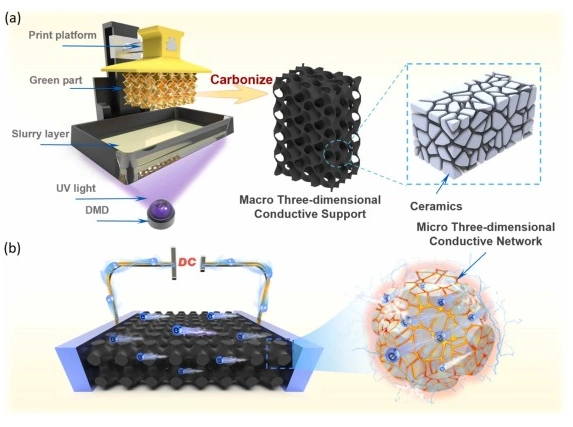
△Figure 1, (a) Schematic diagram of the preparation of macroscopic three-dimensional conductive support and microscopic three-dimensional conductive network; (b) Joule heating mechanism in three-dimensional conductive support.
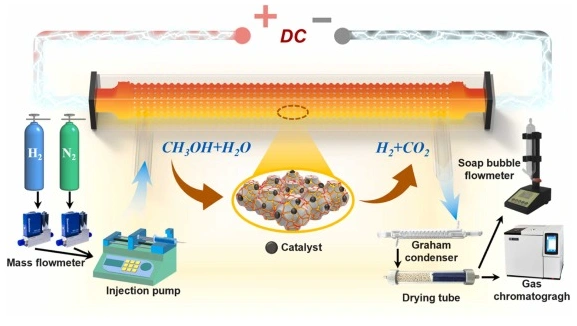
△Figure 2, Schematic diagram of MSR microchannel reactor and test system.
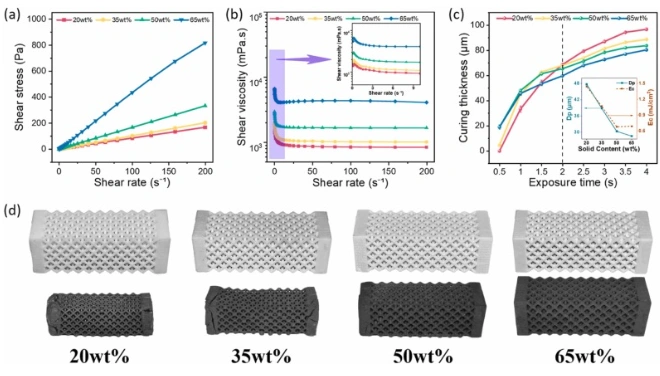
△Figure. 3, the shear stress in ceramic slurries with different solid content levels changes with shear rate; (b) the shear viscosity of ceramic slurries with shear rate changes within different solid content ranges; (c) different solids The curing thickness of the ceramic slurry content varies under different exposure times. The illustration shows the correlation between critical exposure energy and penetration depth at each solid content level; (d) morphological evolution of green body before and after pyrolysis at different solid phase ratios.
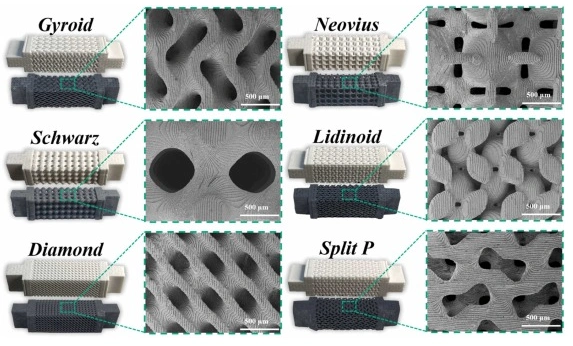
△Figure. 4. Six TPMS structures with a porosity of 60% (see Fig. S3) were printed using a slurry containing 50 wt% ceramic content. This figure includes a macro view and a carbonized SEM image.
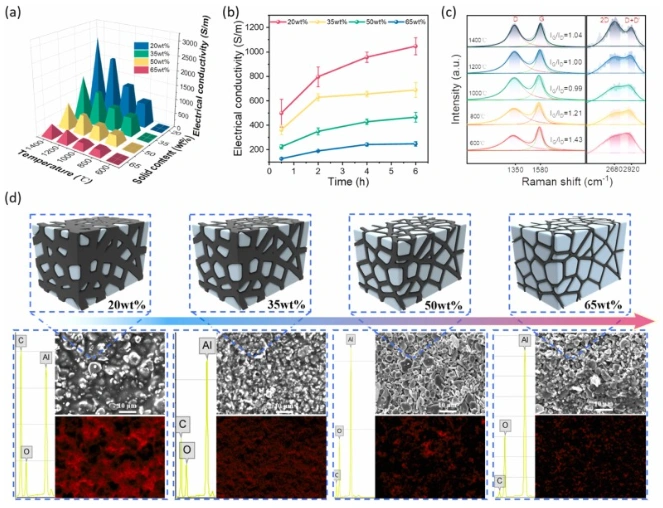
△Figure 5. (a) Conductivity changes of samples with different ceramic contents at constant temperature between 600°C and 1400°C for 2 hours; (b) Different ceramic contents with increasing insulation time at 800°C Changes in the conductivity of the sample; (c) Raman spectrum of the sample with a ceramic content of 50 wt% at different temperatures; (d) SEM/EDS images and three-dimensional conductive network diagrams of samples with a ceramic content processed at 1000°C .
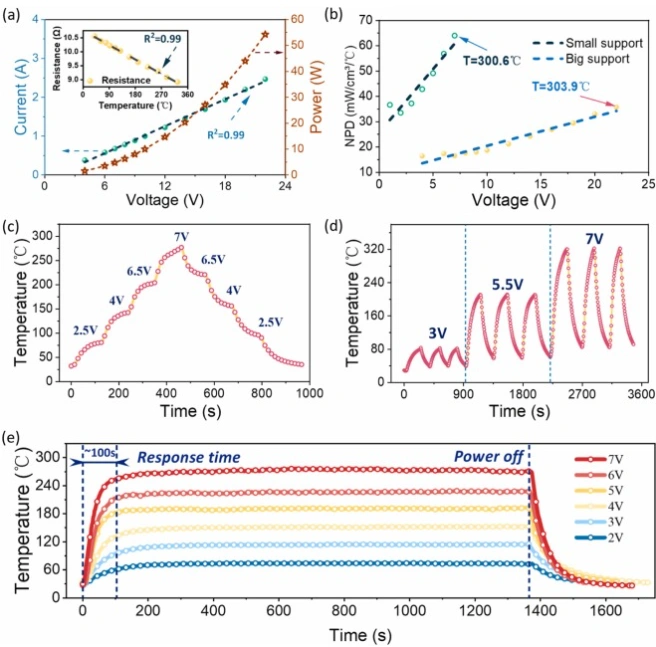
△Figure.6, (a) Current characteristic curve of the conductive bracket; (b) Normalized power density curve of two different volume brackets; (c) Temperature change of the bracket under gradient voltage; (d) 3 V, 5.5 V, Temperature switch response of the bracket at 7 V; (e) Electric thermal stability of the bracket at different driving voltages.
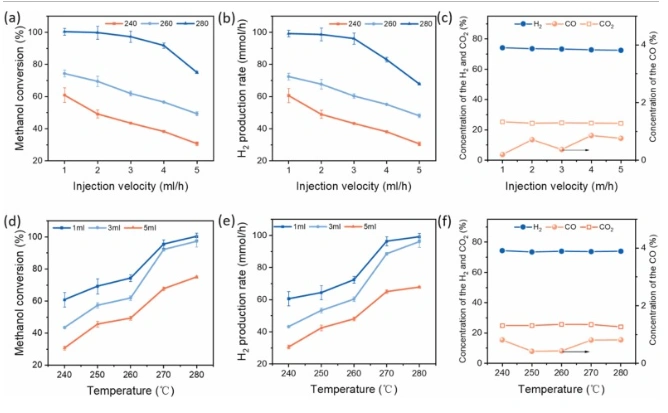
△Figure 7, (a) The change of methanol conversion rate with carrier temperature at different injection speeds during Joule heating; (b) The change trend of H2 generation rate with carrier temperature at different injection speeds during Joule heating; (c) Joule Changes in gas concentration caused by different injection speeds during heating; (d) The methanol conversion rate changes with carrier temperature at different reaction temperatures during Joule heating; (e) The H2 generation rate with carrier temperature at different reaction temperatures during Joule heating (f) Changes in gas concentration caused by changes in reaction temperature during Joule heating.
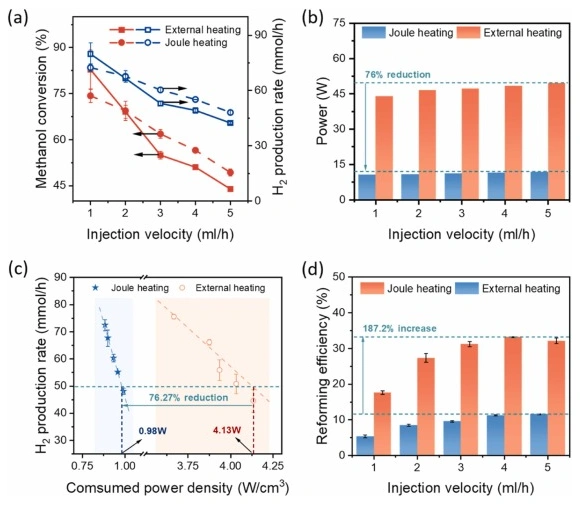
△Figure 8, (a) Methanol conversion and H₂ yield at different injection speeds of Joule heating and external heating at 260°C; (b) Power consumption of Joule heating and external heating to maintain support temperature; (c) Joule heating and external heating The trend of H₂ yield with consumption power density under heating; (d) Reforming efficiency at different injection speeds under two heating modes.
in conclusion
This study used DLP ceramic 3D printing technology to prepare a porous carbon/ceramic composite structure with a three-dimensional conductive network. The experimental results show that the carrier has good electrothermal stability, the start-stop response time is less than 100 s at around 300 °C, and its heating performance remains consistent after multiple cycles. Its hydrogen production performance was tested in a methanol steam reforming (MSR) microchannel reactor, with a maximum methanol conversion rate of 98%, and a hydrogen yield of 101 mmol/h. Compared with the traditional external heating method, the power consumption density is reduced by 76.3%, and the reforming efficiency is improved by 187.2%.
This study provides a customizable preparation method for complex Joule heating catalyst carriers, providing a new strategy for low-power hydrogen production in microstructure reactors.