
Industry Insights
Recently, the team of Mona Yarahmadi and Gemma Fargas from the Polytechnic University of Catalonia published a study titled 'Optimizing rheological characterization for extrusion-based additive manufacturing of Zirconia ceramic inks with varied Yttria content stabilization' in the Journal of the European Ceramic Society, exploringZirconia ceramic inks stabilized with different Yttria (Y₂O₃) content.The optimization of the rheological properties of ceramic inks during direct-write 3D printing.
Original link: https://doi.org/10.1016/j.jeurceramsoc.2024.116797
Adventure Technology official website: http://www.adventuretech.cn/
If you cannot open it, please copy the URL to your browser to view.
Research Content
Zirconia (ZrO₂) ceramics are widely used in fields such as dental restoration due to their excellent mechanical properties (such as high bending strength and fracture toughness). However, traditional 3Y-TZP (3 mol.% Y₂O₃ stabilized tetragonal zirconia polycrystals) still has significant shortcomings in optical properties (such as translucency). To improve its performance, second-generation (Zpex, reduced Al₂O₃ content) and third-generation (Zpex-smile, increased cubic phase content) transparent zirconia materials have been developed. The main goal of this paper is to optimize the printability of ceramic inks in direct ink writing (DIW) by analyzing their rheological behavior and to explore their impact on the microstructure and mechanical properties of 3D printed parts.
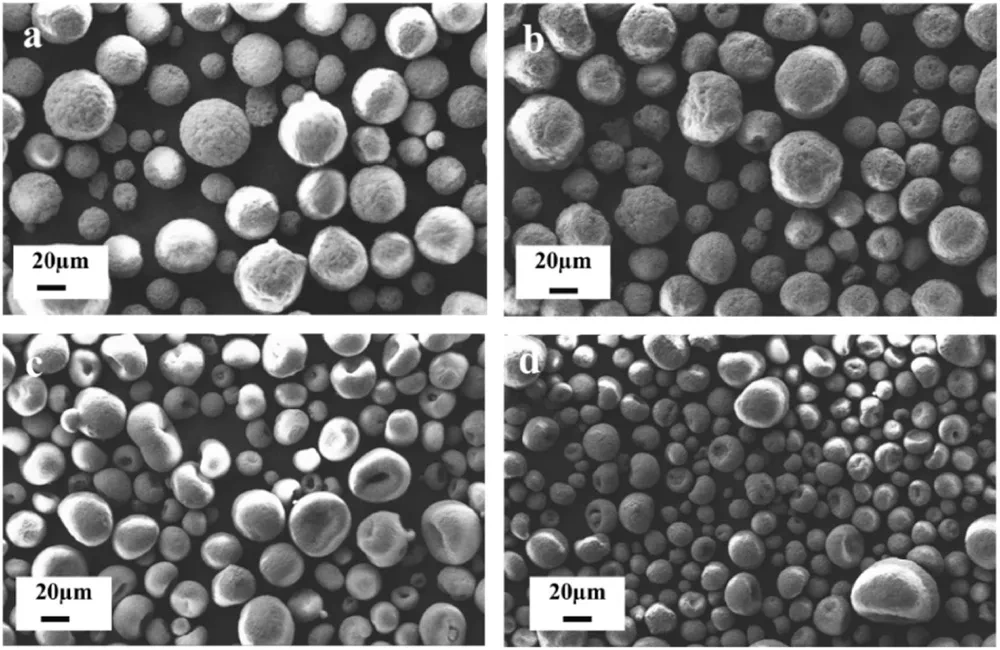
△Figure 1, SEM micrographs of ZrO2 powders: a) TZ-3YSB, b) Zpex, c) Zpex-4, and d) Zpex-smile.
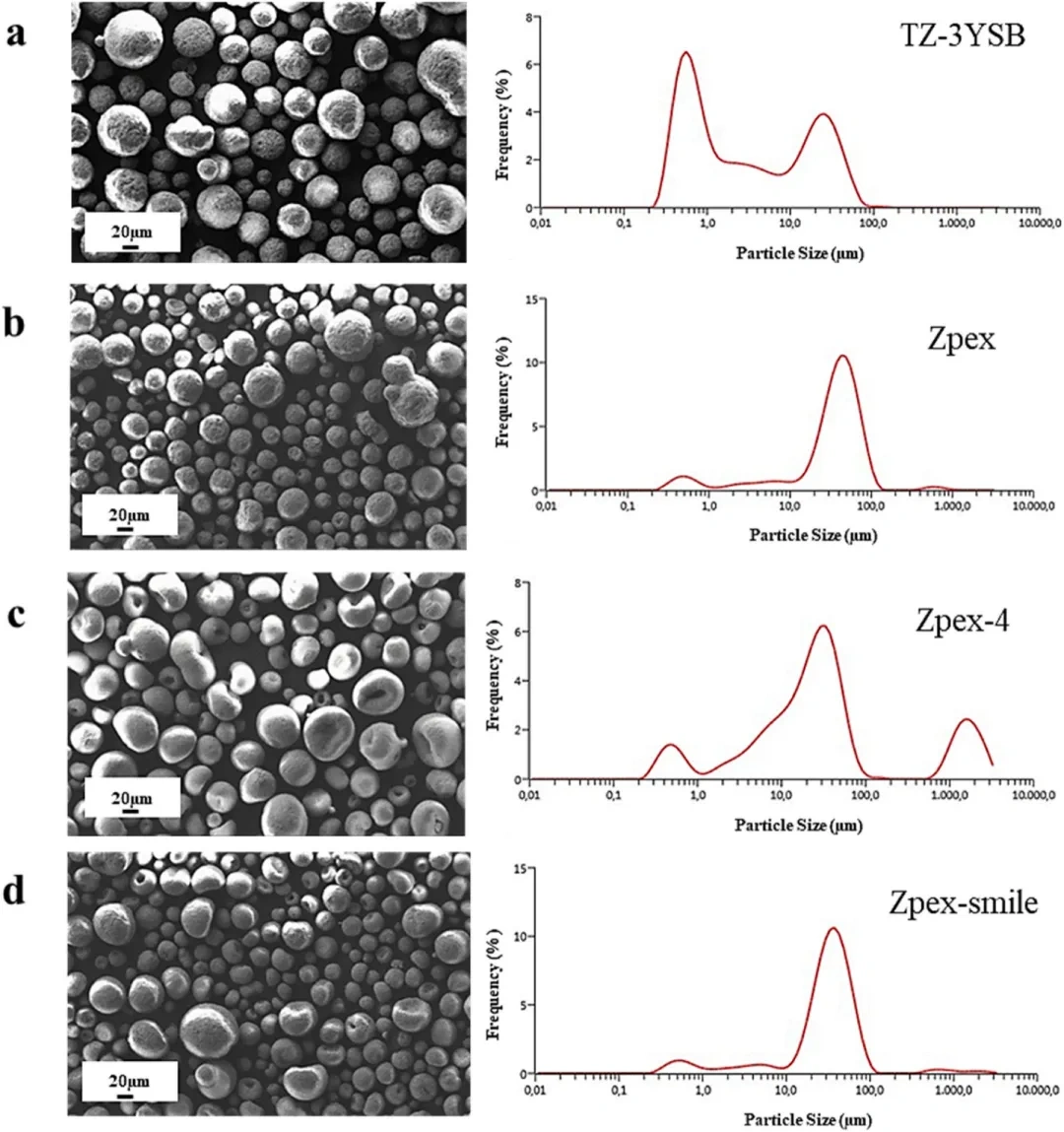
△Figure 2, SEM micrographs of the studied raw materials (left) and particle size distribution (right): a) TZ-3YSB, b) Zpex, c) Zpex-4, and d) Zpex-smile.
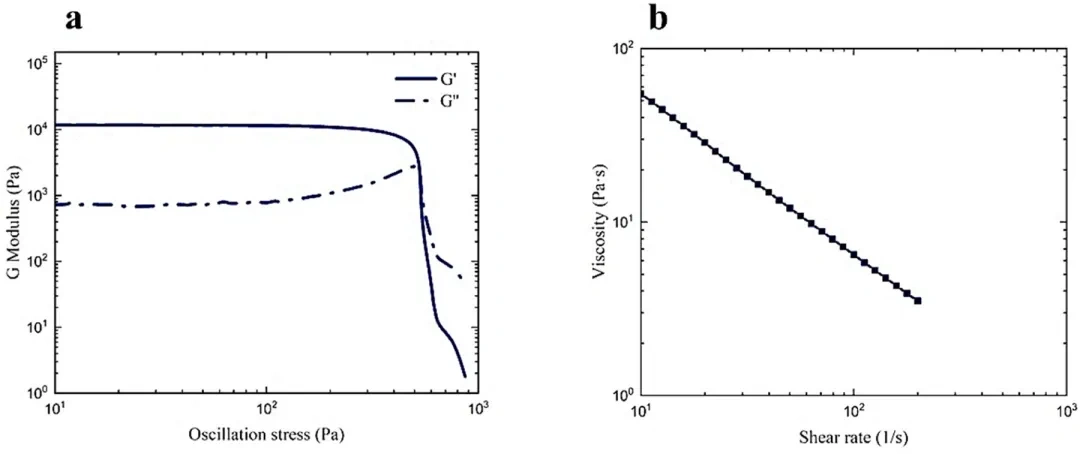
△Figure 3, rheological properties of the gelling agent represented in a log-log format: a) relationship between shear modulus and oscillatory stress, and b) relationship between viscosity and shear rate.
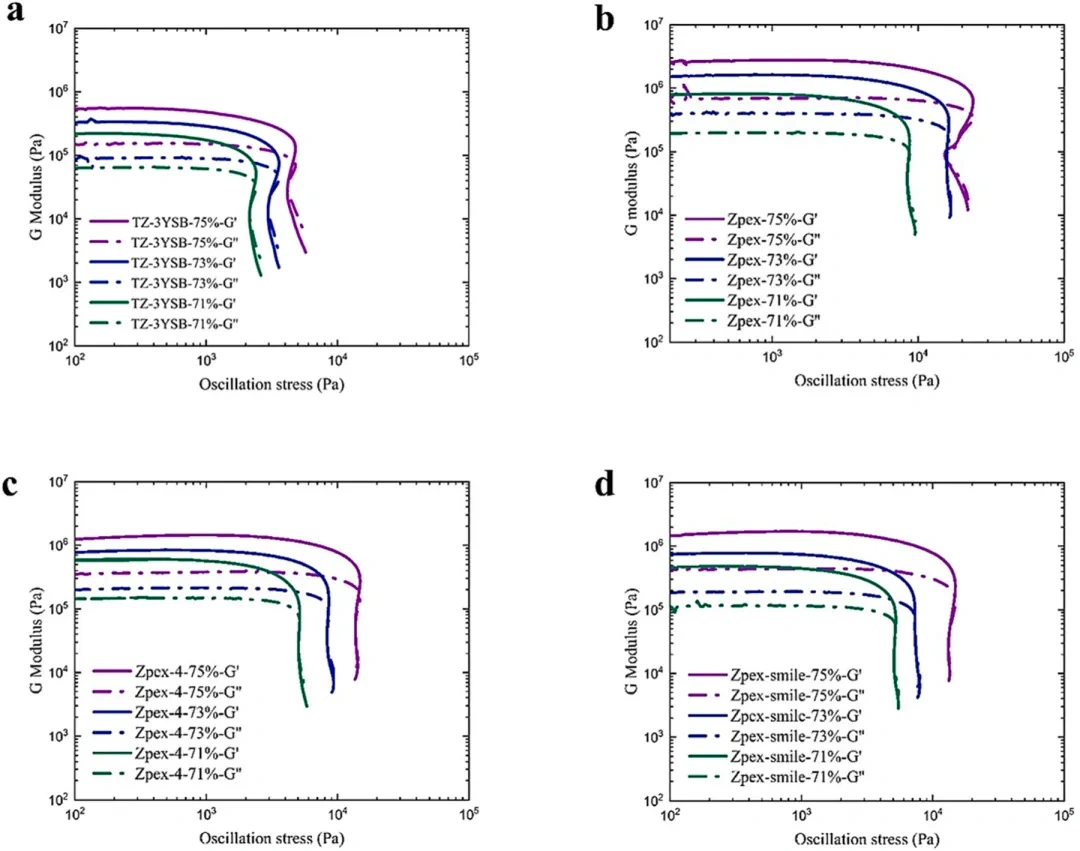
△Figure 4, amplitude sweep tests on different ceramic inks at a frequency of 1 Hz, testing contents are a) TZ-3YSB, b) Zpex, c) Zpex-4, and d) Zpex-smile.
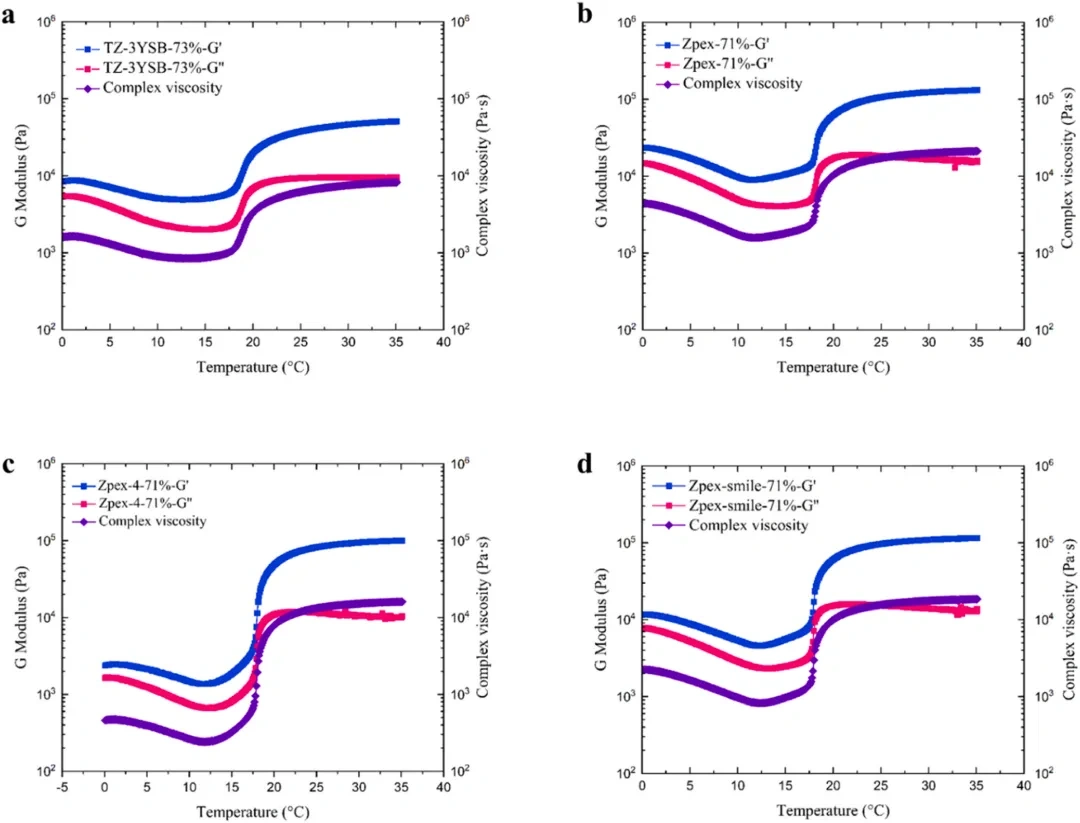
△Figure 5, temperature ramp treatment of the optimized ZrO2-based ceramic materials studied in this paper, with a) TZ-3YSB, b) Zpex, c) Zpex-4, and d) Zpex-smile, where the temperature is ramped down from 35 to 0°C at a rate of 1°C/min, using a 20 mm rough parallel plate geometry with a gap of 500 μm, equipped with a solvent collector.
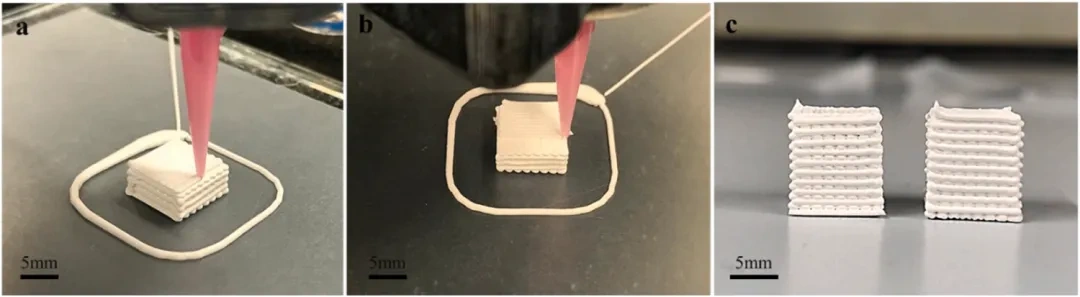
△Figure 6, side and top views of ZrO2 green bodies printed using extrusion-based additive manufacturing technology.
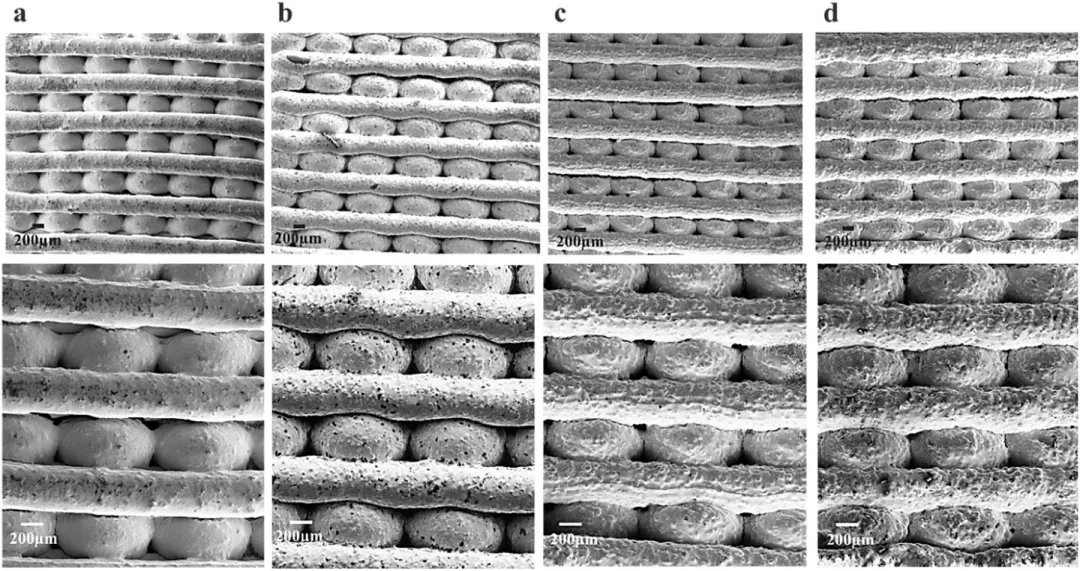
△Figure 7, SEM micrographs of the sintered green bodies: a) TZ-3YSB, b) Zpex, c) Zpex-4, and d) Zpex-smile.
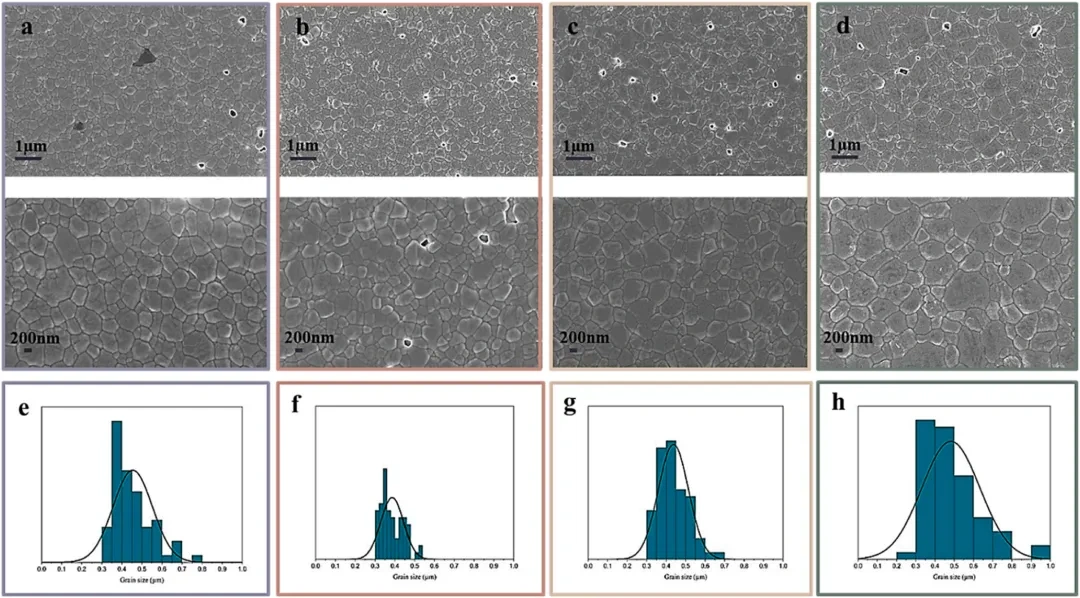
△Figure 8, SEM micrographs of the sintered 3D printed ZrO2 microstructure (a and e): TZ-3YSB, (b and f): Zpex, (c and g): Zpex-4, (d and h): Zpex-smile, and (e to h) grain size histogram distribution.
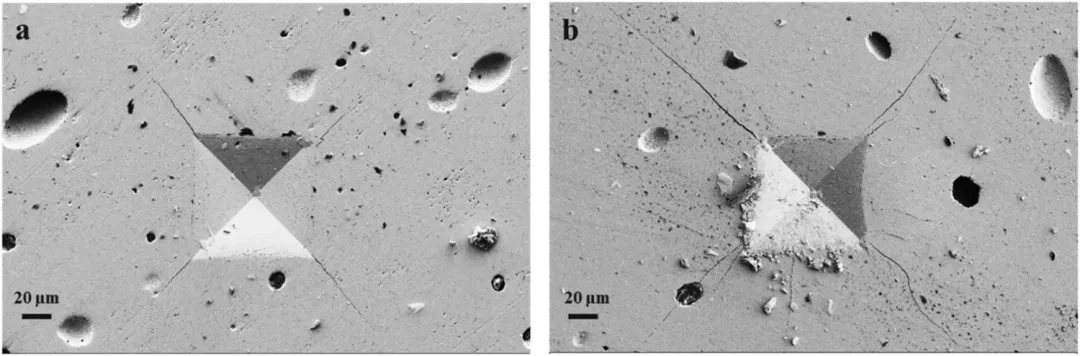
△Figure 9, scanning electron microscope images of residual Vickers indentation on 3D printed zirconia samples under loading control mode at 10 kgf: a) TZ-3YSB and b) Zpex-smile.
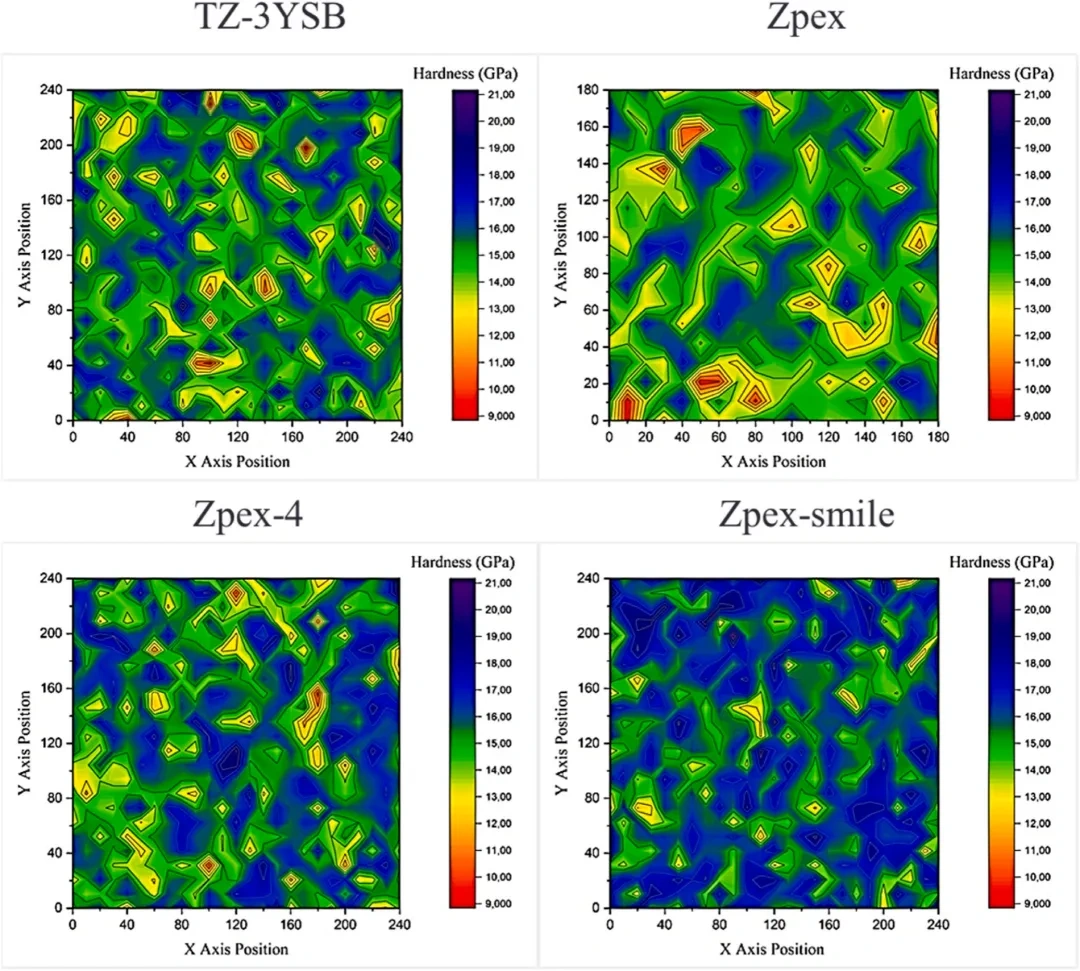
△Figure 10, H plots of 3D printed ZrO2 samples: TZ-3YSB, Zpex, Zpex-4, and Zpex-smile.
Conclusion
This study explores the rheological properties of zirconia (ZrO₂) ceramic inks with different Yttria (Y₂O₃) content, focusing on their performance in additive manufacturing. The main conclusions are as follows:
Particle composition and distribution affect rheological performance.
The feed components and particle size distribution significantly affect the rheology and processing characteristics of the inks. Particles with a larger specific surface area require higher shear stress to flow. All inks exhibit shear-thinning behavior, which is due to the rearrangement and orientation of particles under shear. This behavior significantly increases flow resistance at low shear rates, especially in the Zpex series (Zpex, Zpex-4, and Zpex-smile).
Optimal ceramic content and flow behavior.
Rheological characterization indicates that the optimal ceramic content for TZ-3YSB is 73 wt%, while for the Zpex series it is 71 wt%. These inks exhibit pseudoplastic behavior, conforming to the Herschel-Bulkley model, and their shear-thinning characteristics facilitate printing through small nozzles under low pressure conditions.
Rapid recovery performance and thermal sensitivity.
The 3ITT curves show that the G′ (storage modulus) recovery capability of the Zpex series is superior to that of TZ-3YSB, with Zpex-smile achieving a recovery rate of 25%. The thermal sensitivity of the inks indicates their relation to Pluronic® gel behavior, with a gelation temperature of about 17.5°C being crucial for ensuring printing stability.
Performance of printed parts.
Higher cubic phase content in Zpex-4 and Zpex-smile increases Vickers hardness, but their fracture toughness is lower than that of TZ-3YSB. The hardness and elastic modulus at the submicron scale indicate that defects such as porosity introduced during printing have a minimal impact on the deformation field.
This study provides a systematic optimization method for the rheological properties of ceramic inks, laying the foundation for the design and industrial application of high-performance 3D printed ceramics (such as dental restorations). However, materials with high cubic phase content still require further exploration in balancing toughness and mechanical properties to better meet practical usage needs.