
Industry Insights
Recently, the Meihui team from Northwestern Polytechnical University published a study titled 'Structure designable Al-doped SiOC polymer-derived ceramic for efficient pressure and high-temperature difunctional detection' in the Journal of the European Ceramic Society, exploring the design and application of aluminum-doped silicon oxycarbide (Al-doped SiOC) polymer-derived ceramic materials, particularly their potential as multifunctional sensors in high-temperature and high-pressure environments.
Original link: https://doi.org/10.1016/j.jeurceramsoc.2024.116923
Adventure Technology official website: http://www.adventuretech.cn/
If you cannot open it, please copy the URL to your browser to view.
Research Content
In manyhigh-temperature and high-pressure environmentsmonitoring physical quantities such as pressure and temperature requireshigh-performance sensors.However, traditional pressure and temperature sensors often perform poorly under extreme conditions, facing challenges such ashigh temperatures, high pressures, and corrosion.Therefore, developing sensor materials that can work efficiently under these extreme environments is particularly important.Silicon oxycarbide (SiOC) materialsas a new type of high-performance ceramic, have
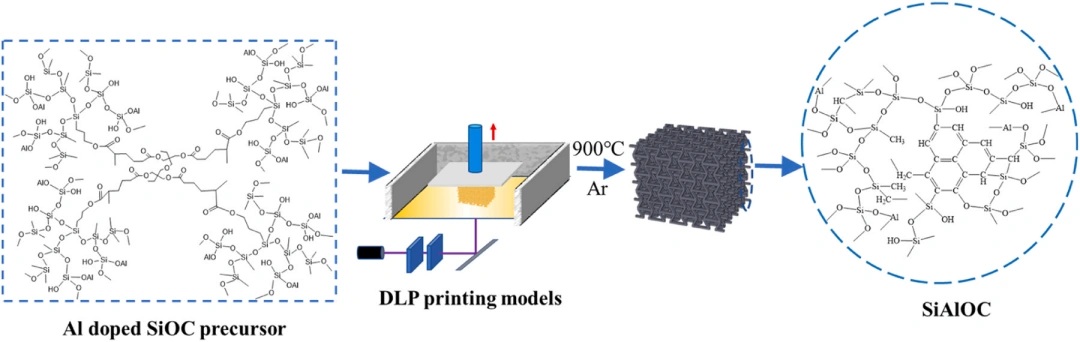
excellent thermal stability, corrosion resistance, and mechanical strength,showing great potential for application in high-temperature and high-pressure environments. However, the performance of SiOC under these extreme conditions may not meet practical needs. Therefore,doping and structural designbecome key to improving its performance. The goal of this study is to develop a high-performance sensor material that canrespond simultaneously to pressure and temperature changes,to meet the detection needs underextreme conditions.This study synthesized aluminum-doped SiOC ceramic materials (SiAlOC) usingpolymer-derived ceramics (PDC) method.Aluminum doping significantly improved the material's
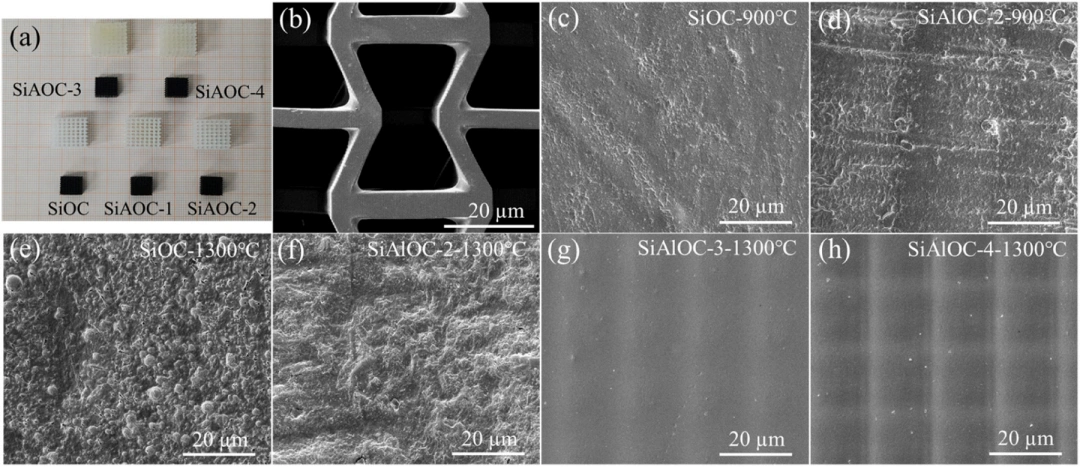
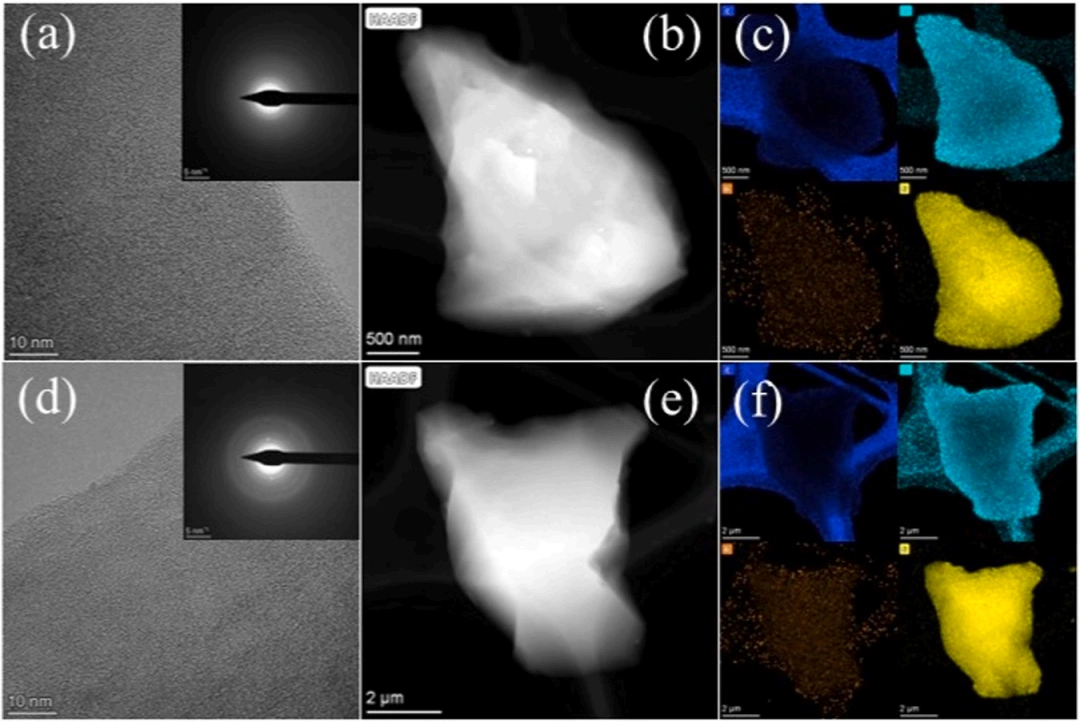
electrical conductivity, thermal stability,andmechanical strength,thereby enhancing its reliability under high temperatures and high pressures. More importantly, the research team useddigital light processing technology (DLP) to precisely control themicrostructure of SiOC ceramics,includingporosity and surface morphology.Through this structural optimization, the material'spressure and temperature response capabilitieswere significantly enhanced, allowing it to operate stably in complex environments.The following are the research methods and data from the article:△Figure 1, Schematic diagram of the molecular structure of SiAlOC precursor solution, DLP printing process, and performance measurement.△Figure 2, (a) Printed MK samples and their corresponding sintered samples; (b) Enlarged basic unit of the inverse honeycomb structure; (c, d) Morphology of SiOC and SiAlOC-2 after 900℃ annealing; (e, f) Surface morphology of SiOC and SiAlOC-2 after 1300℃ sintering; (g, h) Scanning electron microscope (SEM) images of SiAlOC-3 and SiAlOC-4 after 1300℃ treatment.△Figure 3, (a, d) Electron diffraction and high-resolution transmission electron microscope (TEM) images of SiOC and SiAlOC-2; (b, e) Micro morphology of SiOC and SiAlOC-2; (c, f) Element distribution of SiOC and SiAlOC-2.△Figure 4, (a) Resistance and conductivity of different samples; (b, c) XRD and FT-IR spectra of five types of ceramics.△Figure 5, (a) XPS full spectrum of SiOC and four aluminum-doped samples; (b) XPS characterization of aluminum elements in five types of ceramics; (c) Valence band measurement of SiOC and SiAlOC-2 samples; (d-f) XPS spectra and fitting results of Si, O, and C elements.
△Figure 6, (a-f) Comprehensive Raman spectra of five ceramic samples and their fitting results.
△Figure 7, (a, b) Piezo-resistive and strain coefficient (GF) of SiOC, SiAlOC-1 to SiAlOC-4 with inverse honeycomb structure; (c, d) Stress-strain curves of five types of ceramics and mechanical simulation of the inverse honeycomb structure under pressure; (e) Resistance change of SiAlOC-2 during 300 loading-unloading cycles.
△Figure 8, (a, b) Typical unloading-loading cycle response time graphs of SiAlOC-2 and SiOC samples under 800 N load.
△Figure 9, (a) Loading-unloading cycle and remaining time of SiAlOC-2 under 350 N load; (b) Typical loading-unloading cycle graph of SiAlOC-2 under 350 N load; (c) Response time of SiAlOC-2 sample when a rapid force of 350 N is applied; (d) Response time of SiAlOC-2 sample when the 350 N force is instantly removed.
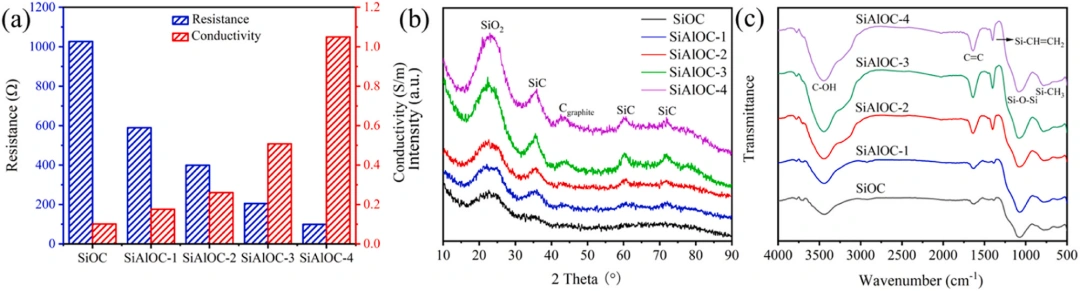
△图4,(a) 不同样品的电阻和电导率;(b, c) 五种陶瓷的XRD和FT-IR谱图。
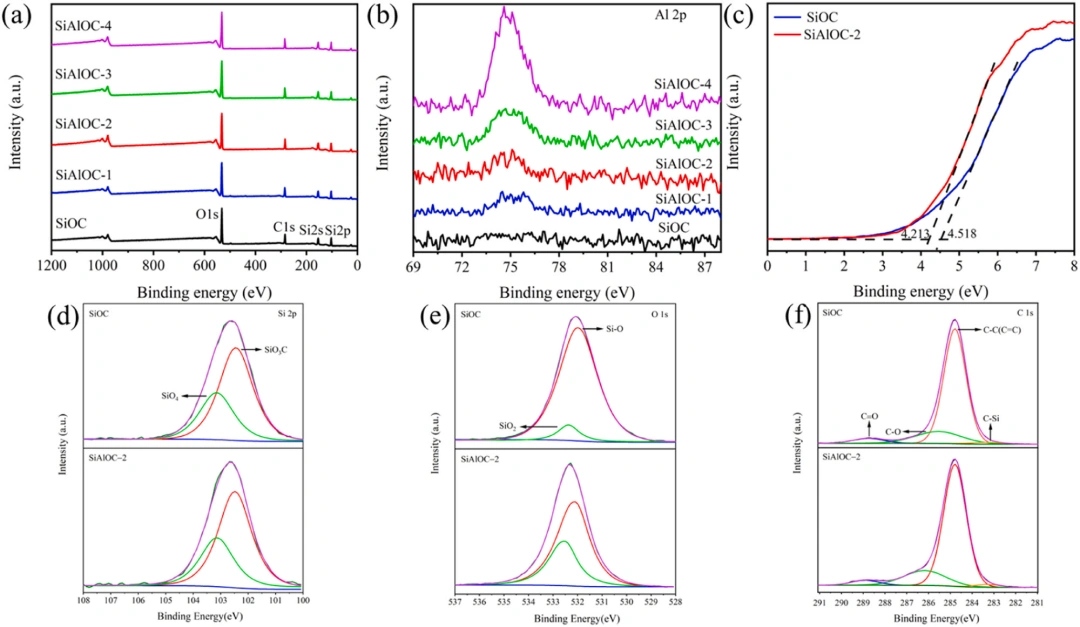
△图5,(a) SiOC和四种铝掺杂样品的XPS全谱;(b) 五种陶瓷中铝元素的XPS表征;(c) SiOC和SiAlOC-2样品的价带测量;(d-f) Si、O和C元素的XPS谱图及拟合结果。
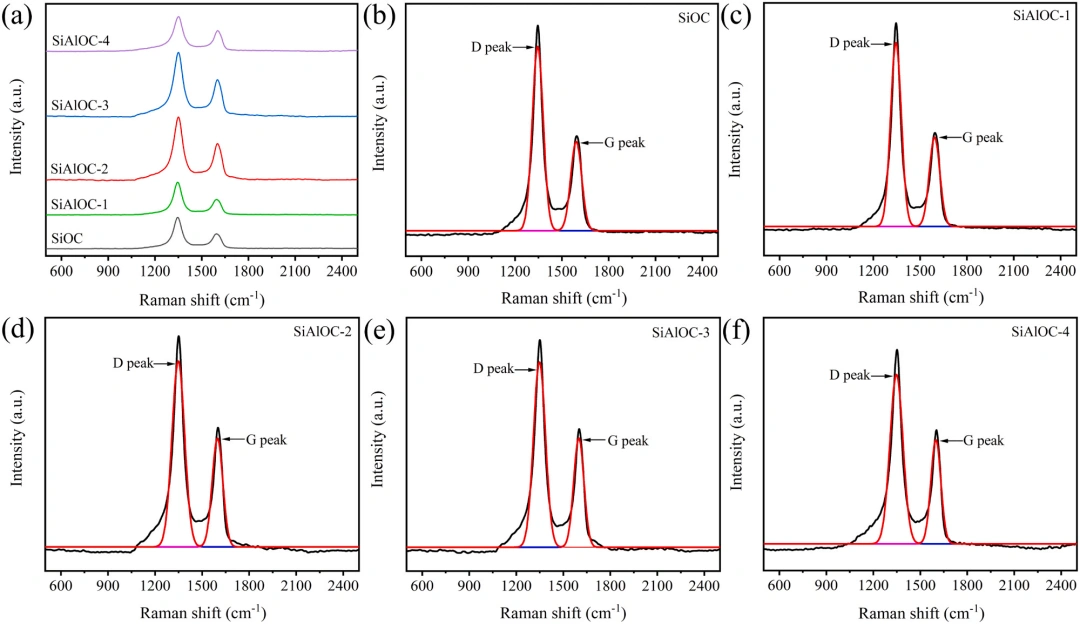
△图6,(a-f) 五种陶瓷样品的综合拉曼光谱及其拟合结果。
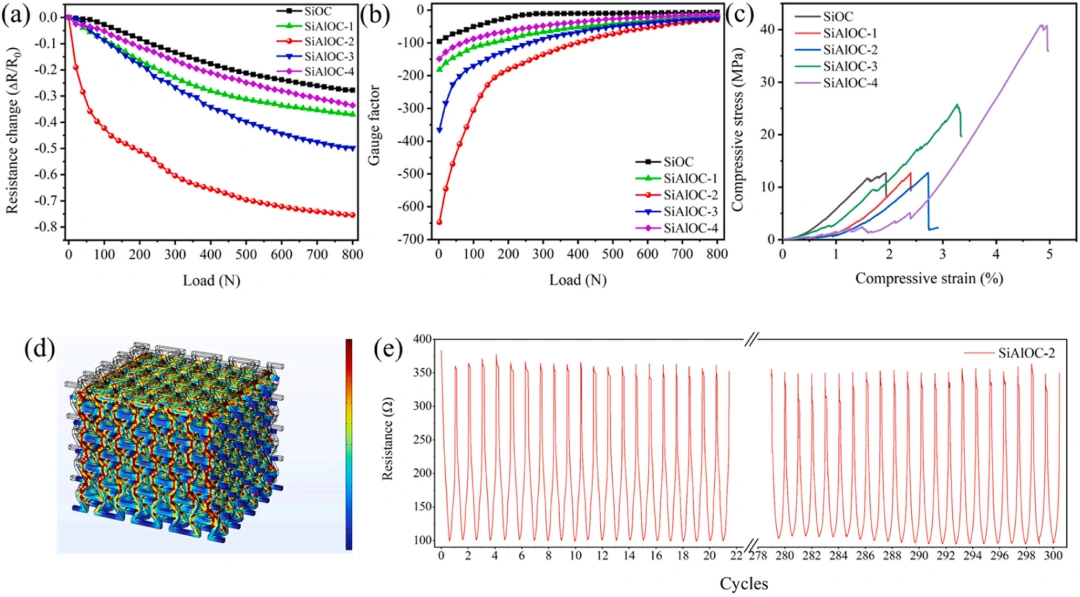
△图7,(a, b) 反向蜂窝结构的SiOC、SiAlOC-1到SiAlOC-4的压电电阻性和应变系数(GF);(c, d) 五种陶瓷的应力-应变曲线以及反向蜂窝结构在压力下的力学模拟;(e) SiAlOC-2在300次加载-卸载循环过程中的电阻变化。
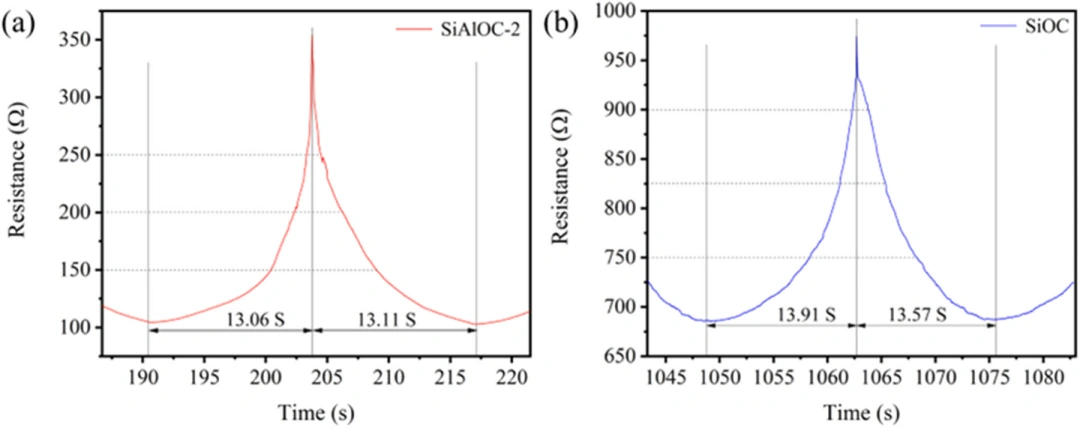
△图8,(a, b) SiAlOC-2和SiOC样品在800 N负载下典型的卸载-加载循环的响应时间图。
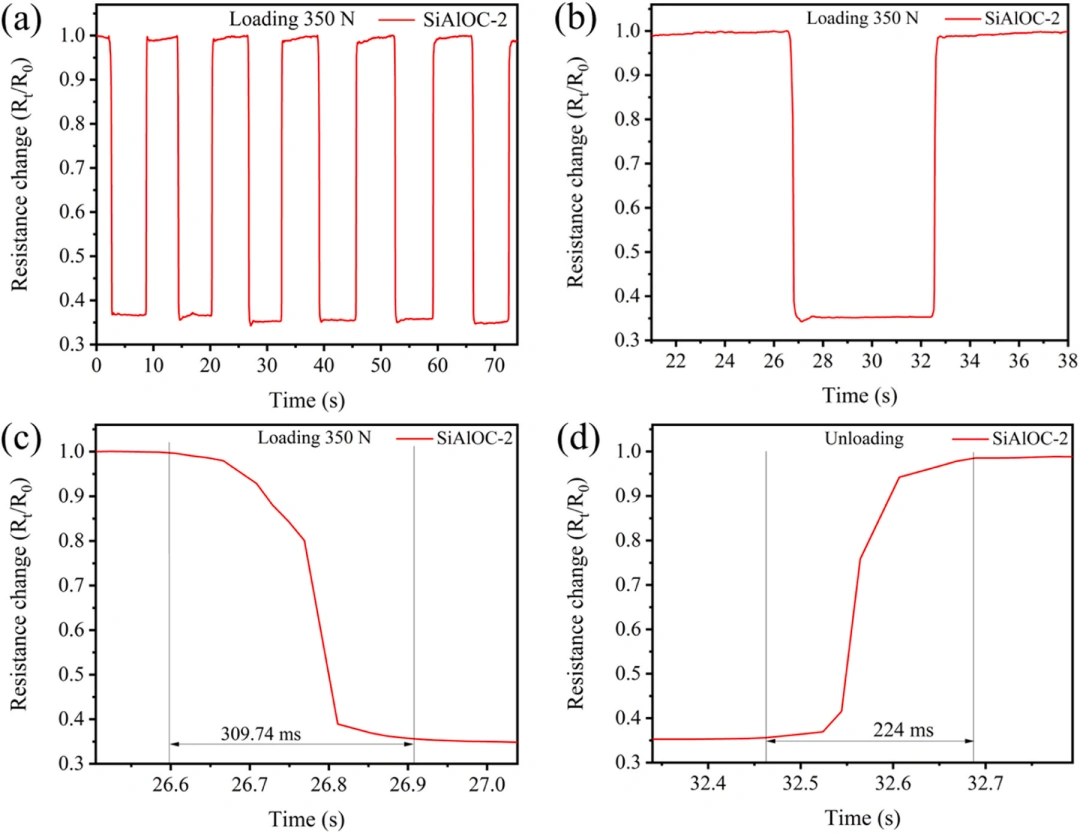
△图9,(a) SiAlOC-2在350 N负载下的加载-卸载循环及剩余时间;(b) SiAlOC-2在350 N负载下的典型加载-卸载循环图;(c) SiAlOC-2样品在快速施加350 N力时的响应时间;(d) SiAlOC-2样品在350 N力瞬间取消时的反应时间。
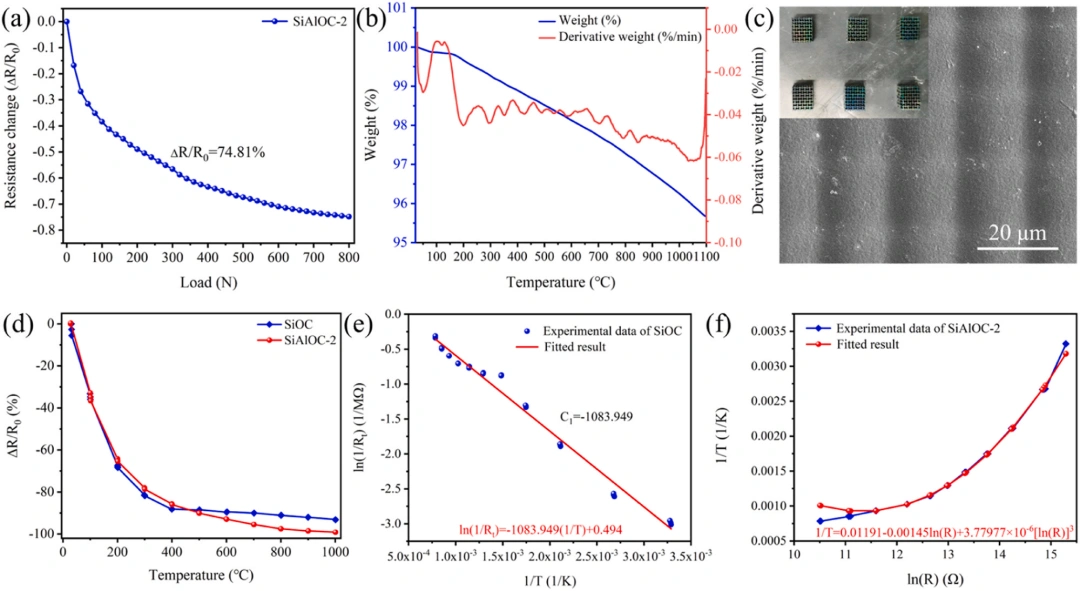
Figure 10, (a) The maximum piezoelectric resistivity of sintered SiAlOC-2 held for 2 hours at 1100°C in an air atmosphere; (b) The thermogravimetric (TG) curve of sintered SiAlOC-2 from room temperature to 1100°C; (c) Scanning electron microscope (SEM) image of SiAlOC-2 after annealing for 2 hours at 1100°C in air, with an inset showing a colored 3D inverse honeycomb structure ceramic; (d-f) The resistance of SiOC and SiAlOC-2 as a function of temperature and their corresponding experimental data fitting results.
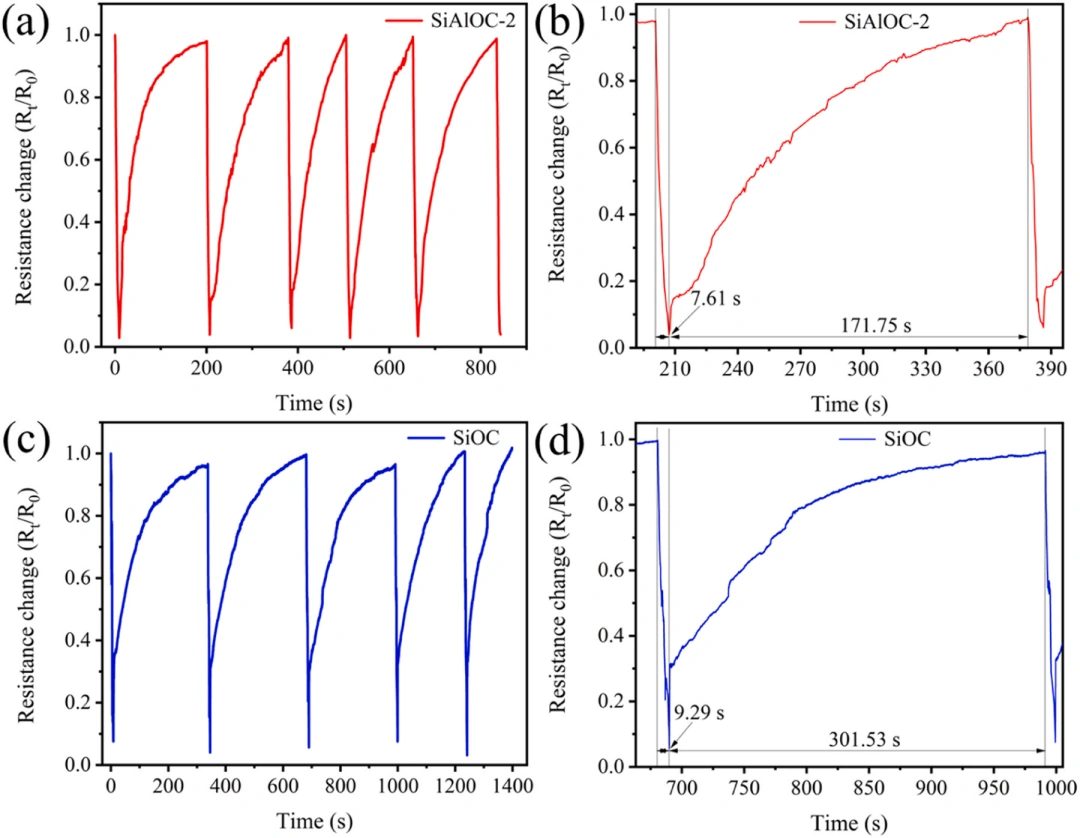
Figure 11, (a, c) Heating-cooling cycle response times of SiAlOC-2 and SiOC samples between room temperature and 600°C; (b, d) An enlarged view of one heating-cooling cycle of SiAlOC-2 and SiOC samples between room temperature and 600°C.
Conclusion
Research shows that aluminum-doped SiOC ceramic materials exhibit excellent high-temperature and high-pressure sensing performance, capable of simultaneously detecting pressure and temperature changes, making them suitable for sensor applications in extreme environments. The application of DLP technology allows for precise design of the material's microstructure, thereby optimizing its sensing response capability. This study provides new solutions for the development of multifunctional sensors under high temperature and high pressure, demonstrating the great potential of SiOC ceramic materials in extreme conditions and laying the foundation for future intelligent sensing technologies.