
Industry Insights
Recently, the team led by Luo Faliang from Ningxia University published a study titled 'Design and catalytic performance of Ni catalyst for CO2 methanation based on DIW-3D printing' in the journal Fuel, exploring the use of DIW-3D printing technology to manufacture nickel (Ni) catalysts to enhance the catalytic performance of the CO2 hydrogenation reaction (CO2 methanation).
Original link: https://doi.org/10.1016/j.fuel.2024.133129
Adventure Technology official website: https://www.adventuretech.cn/
If you cannot open it, please copy the URL to your browser to view.
Research Content
CO2 Methanation Reaction(CO2 + 4H2 → CH4 + 2H2O) is an important chemical reaction that converts greenhouse gas CO2 into useful methane (CH4), which not only helps mitigate greenhouse gas emissions but also provides a potential pathway for energy storage and utilization.Nickel (Ni) based catalystsare widely used due to their lower cost, good catalytic activity, and stability.However, the performance and stability of Ni catalysts are still constrained by many factors, such as the catalyst's active surface area, particle size, and dispersion.In recent years,3D printing technologyDIW 3D printingCO2 Methanation Reactionhas provided new directions for the design and preparation of catalysts. This technology allows for precise control over the morphology, structure, and composition of the catalyst,thereby optimizing the catalyst's performance.The main objective of this study is to design and manufacture nickel (Ni) catalysts based on DIW 3D printing technology and evaluate their catalytic performance in CO2 methanation.
The research team hopes to improve the structure and activity of the catalyst through the advantages of 3D printing technology, enhancing the CO2 conversion rate and methane yield.The following are the research methods and data from the article:(△Figure 1, Structural top view and cross-section view of 1-1 slanted grid, vertical grid, 1-3 dislocation grid, 1-1 rotated slanted grid.△Figure 2, N2 adsorption-desorption isotherms (a) and pore size distribution (b) of catalysts with different Ni concentrations.△Figure 3, Scanning electron microscope images of 20% Ni/SiOC catalyst.△Figure 4, Methanation conversion rates of integral catalysts with different Ni concentrations.△Figure 5, Methanation conversion rates of 20% Ni/SiOC integral catalyst at different reduction temperatures.△Figure 6, Performance of 20% Ni/SiOC catalyst with different 3D printing models under conditions of 250~400℃, 0.1MPa.
△Figure 7, Methanation conversion rates of integral catalysts prepared with different coordinating compounds.△Figure 8, Stability test of 20% Ni/SiOC integral catalyst at 300℃.ConclusionCO2 Methanation ReactionThis article prepared a multi-level pore catalyst and studied the effects of different conditions on its performance.The research indicates that the optimal reaction temperature is 325℃,with a methane selectivity of 100%.The conversion rate of 28% Ni/SiOC catalyst is the highest, reaching 92.18%.When the reaction pressure is increased to 2.0 MPa,the 20% Ni/SiOC catalyst can achieve the highest conversion rate at 300℃, reaching 96.48%.By adding ligands,the reaction temperature can be lowered,△Figure 6, Performance of 20% Ni/SiOC catalyst with different 3D printing models under conditions of 250~400℃, 0.1MPa.
with a conversion rate of 91.25% for 20% Ni/SiOC-AM at 300℃, which is higher than that at the same temperature.
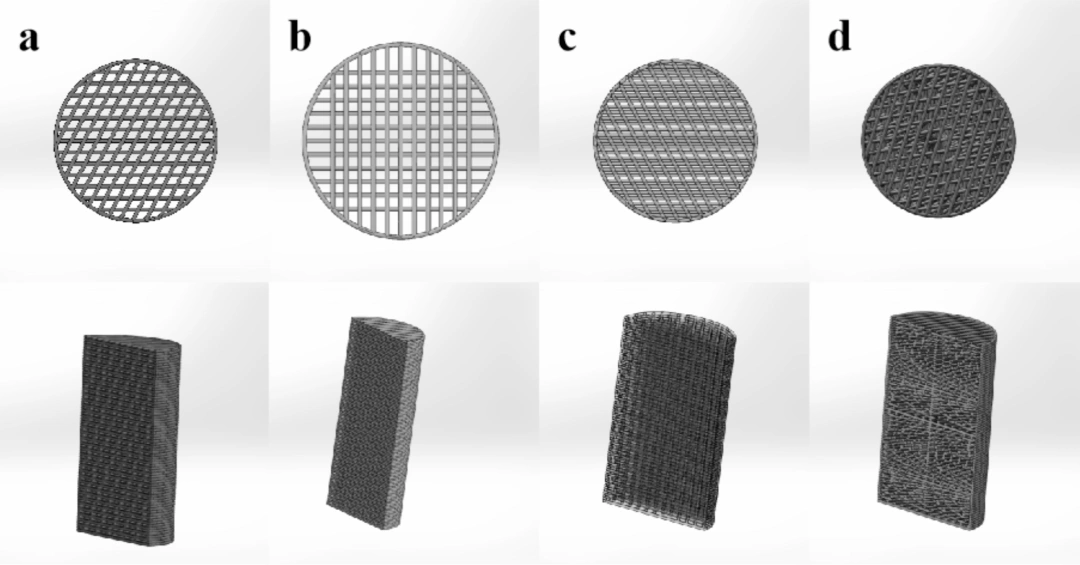
△图1,结构顶视图和剖面图 1-1斜网格、垂直网格、1-3位错网格、1-1旋转斜网格。
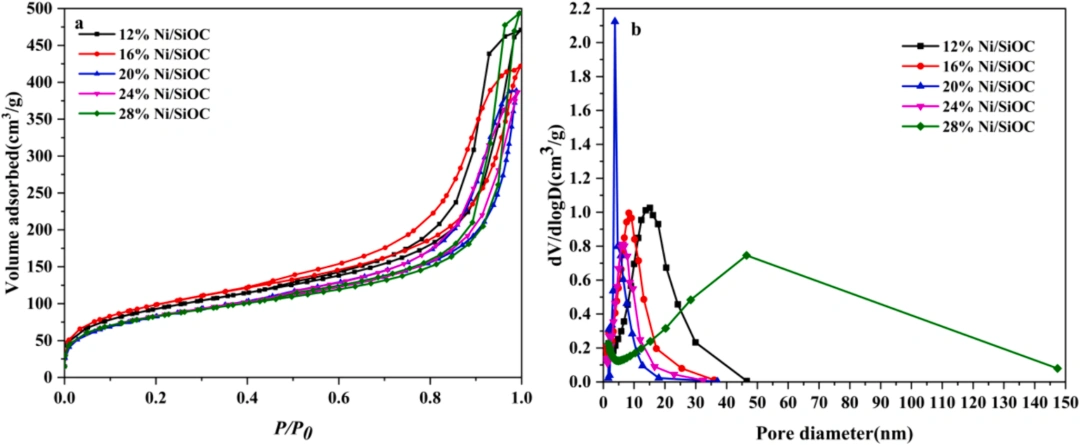
△图2,不同Ni浓度催化剂的N2吸附-脱附等温线(a)和孔径分布(b)。
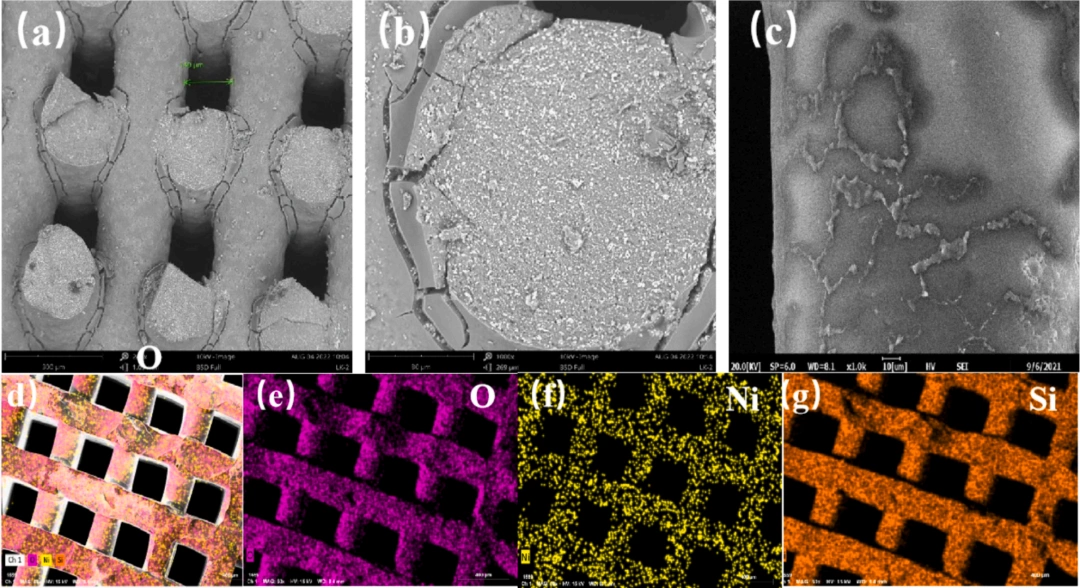
△图3,20%Ni/SiOC催化剂的扫描电镜。
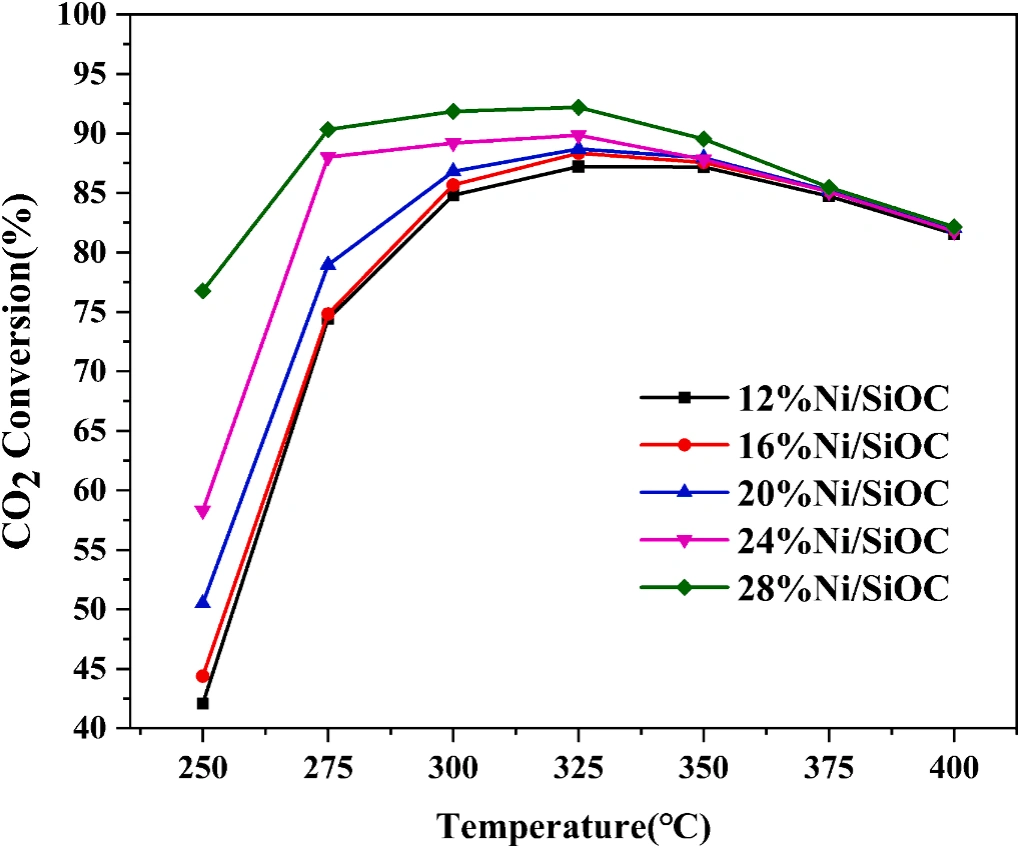
△图4,不同Ni浓度的Ni/SiOC整体式催化剂甲烷化转化率。
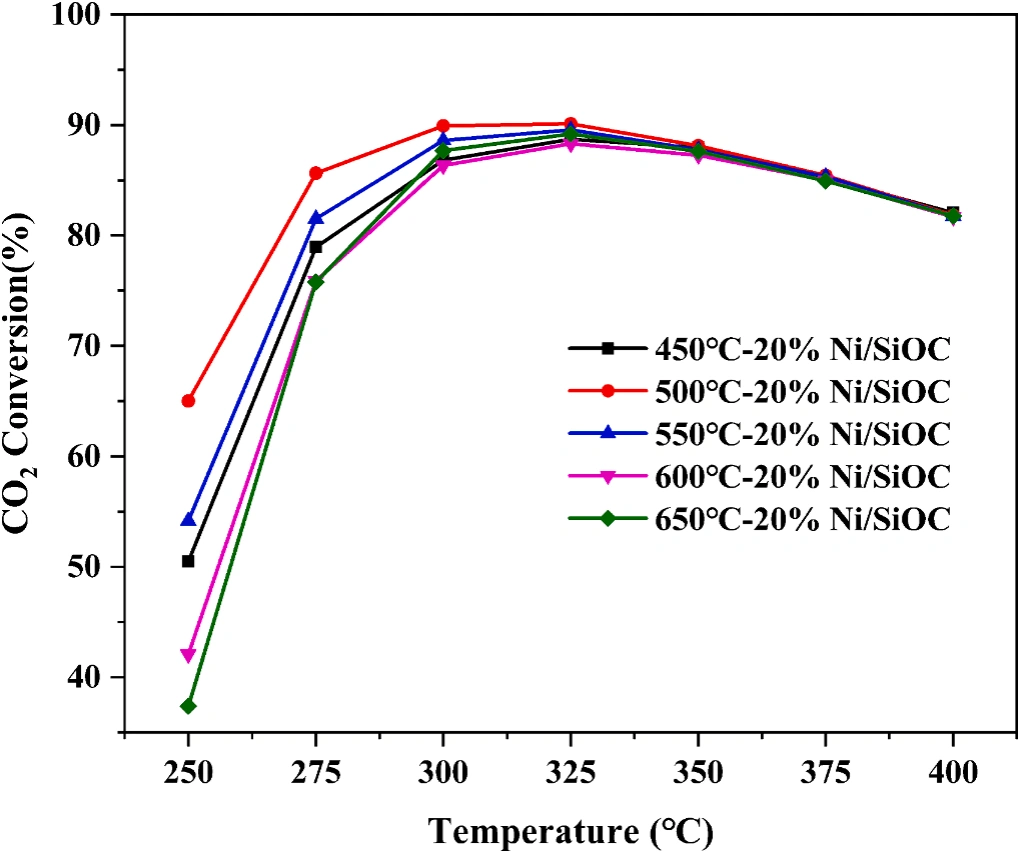
△图5,.20%Ni/SiOC整体式催化剂在不同还原温度下甲烷化转化率。
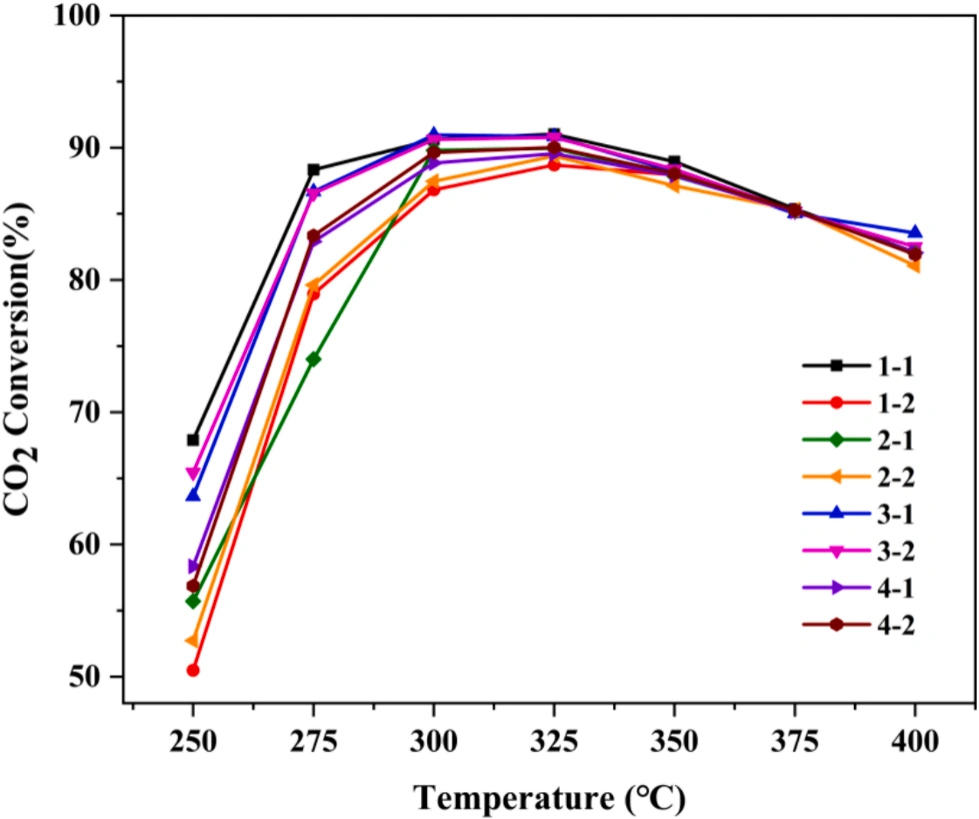
△图6,不同3D打印模型的20%Ni/SiOC催化剂在250~400℃、0.1MPa条件下的性能。
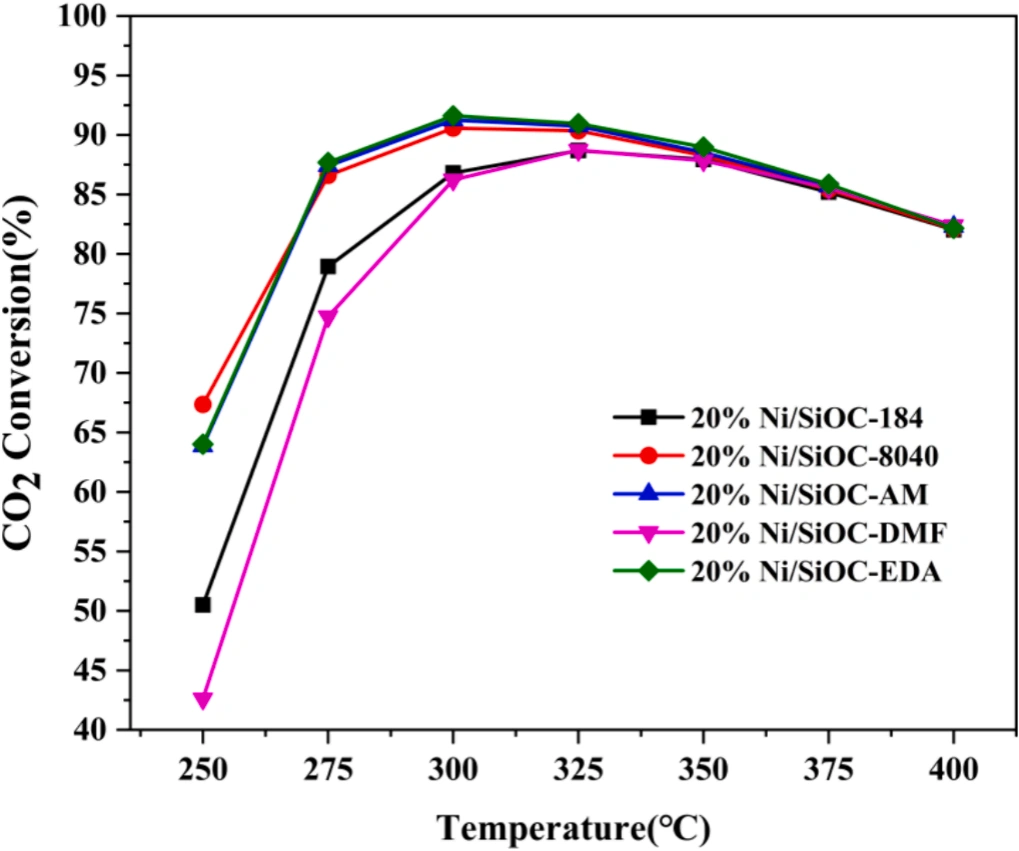
△图7,不同配位化合物制备的整体式催化剂的甲烷化转化率。
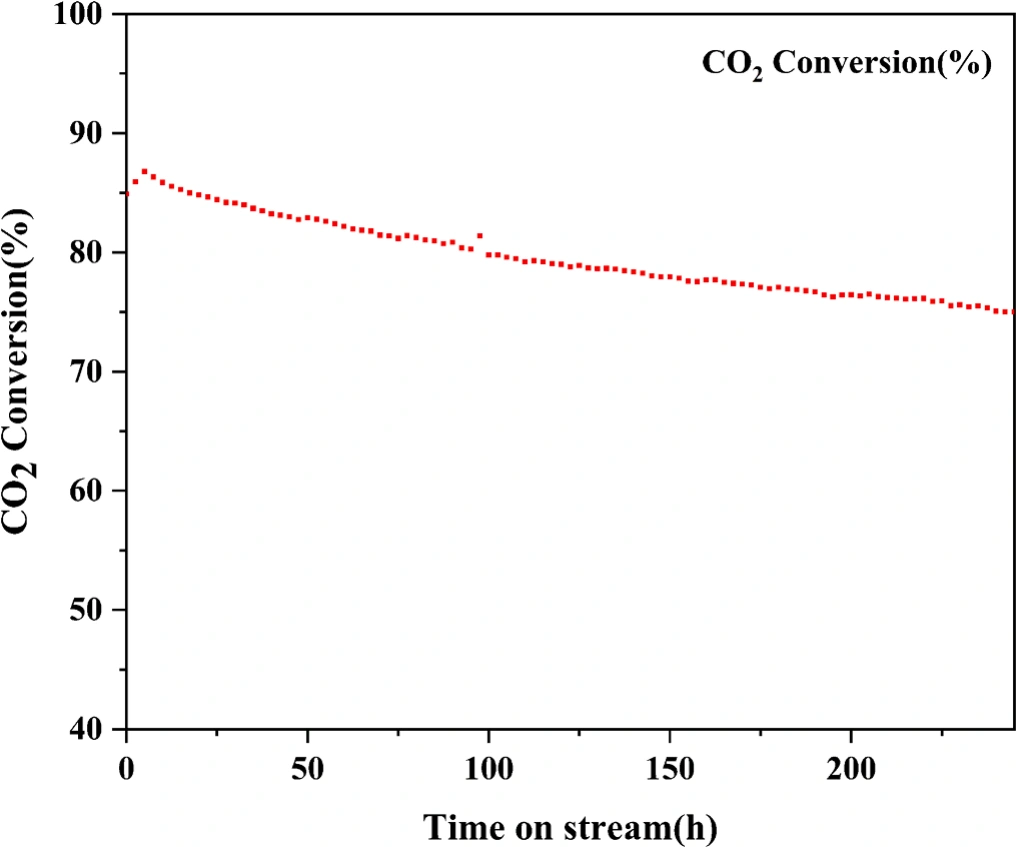
△图8,20%Ni/SiOC整体式催化剂300℃稳定性测试。
结论
本文通过△Figure 1, Structural top view and cross-section view of 1-1 slanted grid, vertical grid, 1-3 dislocation grid, 1-1 rotated slanted grid.制备了多级孔催化剂,并研究了不同条件对The research indicates that the optimal reaction temperature is 325℃,的影响。研究表明,最佳反应温度为325℃,甲烷的选择性为100%,28%Ni/SiOC催化剂的转化率最高,达到了92.18%。当反应压力提高至2.0 MPa时,20%Ni/SiOC催化剂在300℃时能够达到最高的转化率,达到96.48%。加入配体后,可以降低反应温度,在300℃时,20%Ni/SiOC-AM的转化率为91.25%,比同温度下的The 20% Ni/SiOC catalyst is 5% higher.Largerfiber spacingleads to highercatalytic efficiencyas it contributes to bettermass transfer.Additionally, by loadingactive metal onto the surface of 3D printed structures,furtherwaste reductionexperimental methods will be improved.