
Industry new knowledge
Recently, the team of Jinjin Zhang and Naitao Yang from the School of Chemistry and Chemical Engineering of Shandong University of Technology published a study entitled 3D printing of porous zirconia support for solid oxide fuel cells with high cell performance in Ceramics International, reporting the preparation and characterization of solid oxide fuel cells with 3D printing porous 3YSZ microtubules.
Original link: https://www.sciencedirect.com/science/article/pii/S0272884224020613?via=ihub
Adventure Technology official website: http://www.adventuretech.cn/
If it cannot be opened, please copy the URL to the browser.
research content
Porous 3 mol% yttria stabilized zirconia(3YSZ) ceramics are widely used in ceramic filters, catalyst carriers and other fields.High melting point, low density, low thermal conductivity and corrosion resistance. As a MT-SOFC inert support, porous 3YSZ has high redox stability. Traditional preparation methods include extrusion, phase inversion and gel casting, while 3D printing technology based on light curing has attracted much attention. Although 3D printing has high precision and complex structure manufacturing capabilities, its application in MT-SOFC still has challenges, and further research is needed to improve battery performance.
Therefore, this study systematically exploredEffect of pore-forming agent size and content on the microstructure of porous ceramicseffects, andThe heat treatment process on the bending strength and shrinkage of the sintered body.The impact. Subsequently, the evaluationCell performance of 3D printed porous 3YSZ inert support SOFC.
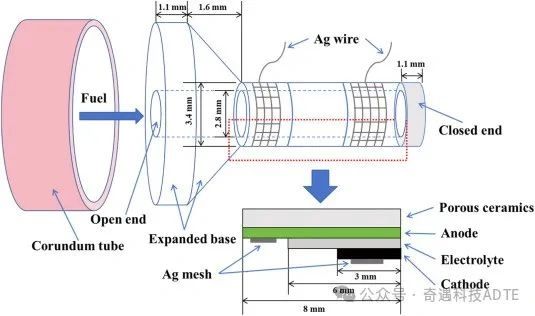
Delta Figure 1, provides detailed information on cell geometry, current collection and sealing.
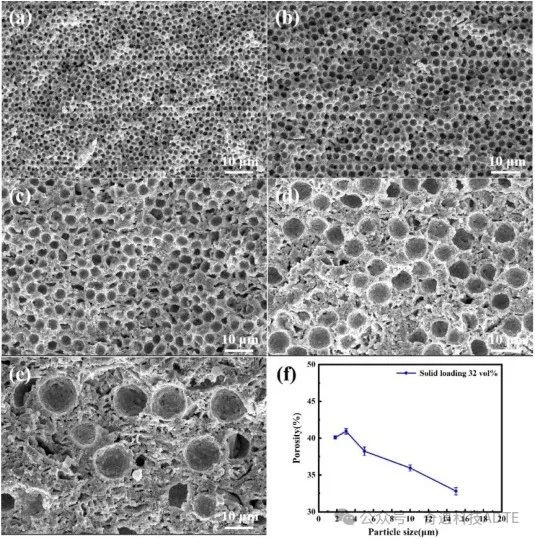
△ Fig. 2, cross-sectional morphology of porous ceramic samples with ceramic loading of 32 vol%, pore former PMMA particle sizes of (a)1.8, (B) 3, (c)5, (d)10 and (e)15 μm, pore former content of 20 wt%, and (f) corresponding porosity after high temperature sintering at 1400°C.
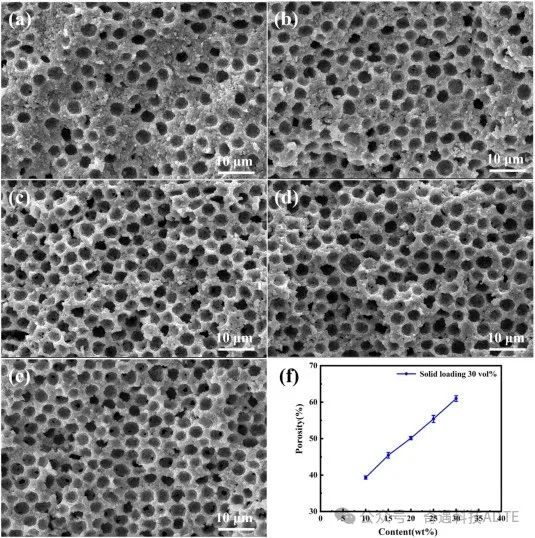
△ Fig. 3, morphology of porous ceramic samples with ceramic loading of 30vol%, pore former PMMA particle size of 3μm, content of (a)10wt%, (B) 15wt%, (c)20wt%, (d)25wt% and (e)30wt%, and (f) corresponding porosity after high temperature sintering at 1400 ℃.
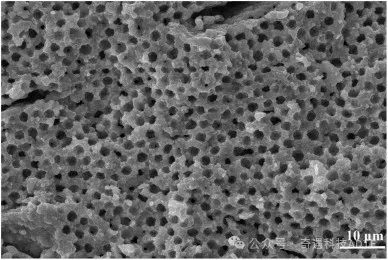
4, the morphology of the porous ceramic prepared when the ceramic loading is 30vol% and the pore-forming agent content is 30wt% after sintering at 1400°C.
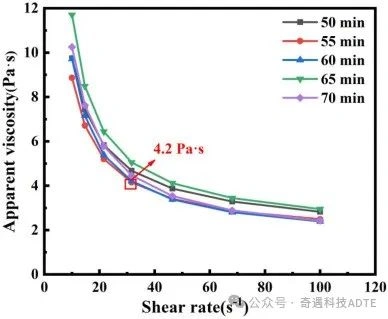
Figure 5, the apparent viscosity of light-cured ceramic slurry changes with shear rate under different ball milling time.
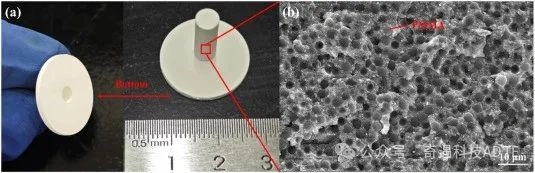
6, (a) photograph and (B) SEM image of a green body printed using a light-cured ceramic slurry, the slurry having a ceramic content of 30vol%, a grinding time of 55 minutes, a pore-forming agent having a particle size of 3 μm and a content of 30wt%.
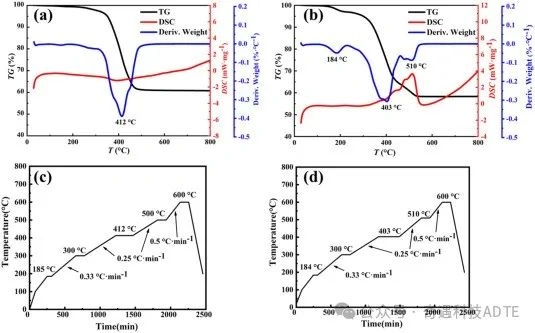
Figure 7,( a, B) TG/DSC curves of green bodies and (c, d) corresponding degreasing procedure in nitrogen and air atmosphere.
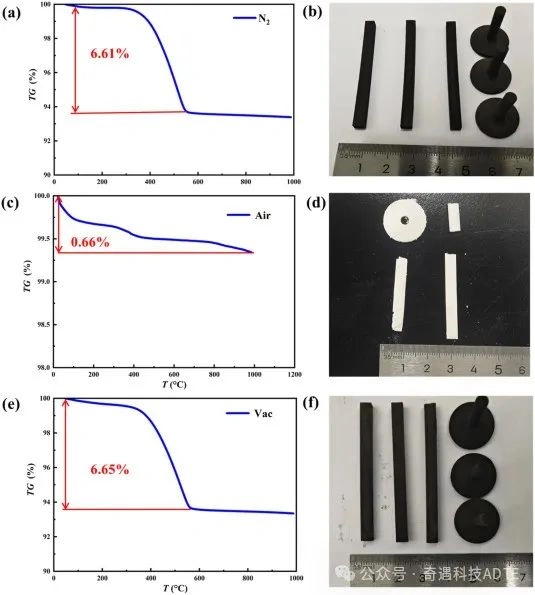
8, Weight loss curves and real photographs of samples after degreasing in (a, B) nitrogen, (c, d) air and (e, f) vacuum.
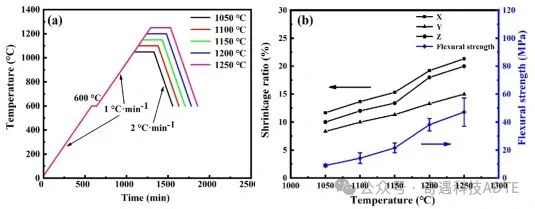
9,(a) sintering procedure and (B) shrinkage and flexural strength of pre-sintered samples at five different temperatures of 1050, 1100, 1150, 1200 and 1250°C.
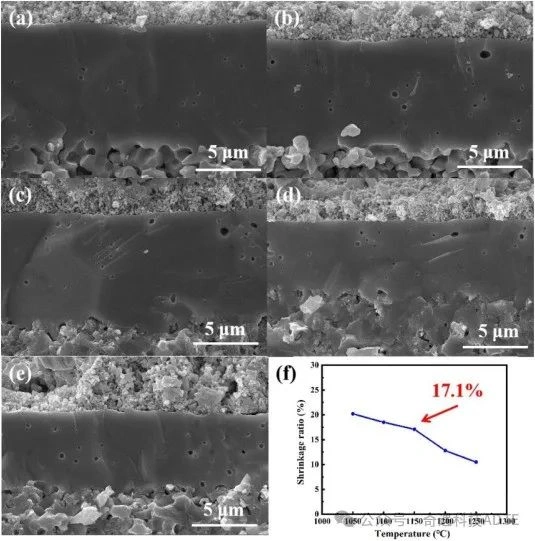
10, SEM images of electrolyte (sintered at 1400°C) on inert supports pre-sintered at different temperatures (a)1050°C, (B) 1100°C, (c)1150°C, (d)1200°C, (e)1250°C, and (f) shrinkage of inert supports sintered from the corresponding pre-sintering temperature to 1400°C.
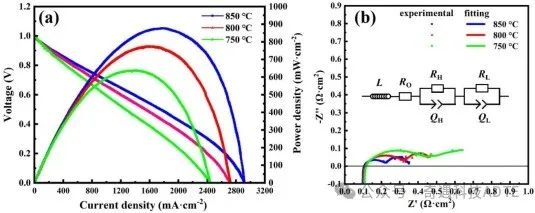
△ Figure 11,(a) Current-Voltage-Power Density (I-V-P) Curve and (B) Nyquist plot of electrochemical impedance spectroscopy (EIS) of porous 3YSZ | | NiO | NiO-8YSZ | | 8YSZ | | LSM | LSM battery.
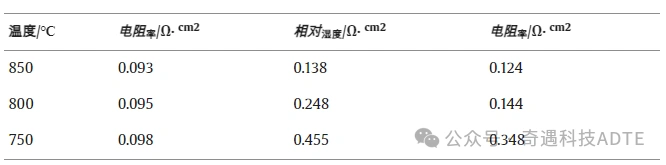
△ Figure 12. Battery impedance parameters measured at different operating temperatures under open circuit conditions.
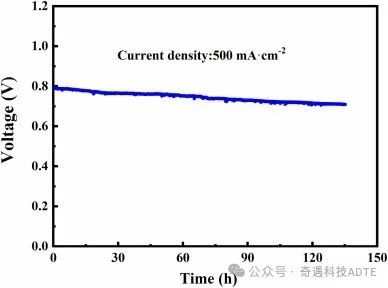
△ Figure 13. Stability test at 850°C with a load current density of 500 mA cm − 2.
research conclusion
In this study, high-performance MT-SOFC based on porous 3YSZ structure were fabricated using SLA 3D printing technology. By studying the influence of different parameters, the optimal preparation conditions were determined. The results show that the best performance can be obtained by using specific particle size and content of pore-forming agent, appropriate ball milling time, nitrogen atmosphere and pre-sintering temperature. Under the optimized conditions, the SOFC exhibited high power density at 850°C and remained intact after testing, and a 3D printed porous 3YSZ inert support for SOFC applications was successfully prepared.