
近日,山东理工大学Shuang Li带领的团队在《Ceramics International》发表了题Silicon carbide ceramics manufactured by digital light processing and low temperature sintering的研究,Silicon carbide ceramics were fabricated by digital light processing (DLP) technology and low temperature liquid phase sintering method.The feasibility of using DLP technology to print silicon carbide ceramics was discussed, especially by adding aluminum oxide (Al₂) and yttrium oxide (Y₂) as sintering additives to the silicon carbide slurry to reduce the sintering temperature and improve the density and mechanical properties of the ceramics.
Original link: https://doi.org/10.1016/j.ceramint. 2024.07.076
Adventure Technology official website: http://www.adventuretech.cn/
If it cannot be opened, please copy the URL to the browser.
research content
Silicon carbide (SiC) ceramics have excellent mechanical, thermal and chemical propertiesTherefore, it has attracted much attention in aerospace and energy-related fields. However, the conventional method of manufacturing silicon carbide ceramics has some problems, such as difficulty in manufacturing a complex shape structure, high sintering temperature, and easy generation of defects.
DLP is a 3D printing technology based on photopolymerization. The photosensitive resin is cured by ultraviolet (UV) irradiation. However, due to the dark color and high light absorption rate of silicon carbide particles, it is easy to affect the light curing depth, resulting in increased printing difficulty. In addition, the sintering temperature of silicon carbide ceramics is usually as high as 2500°C, and this paper passes.The introduction of oxide sintering additives such as Al₂ O and Y-O, and the use of liquid-phase sintering method have successfully reduced the sintering temperature.
The core goal of this paper is to manufacture SiC ceramics by DLP technology and liquid phase sintering, and to study the effect of sintering temperature on its density, pore structure and mechanical properties. Specifically include:
-
Development of silicon carbide photosensitive pastes suitable for DLPand optimize the photo-curing properties of the slurry.
-
optimization of sintering processBy using alumina and yttrium oxide additives to reduce the sintering temperature and improve the densification of ceramics.
-
Evaluating the microstructure and mechanical properties of materialsThe effects of different sintering temperatures on its strength, density and porosity were analyzed.
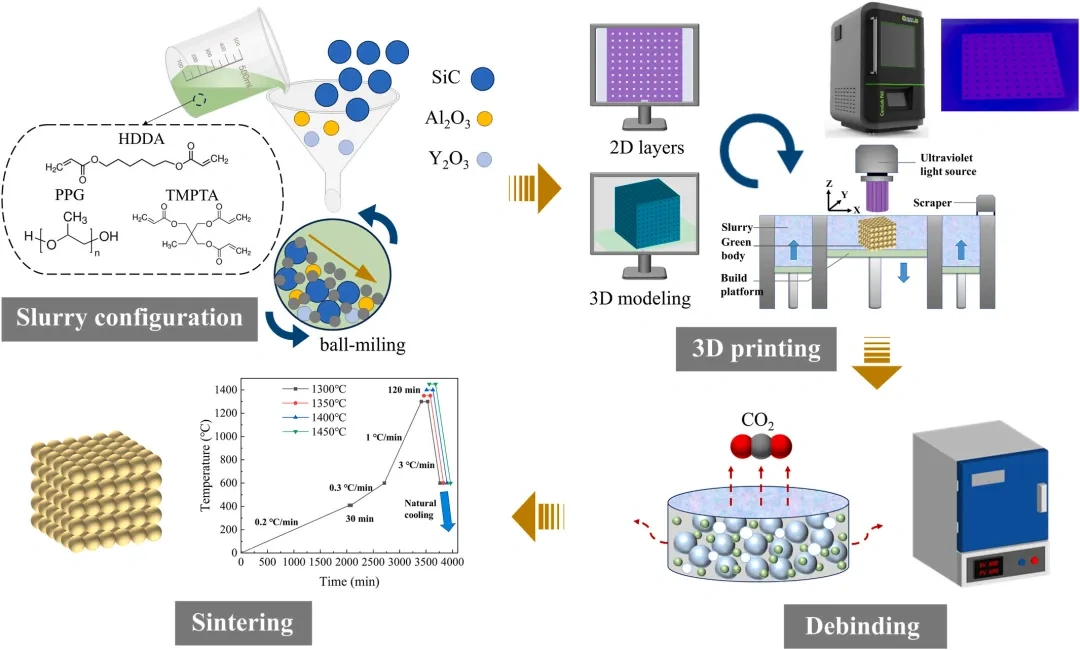
△ Fig. 1, Experimental process of producing silicon carbide ceramics by DLP.
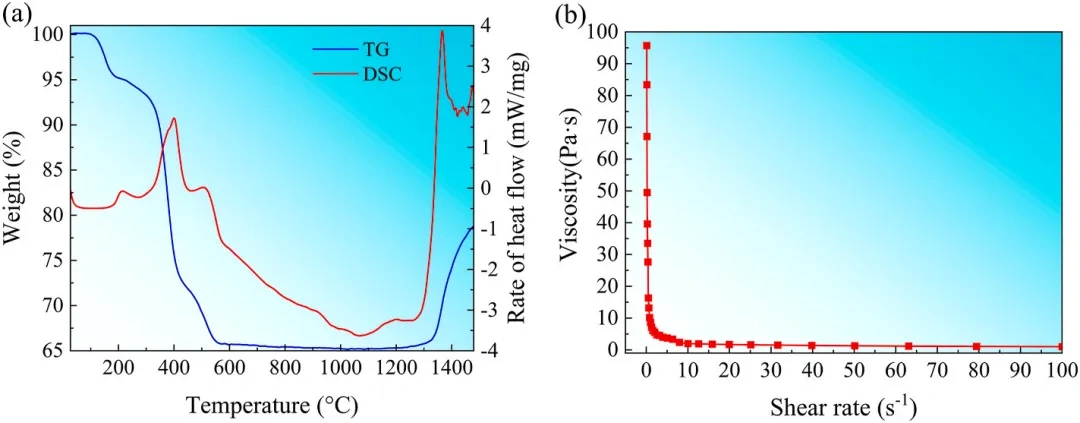
Figure 2,(a) TG-DSC curve of the green body, (B) the viscosity of the SiC slurry changes with the increase of the shear rate.
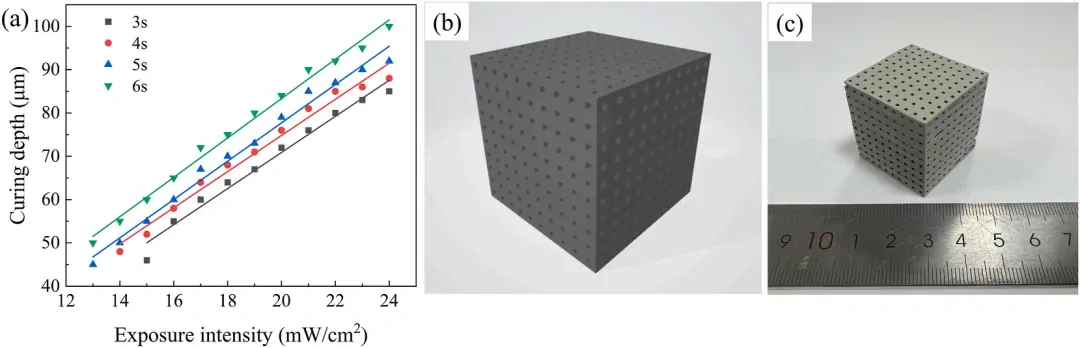
△ Fig. 3,(a) curing depth of SiC photosensitive paste under different exposure parameters, (B) 3D model of ceramic part,(c) printed part with connected channels.
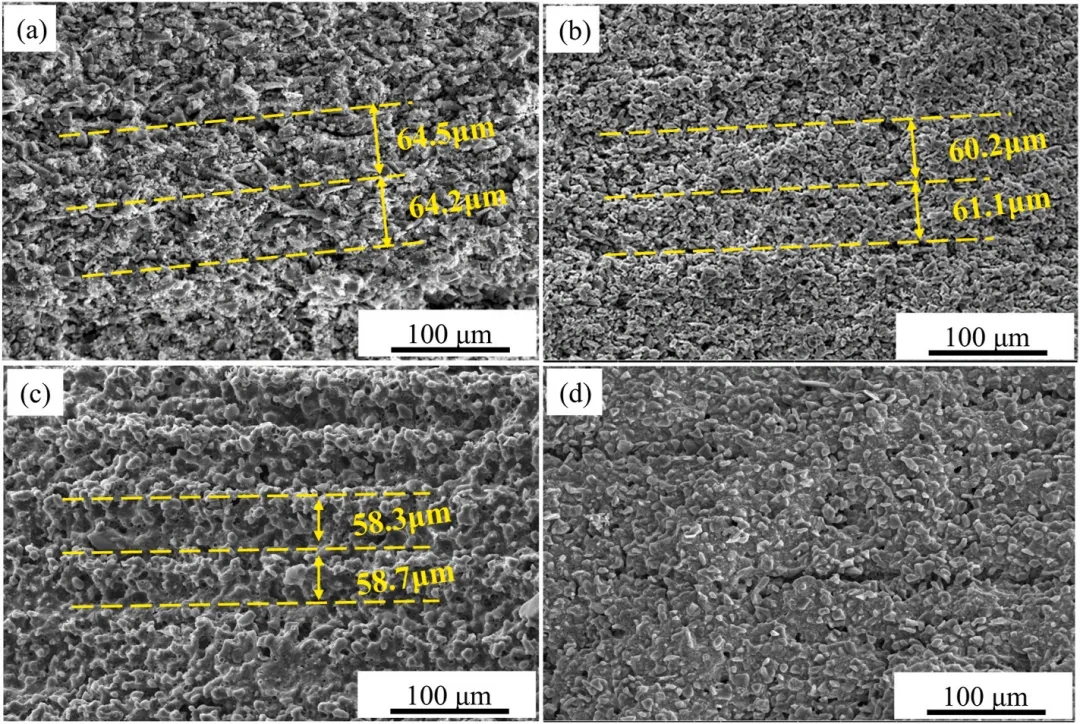
4, interlaminar microstructure of ceramics:(a)1300°C, (B) 1350°C,(c)1400°C,(d)1450°C.
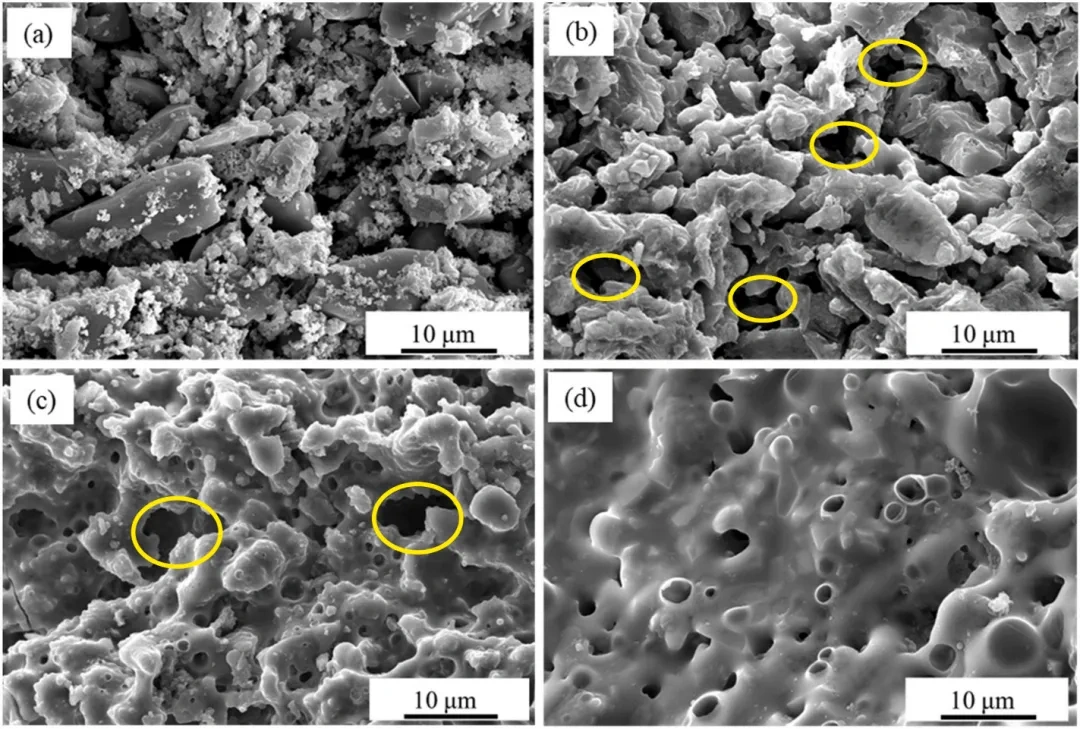
△ Figure 5, ceramic internal microstructure:(a)1300°C, (B) 1350°C,(c)1400°C,(d)1450°C.
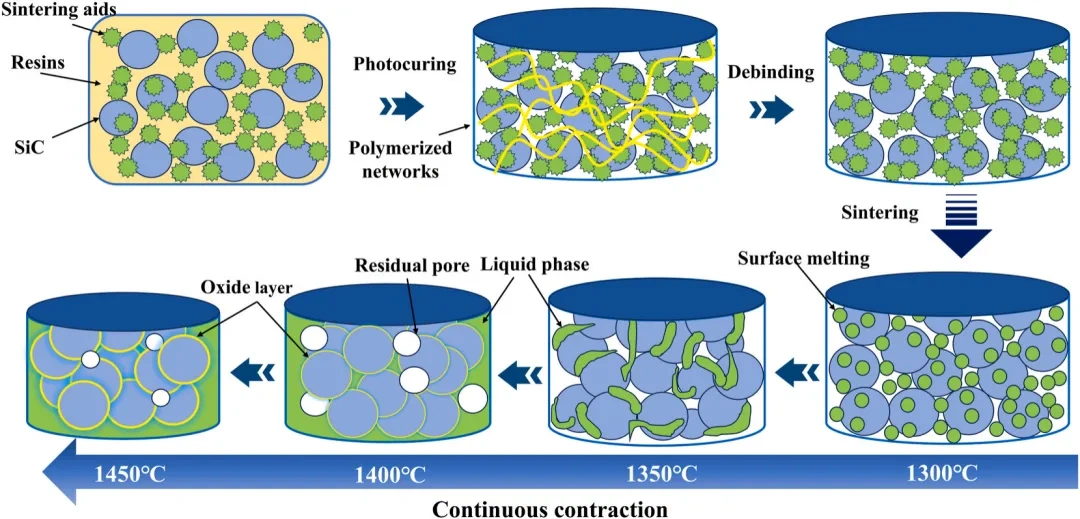
6, schematic diagram of microstructure evaluation during sintering at different temperatures.
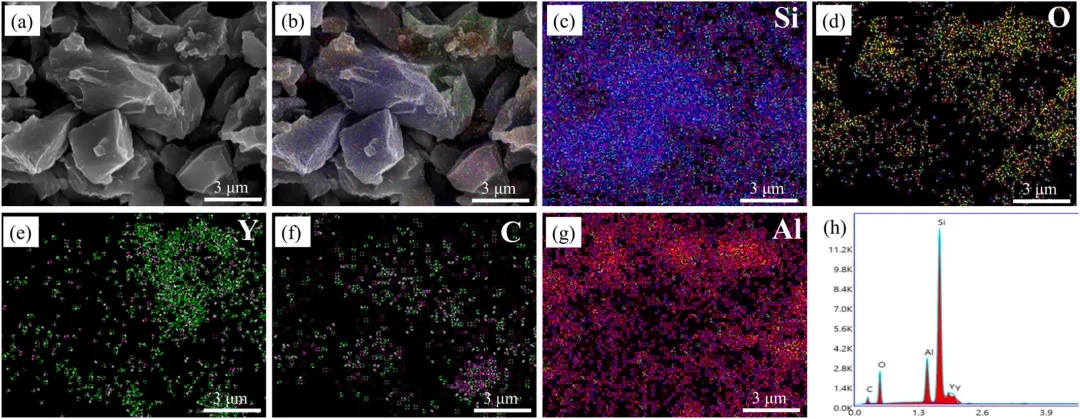
Figure 7, Element distribution of 1350°C sintered ceramics:(a)SEM image, (B) integrity map of all elements,(c)Si element,(d)O element,(e)Y element,(f)C element,(g)Al element,(h) EDS pattern of selected areas.
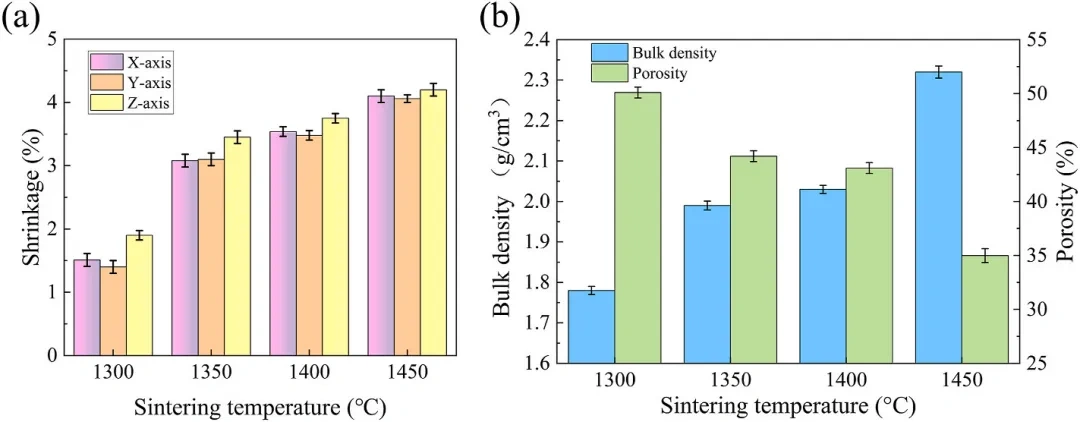
△ Figure 8, the change of shrinkage (a) and bulk density (B) of silicon carbide ceramics at different sintering temperatures.
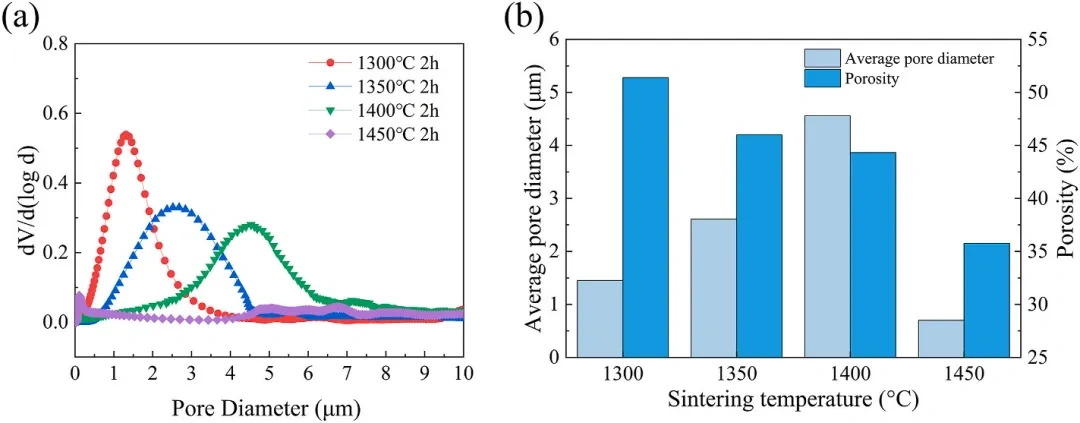
9, pore characteristics of ceramics at different sintering temperatures:(a) pore size distribution, (B) average pore size and porosity at different temperatures.
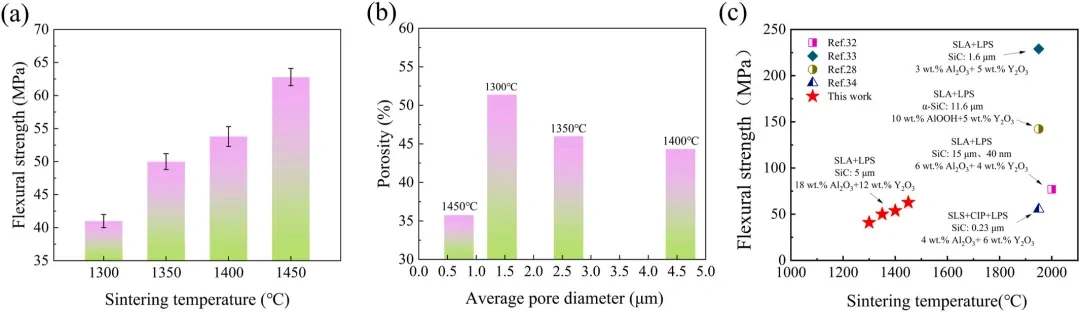
△ Fig. 10,(a) Bending strength of ceramics at different sintering temperatures, (B) Relationship between porosity and average pore size of ceramics,(c) Comparison with LPS SiC ceramics in published literature.
Conclusion
In this study, usingDigital Light Processing (DLP) Technologyandliquid phase sintering process, combinedAl₂O₃-Y₂O₃Additives were used as sintering aids to prepare silicon carbide (SiC) ceramics. The introduction of Al₂ Obasis-Y₂ Obasis additives enhances the stability and curing ability of the photosensitive SiC slurry, resulting in good integrity, accuracy and surface quality of the printed parts. As the temperature increases, the ceramic becomes more uniform and dense due to the melting and infiltration of the liquid phase. As the embryo body shrinks, the bulk density of SiC ceramics increases from1.78g/cm³Increase2.33g/cm³,porositythen from50.21%Reduced35.09%. Due to this evolution of the microstructure, the bending strength of the material changes from41.0MPaRaise62.8 MPa. Therefore, the introduction of Al₂ O₂-Y₂ O₂ sintering aids can not only improve the curing performance of the SiC slurry, but also accelerate the densification of the printed parts and repair the microscopic defects in the sintered body.