
Lattice-Structured Alumina Cylinders in Ceramic 3D Printing: A Research-Oriented Perspective
The development of high-performance ceramic components is increasingly leaning toward complexity—not just in material formulation, but in geometry itself. Among the promising constructs under experimental scrutiny is the cylindrical alumina body enhanced with lattice architectures, fabricated through high-resolution ceramic 3D printing. This particular design direction, though still in an emergent phase, opens meaningful questions in structural mechanics, thermal regulation, and dielectric behavior.
Why Cylindrical? Revisiting Classical Symmetry in Ceramics
In mechanical and thermal applications, cylindrical forms have long served as the structural ideal for pressure-bearing elements, pipes, insulators, and thermal sleeves. Their symmetry is inherently stable under uniform loading. However, when paired with traditional ceramic processing methods, these components are typically monolithic—dense, isotropic, and often limited in functional versatility.
With the advent of ceramic 3D printing, particularly DLP-based additive manufacturing, researchers now have access to digital control over internal geometries—especially periodic lattices embedded within or surrounding the cylindrical core. This geometric freedom raises a compelling inquiry: can one preserve the mechanical strength of a cylinder while imparting the benefits of a porous or lattice-integrated structure?
Embedding Lattices into Alumina Cylinders: Observations and Potentials
In our laboratory, we’ve begun evaluating various cylindrical lattice configurations using alumina (Al₂O₃) as the base ceramic. The choice of alumina is deliberate—it is chemically inert, mechanically robust, and widely understood in high-temperature and dielectric environments.
Through ceramic 3D printing, we have fabricated test specimens involving:
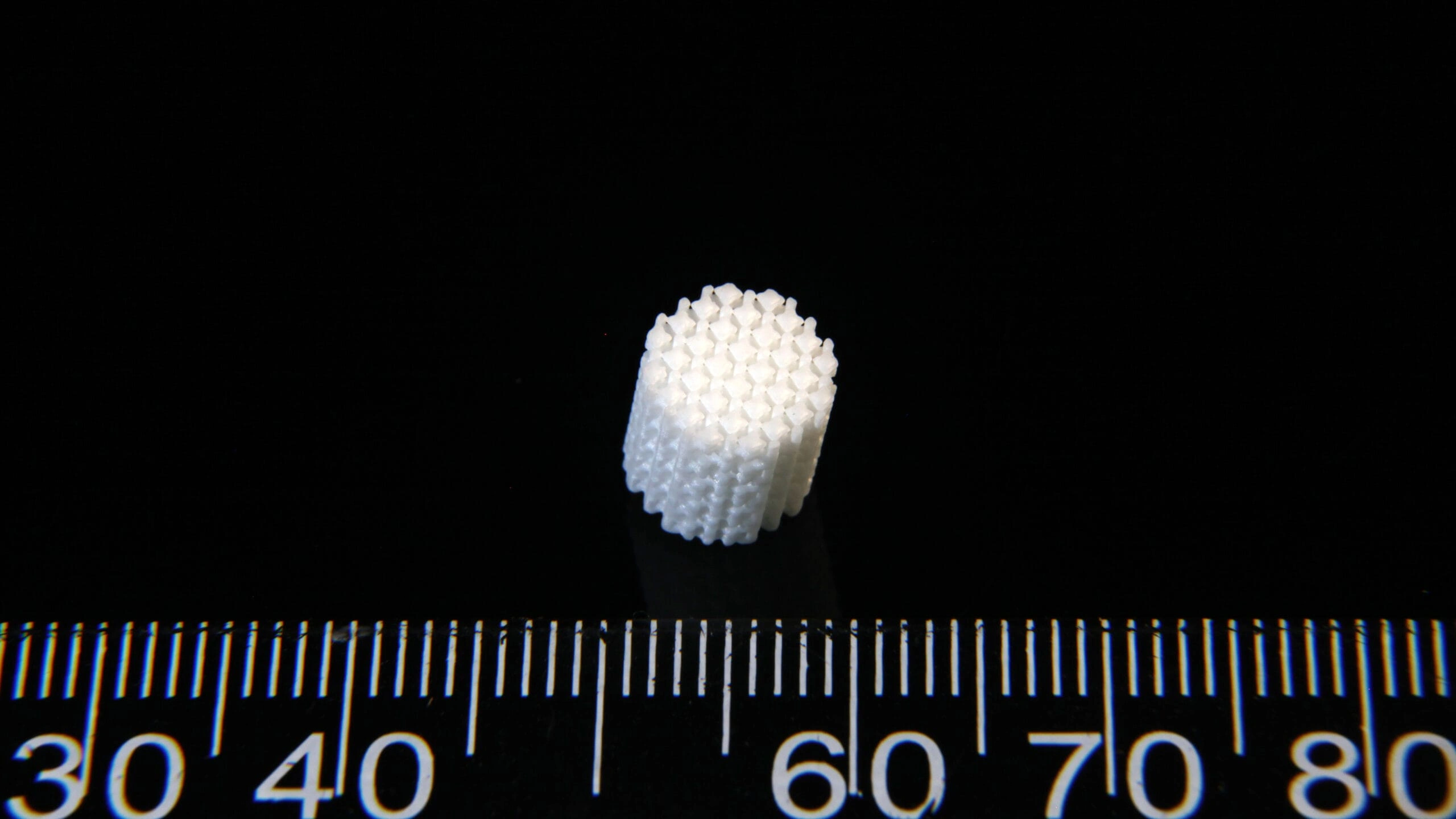
Preliminary thermal shock and load-bearing assessments suggest that lattice-modified cylinders exhibit surprisingly high structural retention, despite their lowered material volume. More interestingly, under certain conditions, thermal gradients within the lattice zones appear better distributed, pointing to a potential for passive thermal regulation—a promising trait for heat-exchanging or insulating applications.
Applications in Electromagnetic and Biomedical Fields
The dielectric nature of alumina, coupled with its stability across frequencies, has long made it a candidate for RF applications. The inclusion of ceramic 3D printed lattices within cylindrical shells may serve twofold: reduce weight and minimize parasitic field interactions, especially in environments requiring minimal reflection or absorption.
On the biomedical side, lattice cylinders offer potential as scaffolding or shielding elements—think of implant casings or vascular supports where porosity aids both fluid dynamics and tissue integration. While metallic or polymer analogs exist, ceramic cylinders printed with precision porosity offer an entirely different spectrum of biocompatibility and long-term chemical resilience.
Manufacturing Challenges and Considerations
Naturally, embedding lattices into cylindrical ceramic geometries is not without challenges. Print resolution, slurry rheology, and post-processing all play pivotal roles. In particular:
-
Printability of overhangs in unsupported lattice zones
-
Debinding shrinkage management, especially at high lattice porosity
-
Sintering warpage control, as radial symmetry must be preserved
However, with tuning of the ceramic 3D printer parameters—including layer thickness, exposure time, and binder distribution—many of these risks can be mitigated. It remains a balance between geometric ambition and fabrication reliability.
Conclusion: Still Early, But Promising
The integration of lattice structures into alumina cylinders using ceramic 3D printing technologies is still an evolving field, but one that carries substantial promise. While we do not yet have full performance maps or failure modes for these novel configurations, the direction is clear: geometry can be engineered as function, and the cylinder—a classical form—may find renewed roles in tomorrow’s ceramic systems.
Keywords Used Throughout the Article:
ceramic 3d print, ceramic 3d printing, ceramic 3d printer, 3D printed ceramics, alumina lattice, lattice cylinder, ceramic architecture, additive ceramic manufacturing, porous ceramic structures
Contact us if your research team is exploring ceramic design beyond the monolith. Our DLP-based ceramic 3D printers support lattice generation, functional prototyping, and scalable production for both academic and industrial use.
Website: https://adt-ceramic3dp.com
Email: adventuretech@adt-ceramic3dp.com