
At the microscale of ceramic DLP 3D printing, producing stable ~100 μm zirconia thin-wall structures is fundamentally a question of how accurately the exposure system translates digital pixels into physical geometry.
In a 25 μm optical resolution system (ADT Ceram-D-L48), a 100 μm wall is defined by only a few projected pixels across its entire thickness. At this scale, geometry is no longer continuous in a macroscopic sense—it is discretely constructed at the level of individual exposure units.
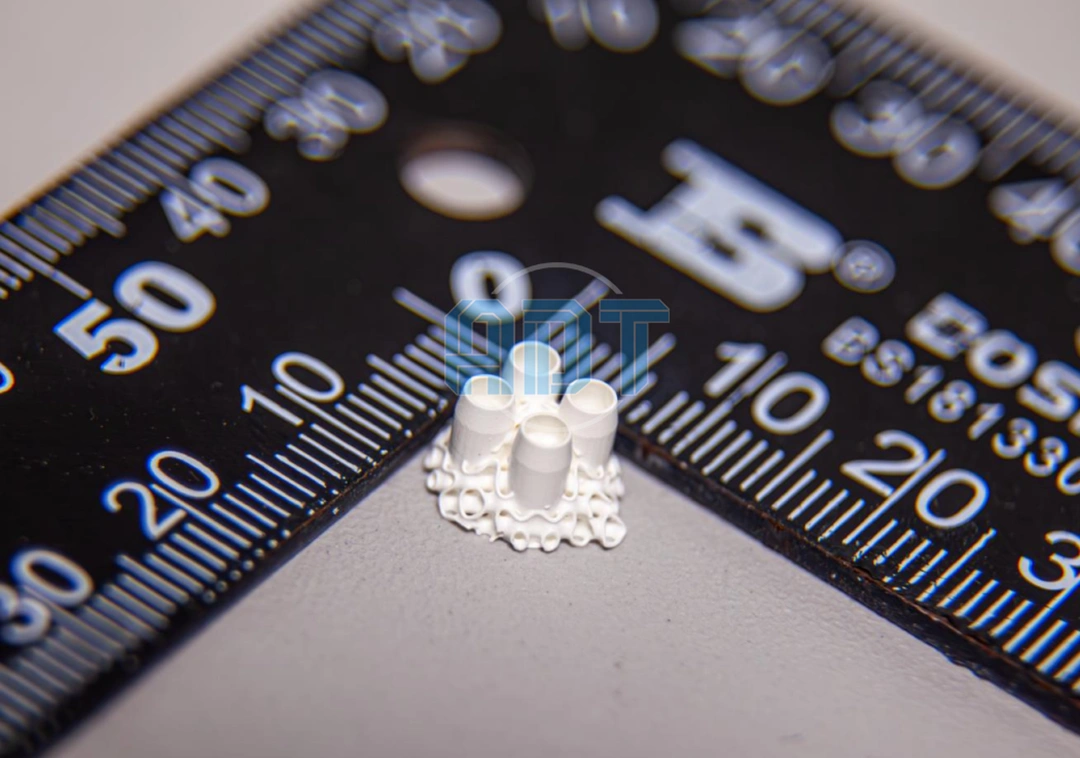
The sample shown here demonstrates the resulting structure after full thermal processing, including debinding and sintering.
What the Sample Shows
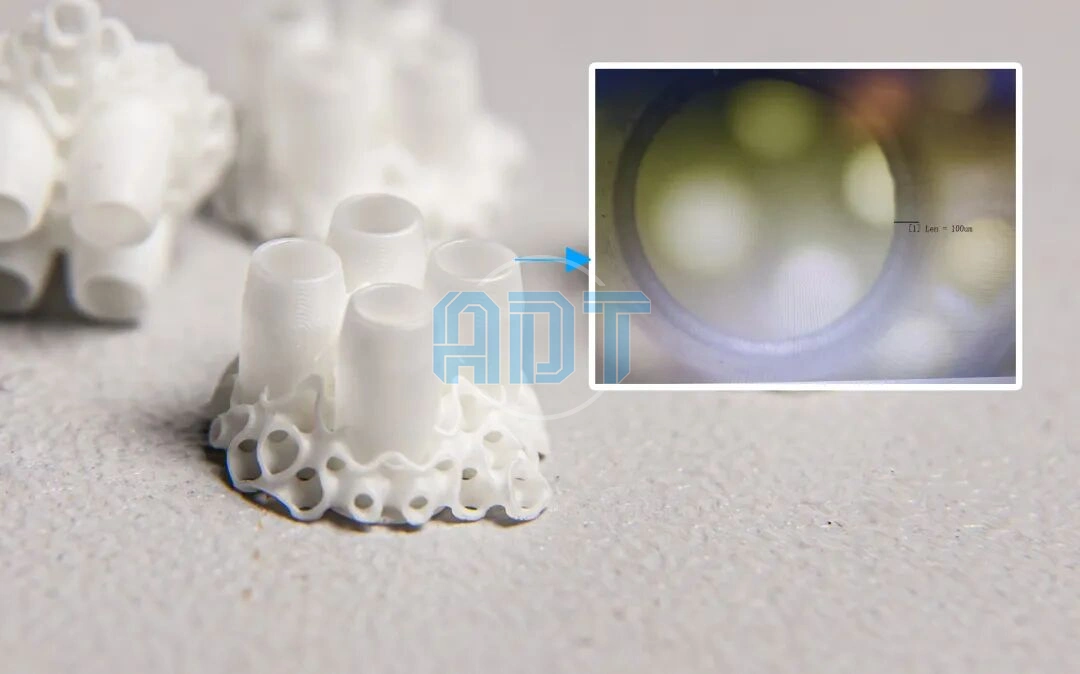
The part consists of multiple hollow cylindrical zirconia features arranged on a shared base.
On the left, we see the fully sintered ceramic component. On the right, a magnified view reveals the internal cylindrical channels. The scale bar indicates feature dimensions in the approximately 100 μm range.
Despite the small size of these structures, the channels remain open and continuous after sintering. The walls retain their shape, and no visible collapse, blockage, or interruption appears within the repeated features.
Building Thin Walls at the Pixel Level
At a wall thickness of roughly 100 μm, exposure resolution becomes a dominant factor.
With a 25 μm pixel size, only a handful of pixels define the entire wall thickness. Each exposure unit therefore contributes directly to the final geometry.
Small variations can become significant:
- Excessive lateral curing may narrow the channel.
- Insufficient exposure may weaken wall integrity.
- Pixel-to-pixel inconsistency may affect dimensional accuracy.
Because so few pixels participate in forming the structure, the exposure process must remain highly consistent throughout the build.
Why 25 μm Resolution Matters
As feature dimensions approach the 100 μm range, the relationship between optical resolution and part geometry becomes increasingly direct.
Every projected pixel contributes to the shape of the green body. With only a limited number of pixels available across the wall thickness, there is little room for dimensional deviation.
The sintered sample demonstrates that the exposure process maintains sufficient control over both wall formation and channel definition, allowing the geometry to remain intact throughout manufacturing.
Surviving Debinding and Sintering
Printing is only the first stage of the process.
During debinding, the removal of organic binders temporarily reduces structural support. During sintering, zirconia densifies and undergoes significant shrinkage. Both stages can introduce distortion, especially in thin-wall geometries.
Nevertheless, the cylindrical channels shown here remain clearly identifiable after full thermal processing. The walls stay continuous, and the hollow features preserve their intended geometry.
Interpreting the Result
The most important observation is straightforward: the approximately 100 μm zirconia walls remain continuous after sintering.
Achieving this result requires more than high optical resolution alone. Several factors must work together:
- Accurate pixel-level exposure control
- Stable green-body formation
- Uniform shrinkage during sintering
When these elements remain balanced, micro-scale ceramic features can pass through the entire manufacturing process while retaining their designed geometry.
Equipment Used
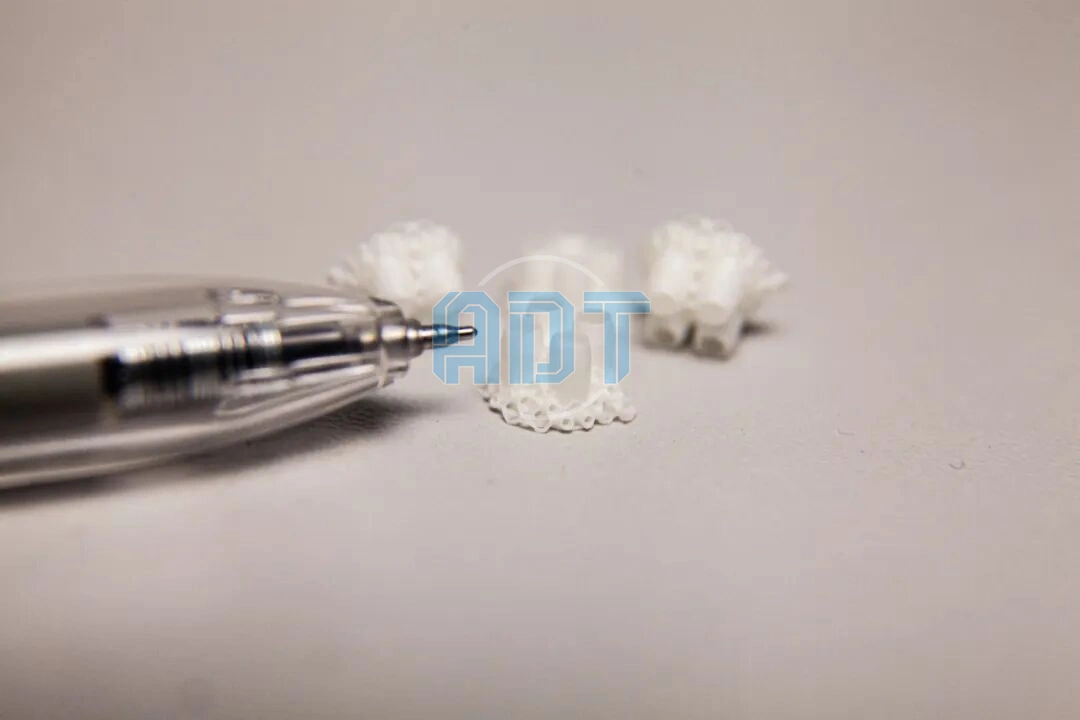
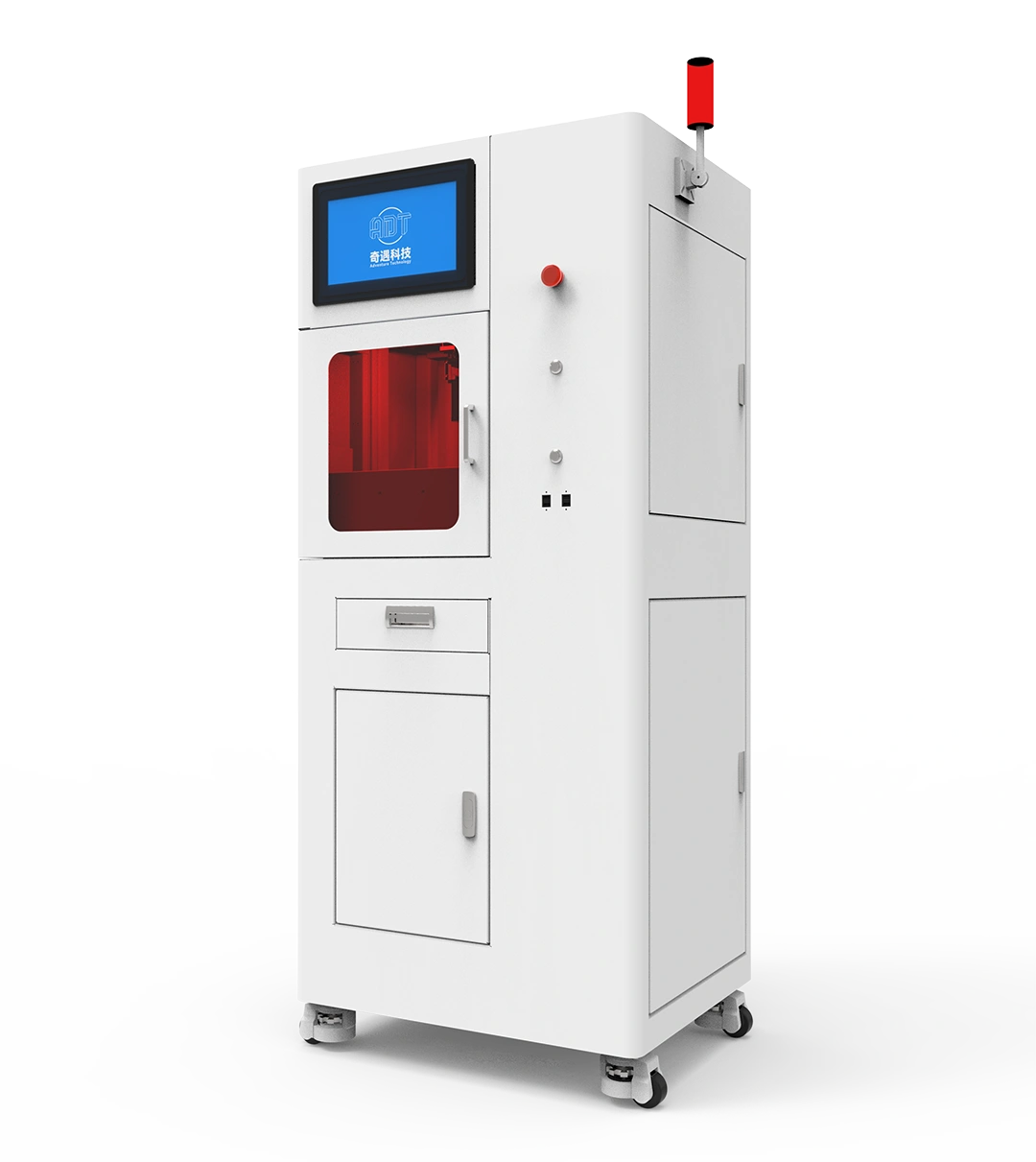
All samples were fabricated on the ADT Ceram-D-L48 DLP ceramic 3D printing system operating at 25 μm optical resolution.
At this resolution, digital exposure patterns translate directly into ceramic microstructures. Feature definition begins at the pixel level and remains visible in the final sintered part.
Conclusion
This study demonstrates the successful fabrication of approximately 100 μm zirconia thin-wall structures using a 25 μm resolution DLP ceramic 3D printing process.
The resulting component contains repeated hollow cylindrical features with open internal channels that remain intact after sintering. The walls show no visible collapse or blockage, even at this scale.
The result highlights the importance of pixel-level exposure control in ceramic DLP printing. When exposure accuracy, green-body stability, and sintering behavior work together, micro-scale zirconia architectures can be produced with reliable structural fidelity.