
Background
Microstructure and surface roughness are two critical factors governing the transparency of transparent ceramics. The manufacturing mechanism of additive manufacturing (AM) layer by layer is destined that the layer thickness has an important influence on the microstructure and surface quality of the printed workpiece. Simultaneously, the occurrence of the stair-stepping phenomenon unavoidably results in a significant surface roughness.
Therefore, in this study, yttria (Y2O3) transparent ceramics with different printing layer thicknesses were fabricated by AM to investigate the effect of layer thickness on its optical and mechanical properties.
Materials and methods
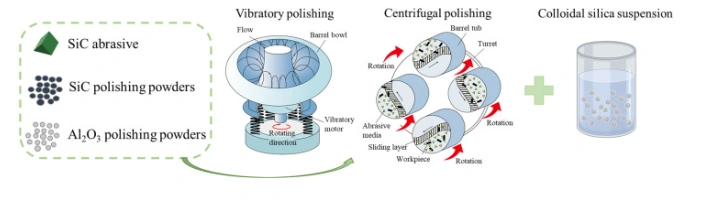
Fig. 1. Schematic diagram of 3D polishing technology.
Research Process
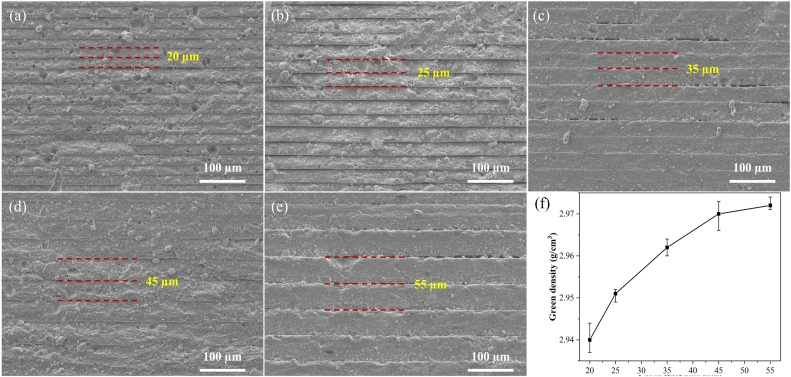
Fig. 2. (a–e) Surface microstructures and (f) densities of green bodies fabricated with layer thicknesses of 20, 25, 35, 45, and 55 µm.
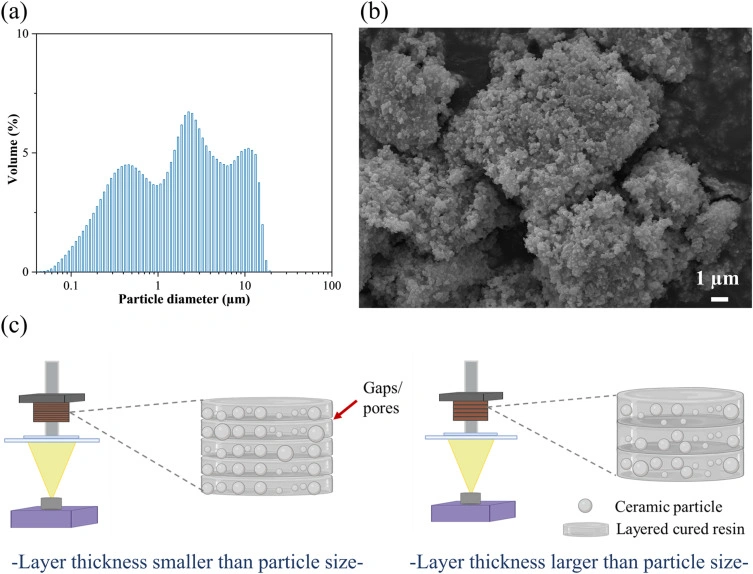
Fig. 3. (a) Particle size distribution and (b) SEM image of doped Y2O3 powders. (c) Schematic diagram of the relationship between layer thickness and particle size.
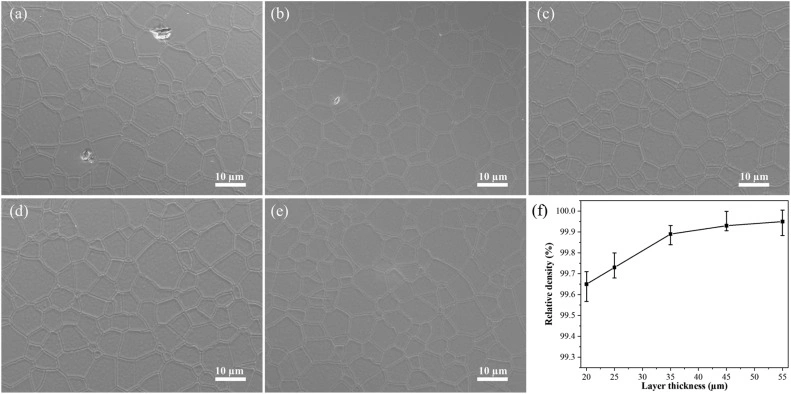
Fig. 4. (a–e) Cross-sectional microstructures of Y2O3 sintered bodies fabricated with layer thicknesses of 20, 25, 35, 45, and 55 µm. (f) Relative densities of Y2O3 sintered bodies fabricated with different layer thicknesses.
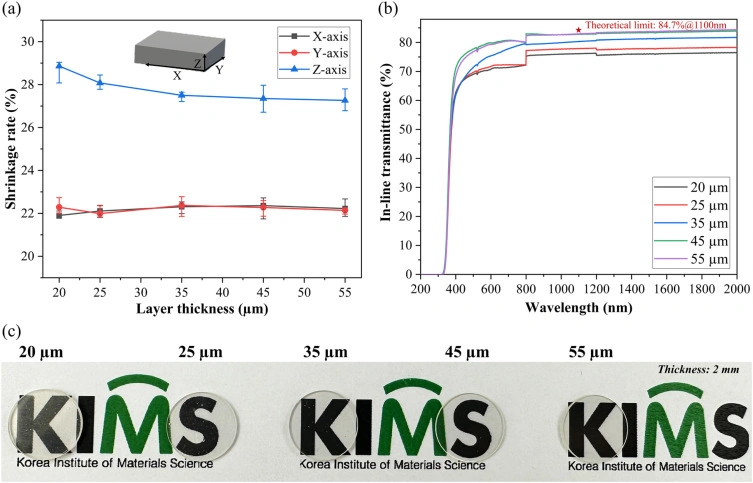
Fig. 5. (a) Shrinkage rate, (b) in-line transmittance, and (c) photographs of Y2O3 ceramics printed with different layer thicknesses.
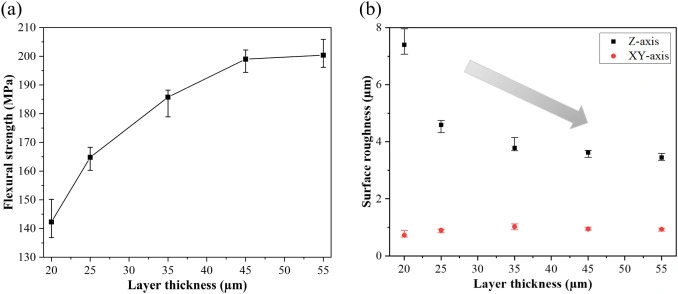
Fig. 6. (a) Flexural strength and (b) surface roughness of as-sintered Y2O3 ceramics printed with different layer thicknesses.
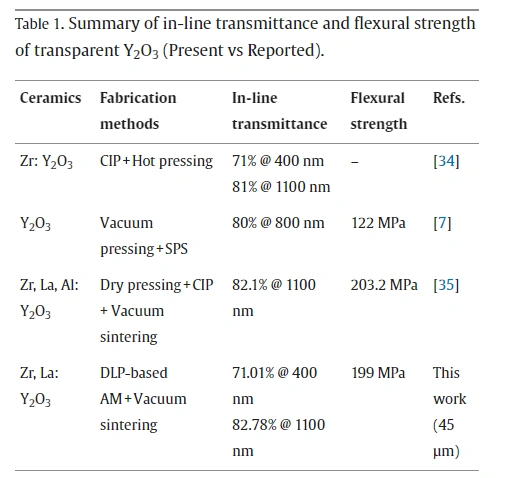
The findings indicate that an increase in the layer thickness correlates with a heightened density in the printed green bodies, subsequently leading to enhanced transmittance in the final sintered body. When the layer thickness approximates or falls below the size of large particle agglomerations found in ceramic powders, numerous pores, and voids emerge within the green bodies. Significantly, at a layer thickness of 45 µm, the in-line transmittance of Y2O3 can reach up to 97.73% of the theoretical limit.
Effect of polishing conditions on AM-fabricated Al2O3 properties
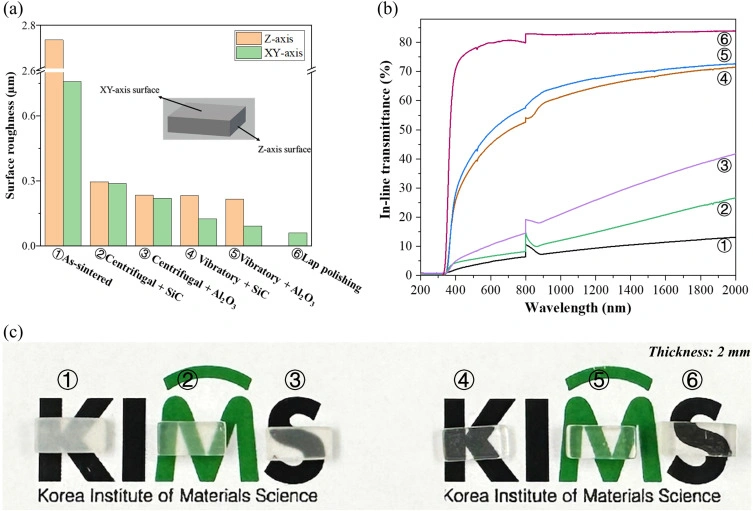
Fig. 7. (a) Surface roughness, (b) in-line transmittance, and (c) photographs of Y2O3 ceramics polished with different methods.
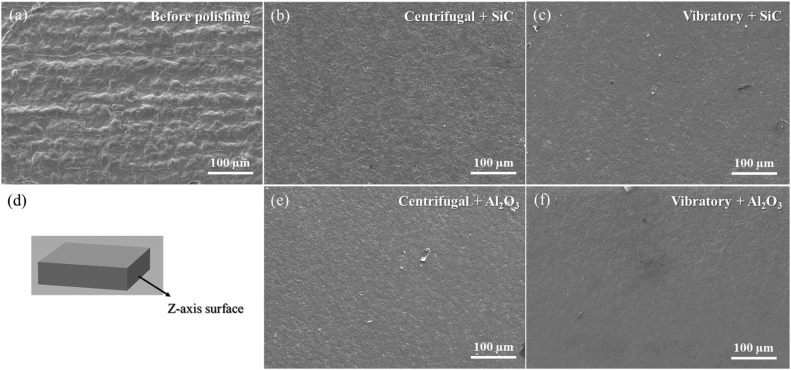
Fig. 8. SEM images of Z-axis surfaces of Y2O3 ceramics (a) before polishing and after polishing with the combinations of (b) centrifugal polishing and SiC powder, (c) vibratory polishing and SiC powder, (e) centrifugal polishing and Al2O3 powder, and (f) vibratory polishing and Al2O3 powder. (d) Schematic diagram of Z-axis surface.
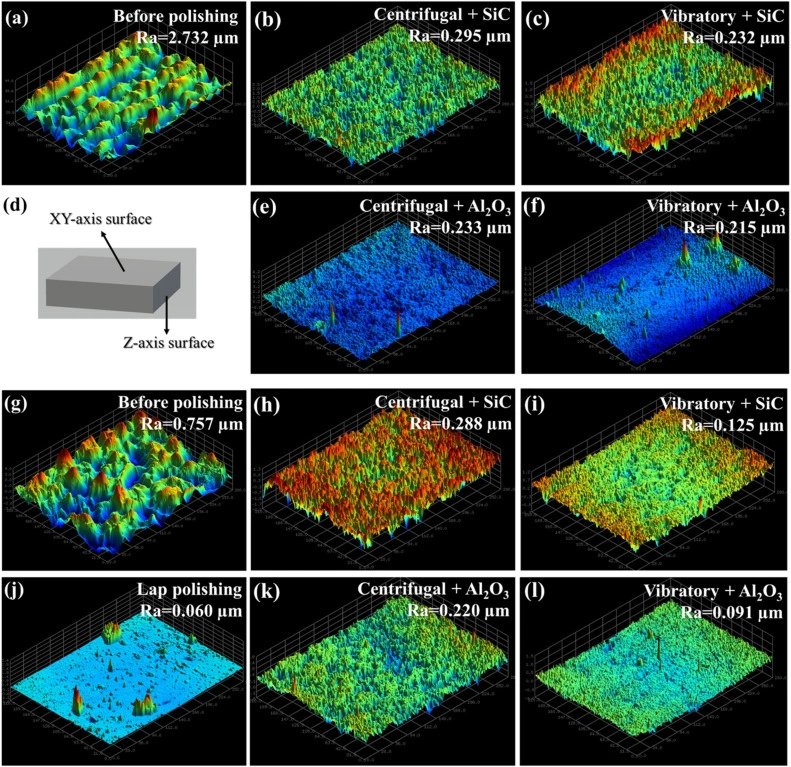
Fig. 9. Z-axis surface morphologies of Y2O3 ceramic (a) before polishing and after polishing with the combinations of (b) centrifugal polishing and SiC powder, (c) vibratory polishing and SiC powder, (e) centrifugal polishing and Al2O3 powder, (f) vibratory polishing and Al2O3 powder. (d) Schematic diagram of XY-axis and Z-axis surface. XY-axis surface morphologies of Y2O3 ceramic (g) before polishing, after polishing with the combinations of (h) centrifugal polishing and SiC powder, (i) vibratory polishing and SiC powder, (j) lap polishing, (k) centrifugal polishing and Al2O3 powder, (l) vibratory polishing and Al2O3 powder.
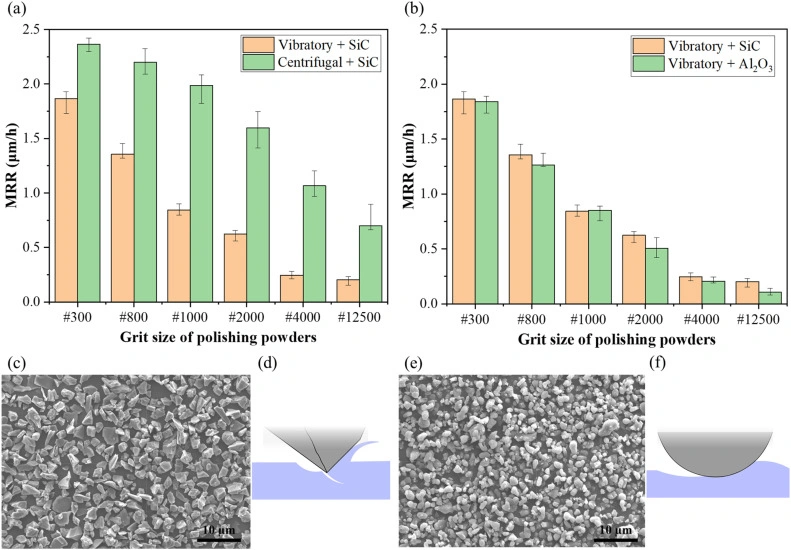
Fig. 10. Material removal rates using (a) different polishing methods and (b) different polishing powders. SEM images of 3000 mesh (c) SiC and (e) Al2O3 polishing powders. Schematic diagram of surface polishing with (d) angular and (f) round powder particles.
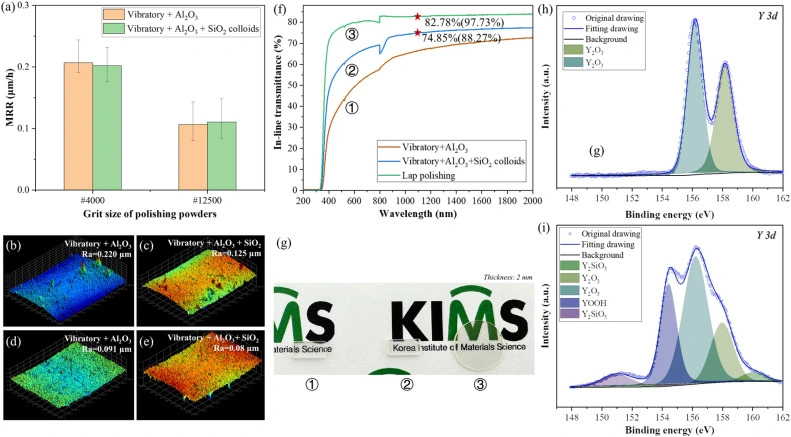
Fig. 11. (a) Material removal rate, (f) in-line transmittance, and (g) photographs of Y2O3 ceramics polished by different polishing methods. Z-axis surface morphology of Y2O3 ceramics polished by the combination of (b) vibratory polishing and Al2O3 powder, (c) along with colloidal SiO2 suspension. XY-axis surface morphology of Y2O3 ceramics polished by the combination of (e) vibratory polishing and Al2O3 powder, (f) along with colloidal SiO2 suspension. XPS spectrum of Y2O3 ceramic surface (h) before and (i) after chemical-mechanical polishing.
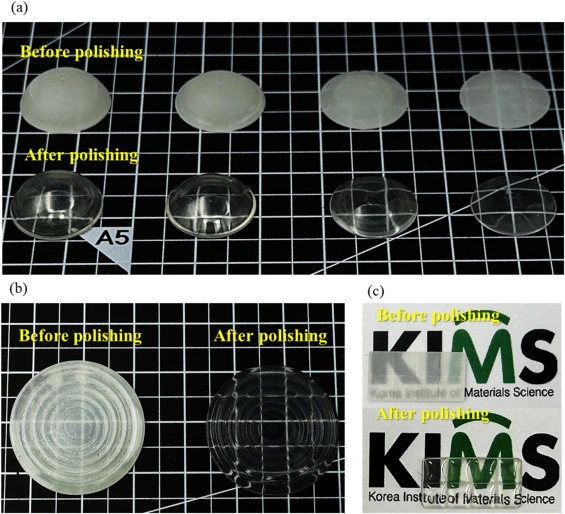
Fig. 12. Photographs of (a) gradient-angle domes, (b) Fresnel lens, and (c) 3D lens array before and after vibration-assisted chemical-mechanical polishing.
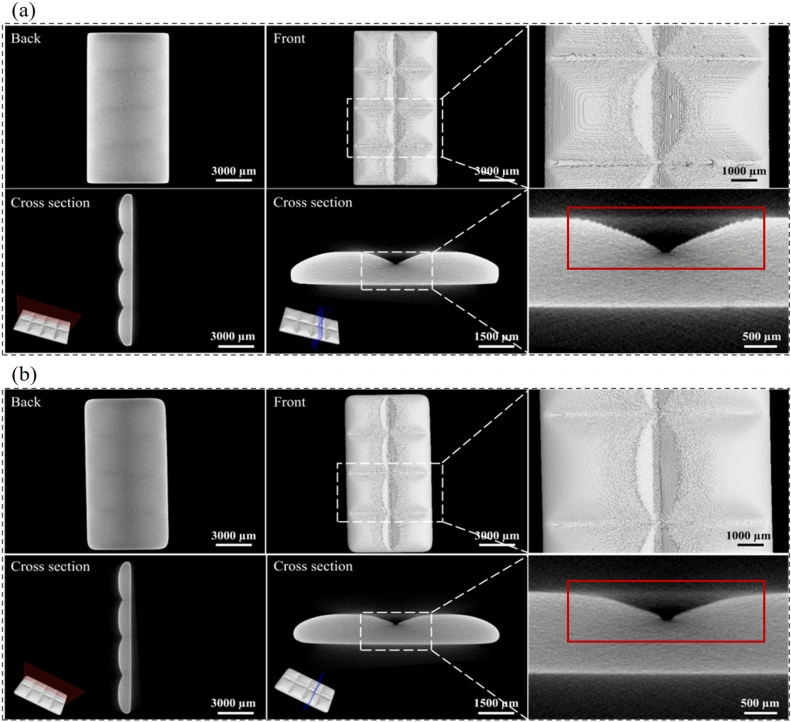
Fig. 13. CT images of 3D lens array (a) before and (b) after vibration-assisted chemical-mechanical polishing.
The surface roughness of the Y2O3 ceramics decreased as the layer thickness increased. To facilitate the further transition from translucent to transparent 3D Y2O3 structures, a vibration-assisted chemical-mechanical polishing technique was developed by replacing water with a colloidal SiO2 suspension. This technique resulted in a significant reduction in the surface roughness of the Y2O3 ceramics by 95.42% and eliminated the stair-stepping phenomenon caused by AM, thus increasing 66.12% of the in-line transmittance.
Conclusions
This study investigated the impact of layer thickness on the microstructure and surface quality of Y2O3 ceramics produced using AM. The results revealed that increasing the layer thickness led to a denser microstructure, increased the transmittance, and reduced the surface roughness of the Y2O3 ceramics. It was determined that when the layer thickness was 45 µm, the transmittance of the AM-fabricated Y2O3 ceramic at a wavelength of 1100 nm achieved 97.73% of the theoretical limit, and the relative density reached 99.95%. The preparation of truly 3D transparent Y2O3 was realized using the developed vibration-assisted chemical-mechanical polishing technology, which involved the combined actions of vibratory polishing, Al2O3 powders, and colloidal SiO2 solution. It also removed the stair-stepping phenomenon caused by AM printing. These enhancements expand their potential applications in laser amplification, optical communications, and other areas requiring high-transparency materials.
Original link: https://doi.org/10.1016/j.jmst.2024.11.019