
AdventureTech leads innovation in ceramic 3D printing with advanced DLP 3D printing systems designed for challenging materials, including high temperature ceramics like ultra-high-temperature ceramics (UHTCs). Our ceramic 3D printers excel at processing high-viscosity ceramic slurries, enabling reliable fabrication of components for extreme environments. This article explores the critical rheology and sedimentation characteristics of ceramic slurries in DLP 3D printing, focusing on UHTCs such as tantalum carbide (TaC) and titanium carbide (TiC).
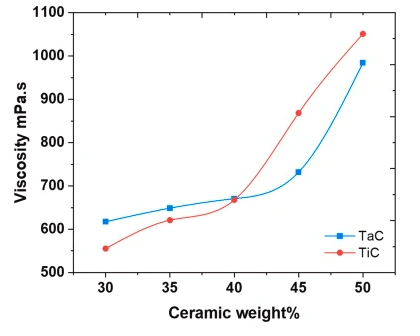 Viscosity curves of TaC and TiC ceramic slurries at varying solid contents, illustrating shear-thinning behavior essential for DLP compatibility.
The Role of Rheology in Ceramic Slurry for DLP Printing
Effective ceramic 3D printing via DLP 3D printing demands ceramic slurries with optimized rheological properties: low viscosity under high shear for smooth recoating, yet sufficient yield stress for shape retention post-curing. For high temperature ceramics, slurries typically require 30-50 wt% solid loading to achieve dense final parts after sintering.
Particle interactions, shear-thinning behavior, and dispersant dynamics govern flow characteristics. High-density materials like TaC exhibit stronger sedimentation tendencies than lower-density TiC, impacting long-term stability during printing.
AdventureTech‘s ceramic 3D printers, featuring peristaltic feeding and automatic filtration, mitigate these issues by maintaining slurry homogeneity even with high-solid-content formulations.
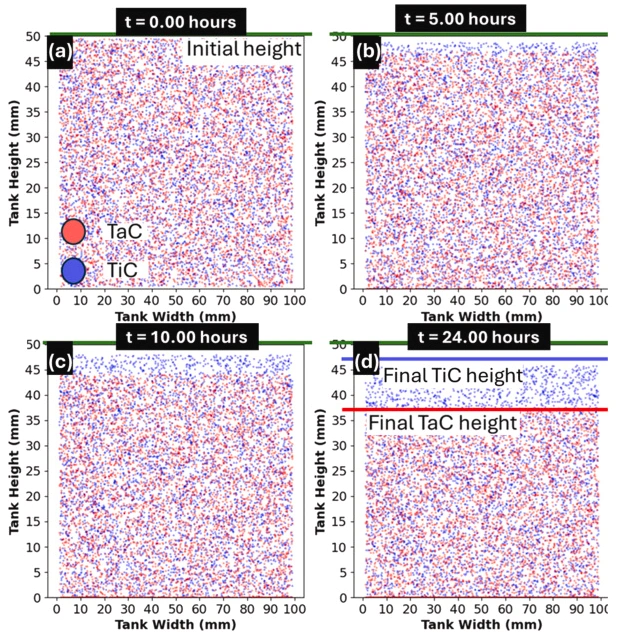 Sedimentation profiles comparing high-density TaC and lower-density TiC slurries, highlighting stability differences over time.
Sedimentation Challenges and Dispersant Optimization
Sedimentation in high-density ceramic slurries (e.g., TaC) arises from gravitational forces outweighing Brownian motion, leading to inhomogeneities and print defects. Experimental methods like flow sweep and amplitude sweep tests reveal how dispersant concentration influences viscoelastic properties and anti-sedimentation performance.
Optimizing dispersants reduces viscosity at operational shear rates while enhancing storage modulus, improving DLP 3D printing reliability for high temperature ceramics.
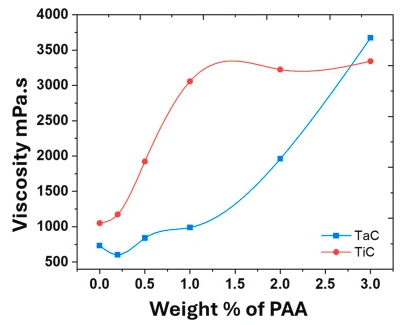 Amplitude sweep results showing the impact of dispersant concentration on storage and loss modulus in UHTC slurries.
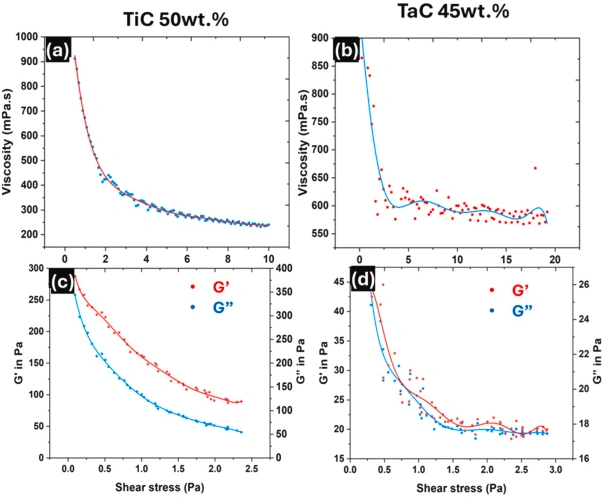 Flow sweep curves illustrating shear-thinning and viscosity reduction with optimized dispersant levels for better recoating in DLP printing.
Experimental Insights and Printed Outcomes
Studies on TaC and TiC slurries demonstrate that balanced particle interactions and dispersant kinetics enable stable, printable formulations. Shear-thinning ensures efficient layer recoating, while controlled sedimentation prevents nozzle clogging analogs in vat systems.
Successful prints yield dense UHTC components with minimal defects, suitable for aerospace and hypersonic applications requiring thermal stability above 2000°C.
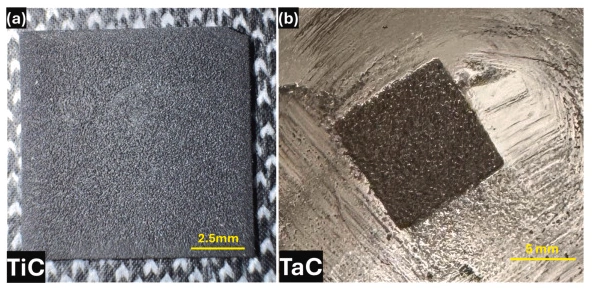 Complex lattice structure printed from optimized UHTC slurry, showcasing geometric freedom in high temperature ceramics.
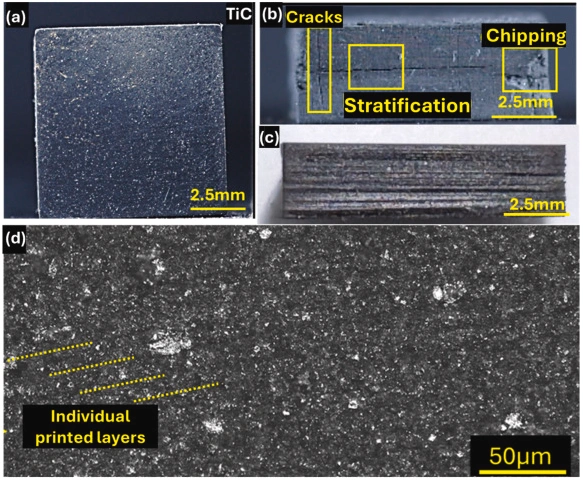 High-resolution UHTC part demonstrating layer uniformity and detail retention post-optimization.
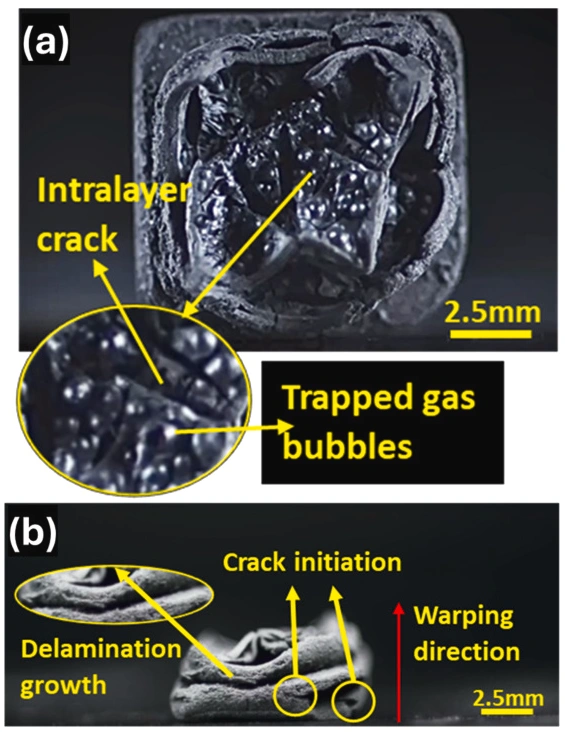 Advanced UHTC prototype with internal channels, enabled by stable ceramic slurry handling.
 Sintered high-density TaC-based part achieving excellent mechanical properties.
 Intricate high temperature ceramic component highlighting the capabilities of optimized slurries in DLP printing.
These results, achievable on AdventureTech platforms, underscore how rheology-informed slurry design advances reliable ceramic 3D printing of UHTCs.
Applications in Extreme Environments
Optimized ceramic slurries enable high temperature ceramics for turbine blades, hypersonic leading edges, and nuclear components—where traditional manufacturing falls short in complexity and performance.
Challenges and Future Directions
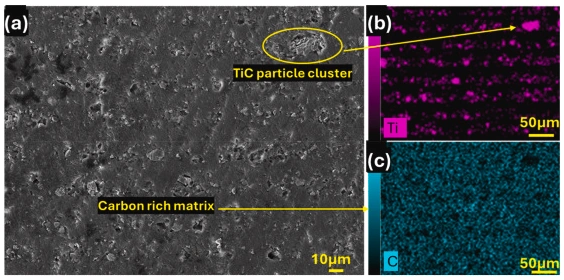
Ongoing hurdles include scaling high-solid loadings without agglomeration and ensuring long-term slurry stability. Advances in dispersants and printer hardware, like AdventureTech‘s dual-scraper and filtration systems, continue to push boundaries.
Partner with AdventureTech for High Temperature Ceramic Solutions
Founded in 2015, AdventureTech delivers industrial-grade ceramic 3D printers trusted by Tsinghua University, Harbin Institute of Technology, and the Chinese Academy of Sciences. Our expertise in high-viscosity ceramic slurry handling supports breakthrough research in high temperature ceramics.
Explore our DLP systems at AdventureTech About Page.