
Imagine this scenario: an aerospace engine manufacturer is designing the next-generation turbine blade. The design requirements are exceptionally demanding: it must withstand continuous high temperatures of 1600°C, have a complex internal cooling channel structure, weigh 40% less, and all work from design verification to functional prototype must be completed within 8 weeks. Traditional precision ceramic casting processes struggle to meet these challenges—mold costs are high, manufacturing cycles are long, and most importantly, the biomimetic topological structures that significantly improve cooling efficiency simply cannot be manufactured using traditional methods.
This is the reality that ceramic 3D printing is disrupting. Today, industries such as aerospace, electronics, energy, medical devices, and advanced engineering all rely on technical ceramics to address challenges related to high-temperature resistance, chemical stability, and mechanical durability.
This article provides a clear and comprehensive overview of ceramic 3D printing technology—including its working principles, importance, underlying technologies, and application areas. Whether you are evaluating new manufacturing methods, researching materials, or exploring engineering-grade ceramic solutions, this article will help you understand the fundamental principles and advantages of ceramic additive manufacturing. Incidentally, if you need assistance, please contact us immediately. As a provider of high-tech solutions for ceramic additive manufacturing, Adventure Technology focuses on helping businesses accelerate innovation and overcome production bottlenecks.
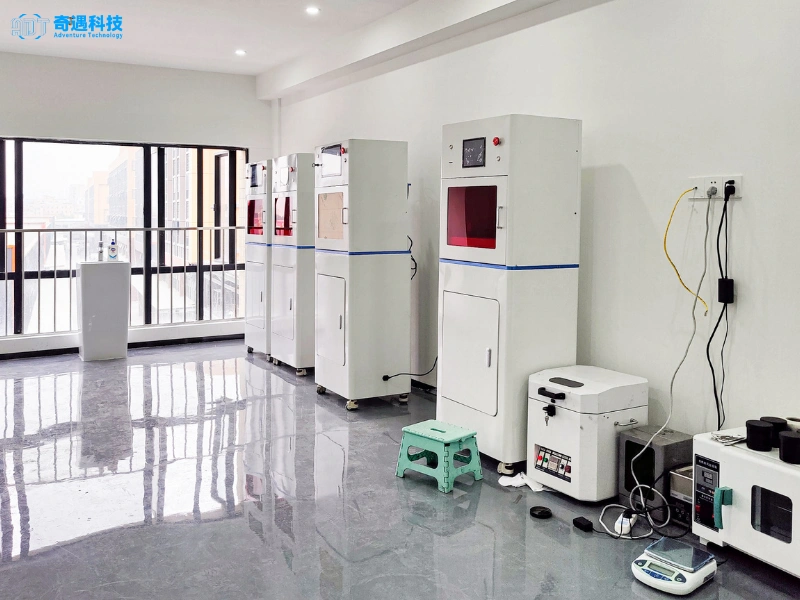
Current Situation Statement
According to Research Nester data, the global manufacturing 3D printing market reached approximately US$19.74 billion in 2024 and is expected to grow to US$122.84 billion by 2037, with a compound annual growth rate (CAGR) of 15.1%. Meanwhile, although ceramic 3D printing started later and is smaller in scale, its development speed far exceeds the average level of the additive manufacturing industry. A Grand View Research report shows that the ceramic 3D printing market was approximately US$0.97 billion in 2024 and is expected to grow to US$3.88 billion by 2030, with a CAGR of 25.7%.
What is Ceramic 3D Printing?
Before delving into the technical details, let's first state a fundamental concept: what is the essence of ceramic 3D printing?
Simply put, it is the combination of advanced ceramic materials science and digital additive manufacturing technology, which allows for the direct fabrication of complex geometric ceramic parts based on three-dimensional digital models through a layer-by-layer construction process. The core of the technology is the combination of ceramic powder or slurry with a forming mechanism (such as photopolymerization, binder jetting, or material extrusion) to create a green body. However, unlike common plastic or metal 3D printing, ceramic printing involves a crucial "secondary transformation" process—the printed object is only a green body, which must undergo precisely controlled debinding and high-temperature sintering to obtain the final, fully dense ceramic part.
This is precisely where the unique charm and challenges of ceramic 3D printing lie. It is not just a printer, but a complete ecosystem encompassing material formulation, printing process, post-processing sintering, and quality control.
How Ceramic 3D Printing Works
Ceramic 3D printing involves several key stages—from preparing the digital model to printing, debinding, sintering, and final finishing.
Each step affects the precision, strength, and final performance of the ceramic component.
Digital Model Preparation
The process begins with a 3D CAD model of the part. Engineers optimize the design for ceramic additive manufacturing by adjusting wall thickness, support structures, internal channels, and tolerances. The model is then sliced into thin layers, creating the instructions the printer will follow.
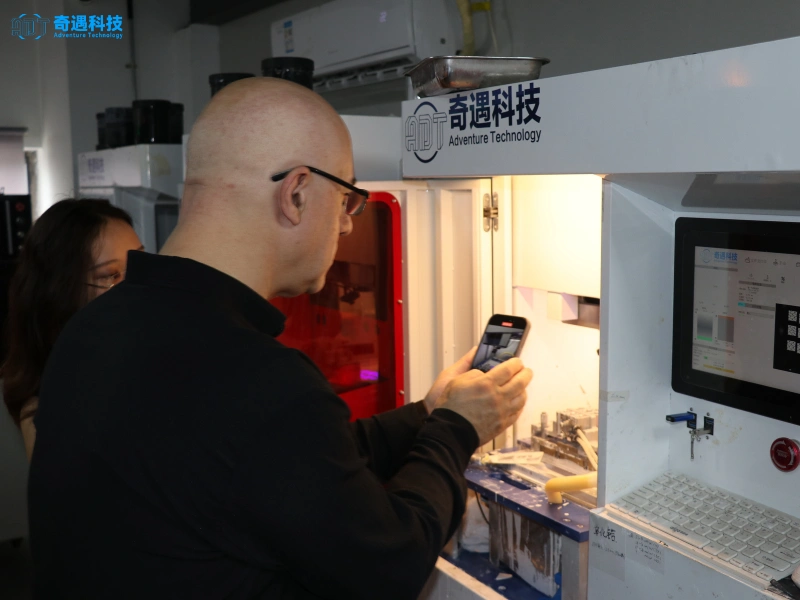
Layer-by-Layer Printing
Depending on the printing technology—such as SLA/LCM, binder jetting, or material extrusion—the printer forms the part layer by layer using ceramic-loaded resin, ceramic powder with binder, or a ceramic paste.
This step creates what is known as a “green body,” which has the correct shape but is not yet fully dense or strong.
Debinding & Sintering
After printing, the green part undergoes debinding to remove organic binders or polymers.
Then it is sintered at high temperatures—typically between 1,000°C and 1,600°C—causing ceramic particles to fuse and densify.
This stage significantly strengthens the part and determines its final mechanical, thermal, and chemical properties.
Post-processing
Once sintered, the part may undergo additional finishing processes such as grinding, polishing, machining, or coating to achieve the desired surface quality or functional performance. Industrial applications may also require dimensional inspection or nondestructive testing.
Main Ceramic 3D Printing Technologies
Ceramic 3D printing includes several distinct technological approaches, each suited for different materials, resolutions, and industrial applications. Below are the most widely used technologies in the field today.
SLA / LCM (Lithography-Based Ceramic Manufacturing)
SLA/LCM is one of the highest-resolution ceramic 3D printing methods. It uses light—typically UV—to selectively cure layers of ceramic-filled photopolymer resin. After printing, the resin is removed, and the ceramic part is sintered to achieve full density.
Key advantages:
- Extremely high precision
- Smooth surface finish
- Ability to produce very fine features
- Suitable for technical ceramics like alumina and zirconia
Typical applications:
Microfluidics, semiconductor components, dental parts, high-precision engineering parts.
Binder Jetting
Binder jetting spreads a thin layer of ceramic powder and selectively deposits a liquid binder to form each layer. After printing, the part undergoes debinding and sintering.
Key advantages:
- Faster printing speed
- Suitable for larger components
- No need for support structures
- Lower material cost
Typical applications:
Industrial components, porous ceramics, large technical parts.
Material Extrusion
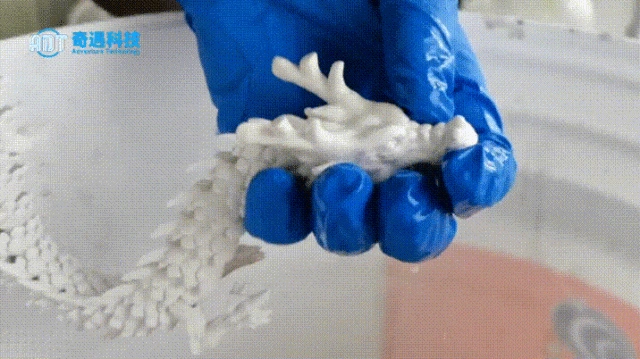
Material extrusion uses a ceramic paste or slurry that is extruded through a nozzle to build the part layer by layer. This method is flexible and suitable for both technical and traditional ceramics.
Key advantages:
- Cost-effective
- Compatible with various ceramic materials
- Good for functional prototypes and structural parts
Typical applications:
Filters, biomedical scaffolds, structural ceramics, experimental research.
elective Laser Sintering (SLS) for Ceramics
Although less common for ceramics due to high melting points, SLS can be used for certain low-melting or specially formulated ceramic powders. A laser selectively sinters powder particles to form each layer.
Key advantages:
No binders required
Strong mechanical properties
Suitable for complex geometries
Typical applications:
Specialty ceramics, R&D, custom-designed functional parts.
Conclusion
Ceramic 3D printing is transforming the way engineers and manufacturers design and produce high-performance ceramic components.
The fact remains that, since the technology is still in its early stages, organizations that adopt ceramic 3D printing early gain significant benefits—they become more flexible in design, more efficient in production, and able to innovate more than ever before. Whether you are exploring the technology for prototyping, research, or producing final products, ceramic additive manufacturing offers new opportunities not possible with traditional technologies.
If you want to learn more about how ceramic 3D printing can support your applications or engineering challenges, Adventure Technology is ready to assist you with expertise, materials, and tailored solutions.