
With the rapid development of additive manufacturing technologies, 3D printing has been widely applied across many industries. In particular, DLP (Digital Light Processing) ceramic 3D printing, known for its high precision and high resolution, has emerged as a new force in the field of ceramic manufacturing. However, this technology is more challenging than it appears on the surface.
This article will guide you through the complete workflow of DLP ceramic 3D printing, helping you better understand this advanced additive manufacturing technology.
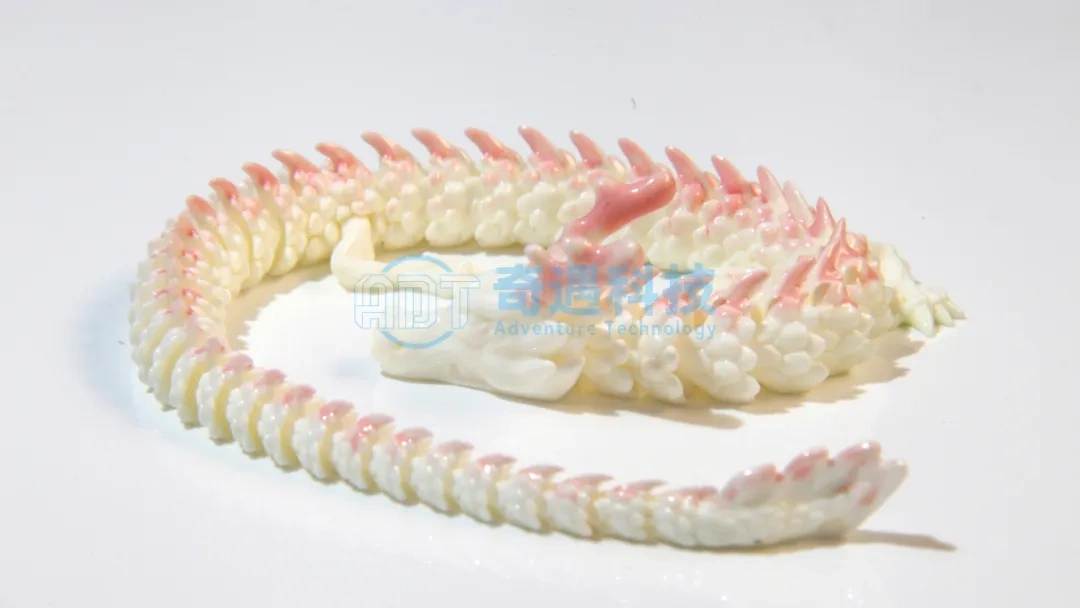
What is DLP Ceramic 3D Printing?
DLP ceramic 3D printing is a high-precision additive manufacturing technique based on digital light projection.
It works by mixing ceramic powders with photosensitive resins to form a printable slurry. The printer cures the slurry layer by layer, forming intricate ceramic components with high detail and structural accuracy.
Key advantages include:
- High-resolution layer-by-layer printing
- Efficient production of complex geometries
- Compatibility with advanced ceramics like zirconia and alumina
The Complete DLP Ceramic 3D Printing Workflow
1.3D Modeling
Use professional CAD software (such as SolidWorks or Rhino) to create a 3D geometric model of the product. To ensure the model is suitable for DLP printing, special attention must be paid to the model’s structural support and dimensional tolerances during the design process.
2.Slicing the Model
Next, the 3D model is imported into slicing software (e.g., CHITUBOX) and divided into multiple 2D layers for printing.
At this stage, engineers set key printing parameters, such as layer thickness, exposure time, and light intensity, according to the material properties and desired print quality.
3.Preparing the Ceramic Slurry
Depending on the material of the product to be printed (such as advanced ceramics like zirconium oxide, alumina, and silicon carbide), weigh out an appropriate amount of ceramic powder and photosensitive resin and mix them to prepare a ceramic slurry. This step requires the slurry to have good fluidity and uniformity to ensure the stability of the slurry during the printing process.In DLP ceramic printing, slurry formulation is highly sensitive to particle size distribution and solid loading. Poor slurry stability can lead to sedimentation, inconsistent curing depth, and print defects.
4.Printing
We pour the prepared ceramic slurry into the printer’s resin tank, and the DLP ceramic 3D printer cures each layer using digital light projection. Operators carefully adjust exposure parameters, including exposure time and light intensity, to achieve precise layer solidification and maintain dimensional accuracy in the final ceramic part.
5.Cleaning
After printing, remove the sample, select a suitable cleaning solvent to clean it, remove the ceramic slurry adhering to the surface, and obtain the product blank.
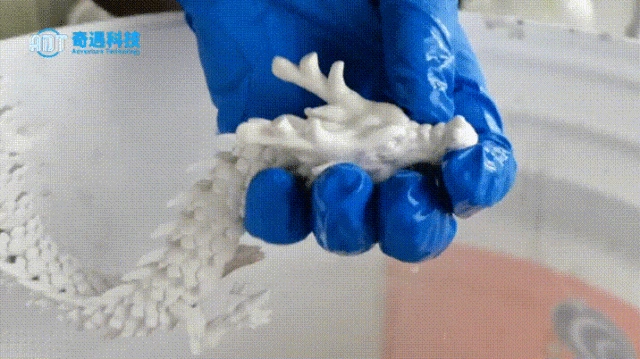
The animation demonstrates the meticulous sample cleaning process.
6.Debinding and Sintering
The sample preform needs further debinding and sintering to remove organic components (photosensitive resin) and sinter the ceramic particles into a dense solid. This step is a key step in photopolymer DLP ceramic 3D printing and is time-consuming; for some larger samples, it may take 3-4 days for debinding and sintering.
7.Post-Processing
Sintered parts may need polishing, grinding, or glazing for improved surface finish and durability.
Benefits of post-processing:
- Enhances aesthetics
- Improves mechanical performance
- Extends component lifespan
Photopolymer DLP ceramic 3D printing technology exhibits extremely high precision and the ability to form complex structures through a complete process from 3D model design, slicing and parameter setting, ceramic slurry preparation, layer-by-layer curing and printing to sintering.
Why choose us for DLP ceramic 3D printing?
Choosing the right DLP ceramic 3D printing system depends on more than just machine specifications. More importantly, it depends on whether the entire process, from material properties to sintering results, is truly understood and controlled.
We are a high-tech company specializing in ultra-high-speed ceramic additive manufacturing technology, providing users with complete overall solutions for ceramic 3D printing.