
In ceramic sintering research, temperature, holding time, atmosphere, and powder properties are usually considered decisive factors, while gravity is often overlooked. However, from the initial particle rearrangement in the early stages of sintering to the densification kinetics and microstructure evolution in the middle and later stages, gravity is always involved, influencing the sintering results in a subtle yet real way. With the advancement of hypergravity and microgravity experiments and research on complex ceramic structures, the effect of gravity is gradually transforming from a neglected constant into a variable worthy of active study.
| Parameter / Gravity Environment | Hypergravity | Normal Gravity | Microgravity |
|---|---|---|---|
| Density | High (up to 99.96%) | Medium | Low |
| Shrinkage Rate | Relatively High | Medium | Low |
| Porosity | Extremely Low | Medium | Relatively High |
| Material Transport Rate | Fast | Medium | Slow |
Overview of the Ceramic Sintering Process
Ceramic sintering is the process of heating 3D-printed ceramic “green bodies” to high temperatures, causing the particles to diffuse and bond with each other, ultimately forming a dense, hard final part. Sintering not only changes the material’s microscopic structure but also causes the part to shrink—an effect that is crucial for both dimensional accuracy and mechanical performance.
During sintering, several key physical changes occur:
- Particle diffusion and bonding: Ceramic particles move at high temperatures and fuse together, creating a continuous, dense structure.
- Pore shrinkage: Voids within the green body gradually diminish, increasing the density of the part.
- Overall shrinkage: The entire ceramic piece contracts, with the extent of shrinkage depending on the material type and sintering temperature.
It’s important to note that as the temperature rises, the mechanical strength of the green body drops significantly. At this stage, the material becomes more susceptible to deformation from external forces—or even its own weight. Understanding these mechanical changes and shrinkage behaviors during sintering is therefore essential for predicting and controlling sagging or distortion caused by gravity.
How Gravity Influences Ceramic Sintering
1. Early Sintering
In the early stages of sintering, before significant atomic diffusion and grain boundary migration occur, the densification of the green body mainly relies on particle rearrangement and improved contact conditions. At this stage, gravity does not act as macroscopic compaction, but rather by influencing the local stability and packing pattern of particles, reducing initial porosity and creating more favorable structural conditions for subsequent densification.
Experiments show that even at the micrometer or submicrometer scale, gravity can significantly improve particle arrangement. For example, in a 0.1 μm-scale MgO powder system, the density of the sintered body can approach 99.5% by utilizing gravity conditions appropriately. This indicates that the initial structure in the early stages of sintering is not only determined by the forming process, but gravity also plays a role in shaping the initial microstructure.
2.Densification Stage
In the mid-to-late stages of sintering, the densification process is primarily driven by diffusion, evaporation-condensation, and grain boundary migration. Gravity does not directly drive atomic diffusion, but it indirectly affects the material transport path and rate by altering particle contact relationships, pore morphology, and local stress distribution.
- Under normal gravity conditions, this effect is usually considered naturally occurring and insignificant.
- Under hypergravity conditions, particle contact is more complete, pores are easier to close, diffusion and evaporation-condensation are accelerated, and density increases.
- In a microgravity environment, particle rearrangement is limited, the densification process slows down, and the final density is lower than that obtained under normal gravity sintering.
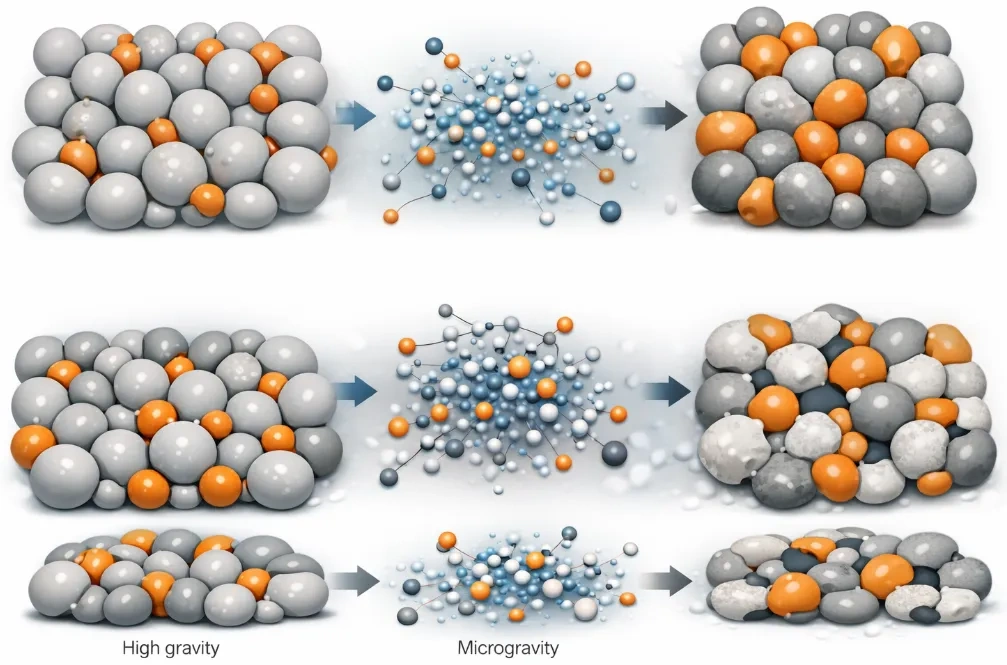
3. Pores, Shrinkage, and Macroscopic Properties
The pore structure forms a crucial link between the sintering process and material performance. Gravity significantly affects pore evolution: during the transition from interconnected pores to isolated pores, the number, size, and distribution of voids are all influenced by gravitational conditions.
Studies show that in certain oxide ceramic systems, a 5% increase in internal porosity can lead to a 25% drop in tensile strength. In atmospheric-pressure sintering of 3D-printed silicon carbide ceramics, the combined effects of structural constraints and gravity can produce overall linear shrinkage exceeding 20%, placing higher demands on dimensional accuracy.
4. Structural Stability in the High-Temperature Viscoplastic Stage
When the sintering temperature approaches or exceeds the material’s softening range, the green body enters a high-temperature viscoplastic state, reducing its resistance to deformation. At this point, the effect of gravity becomes more pronounced: thin-walled, cantilevered, or complex topological structures may exhibit creep sagging or localized deformation.
Why are ceramic 3D printed parts more susceptible to gravity
Ceramic 3D printed parts are more susceptible to gravity than traditionally molded ceramics, primarily due to the characteristics of their manufacturing process. Firstly, printed parts are formed by stacking layers one by one, with each layer having limited bonding strength. Secondly, ceramics typically have high porosity and low mechanical strength. Therefore, as sintering temperatures rise and the material softens, sagging, bending, or warping is more likely to occur. Furthermore, 3D printing can create suspended, thin-walled, or complex free-form surface structures, especially for large parts, increasing their weight and making them more prone to localized deformation or dimensional deviations.
How to Reduce Gravity Effects
Although gravity cannot be avoided during ceramic sintering, sagging, bending, and dimensional deviations can be reduced through proper design and process control. Common methods include:
Optimizing Part Design
During the design stage, increasing the thickness of thin sections or adding fillets can improve local stiffness and enhance part stability during sintering. At the same time, adjusting the orientation of the part in the furnace to reduce overhanging or load-bearing thin walls is helpful. For complex structures, removable supports can be added to help maintain overall shape stability.
Improving Green Body Strength
Choosing high-performance slurries or pastes to enhance layer-to-layer bonding can effectively improve green body stability. In addition, optimizing layer thickness, infill density, and print paths can also enhance overall part strength. Appropriately extending post-print curing or drying time makes the green body stronger and better able to resist gravity-induced deformation.
Controlling the Sintering Process
During sintering, setters or support structures can be used to support the part and prevent collapse at the base. At the same time, adjusting the heating rate and dwell stages slows the material softening, reducing gravity effects. For large or complex parts, segmenting or batch sintering can reduce stress concentration, ensuring dimensional accuracy and structural integrity.
The gravity effect is an important factor in ceramic sintering, and it is particularly significant for ceramic 3D printed parts. For customers aiming to achieve high-quality ceramic 3D printing components for industrial applications, selecting reliable ceramic 3D printing equipment and a well-optimized sintering process is the key to ensuring successful sintering and minimizing the impact of gravity.