
You finish a perfect zirconia part on the DLP 3D printing machine. The geometry looks flawless. Then you put it in the furnace for debinding, and the entire production timeline stalls. Twenty hours, then forty, then sixty, then eighty. The classical literature reports debinding cycles that exceed 120 hours for DLP-printed ZrO2. By the time your green body finally sees a sintering furnace, you have already burned through a full working week, and you have not yet confirmed whether the part has survived the slow polymer burn-out.
Most researchers accept this as the price of doing business. A new study in Ceramics International suggests that the price is much higher than it needs to be — and that a simple post-printing cleaning step is the lever to bring it down.
Yujie Zhao, Shaojun Liu, Fei Liu, and Jiarui Huang from Central South University and the National Center for Nanoscience and Technology published a paper in February 2026 that tackles this exact problem. Their approach is straightforward: rather than redesign the slurry or rewrite the debinding profile, they add a targeted cleaning treatment that builds a network of pore channels inside the ZrO2 green body. Those channels let pyrolysis gas escape during thermal debinding, which prevents cracks and cuts the cycle from 120 hours down to 45 hours. The cleaned parts reach a maximum flexural strength of 1000.4 MPa after sintering at 1500 °C.
In this article, we walk through the study in detail. We explain why debinding is the silent bottleneck in DLP 3D printing of ceramics, what the team did differently, and how you can apply their insights to your own materials and workflows. Whether you make dental implants, structural bioceramics, or functional prototypes, the lessons translate directly.
Why Debinding Is the Silent Bottleneck in DLP 3D Printing
If you have ever run a DLP 3D printing workflow end to end, you know the feeling: the printing step is fast, the post-processing step is slow. A medium-complexity part prints in a few hours. Debinding and sintering together take days.
The reason sits inside the green body itself. A DLP-printed ceramic part is a composite of ceramic powder (typically 80 wt% or more) embedded in a cross-linked photopolymer network. When you heat the green body in a furnace, that polymer network has to decompose and escape as gas. If the gas cannot get out fast enough, pressure builds up inside the part, and you get cracking, delamination, or warping. The classical workaround is to debind very slowly — for example, holding at multiple low temperatures for many hours, or running the cycle under a controlled atmosphere — so the gas has time to diffuse out. The result is a long, painful process.
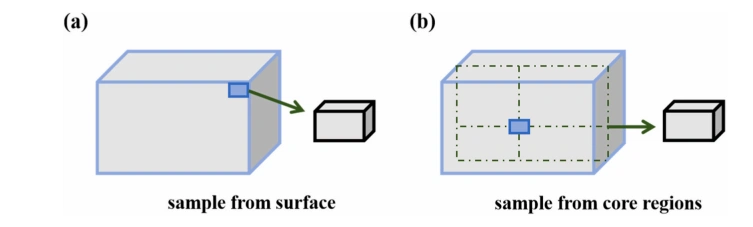
Fig. 1 — Schematic diagram showing how the team took TG samples from DLP-printed ZrO2 green bodies: (a) from the surface and (b) from the core region. The distinction matters because surface and core resin can behave very differently during thermal decomposition. (Reprinted from Zhao et al., Ceramics International 52 (2026) 16735–16744, with permission from Elsevier.)
The recent literature shows several strategies for shortening debinding time:
- Atmosphere control. Shen et al. demonstrated that a 95 vol% N2 + 5 vol% H2 atmosphere suppresses crack formation during debinding.
- Optimized debinding profiles. Marie et al. pushed the maximum thickness of crack-free silicon nitride cubes from 4 mm to 11 mm by tuning the heating schedule.
- Non-reactive diluents in the slurry. Kim et al. showed that adding a diluent reduces debinding defects.
- Solvent or supercritical CO2 pre-treatments. Nurmi et al. demonstrated supercritical CO2 extraction for DLP-fabricated ceramics.
These methods work, but they either require special equipment (gas blending, pressure vessels) or shift the chemistry of the slurry in ways that can hurt printing performance. The cleaning-treatment approach that Zhao and colleagues developed is more accessible. It uses ordinary cleaning baths, runs at atmospheric pressure, and adds only minutes to the workflow.
What the Study Set Out to Do
The team’s goal was simple but ambitious: find a cleaning agent that would build uniform pore channels inside the ZrO2 green body without damaging interlayer bonding, and use those channels to speed up thermal debinding while keeping — or even improving — the mechanical properties of the sintered part.
To test the idea properly, they prepared a high-solid-loading ZrO2 slurry at 82 wt% and printed green bodies on a standard DLP system. The starting powder was sub-micron — fine enough for high-resolution printing without the viscosity penalty that ultra-fine powders impose.
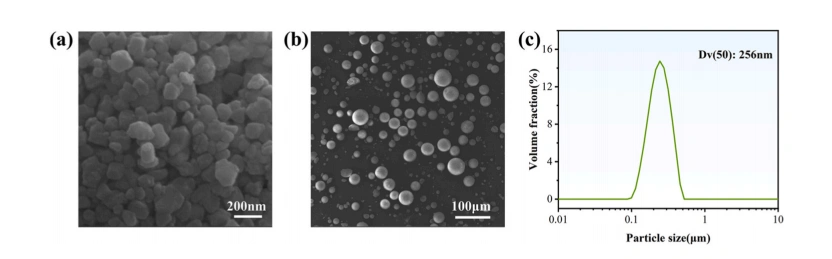
Fig. 2 — Characterization of the starting ZrO2 powder: (a)(b) SEM morphology at two magnifications, and (c) the laser-diffraction particle size distribution. (Reprinted from Zhao et al., Ceramics International 52 (2026) 16735–16744, with permission from Elsevier.)
Rheology and curing tests confirmed the slurry was printable: viscosity stayed below 800 mPa·s at the standard shear rate, and the cure depth at 7 mJ/cm² exposure fell within the forming window. With the printing baseline locked in, they turned to the central question: which cleaning agent should they use?
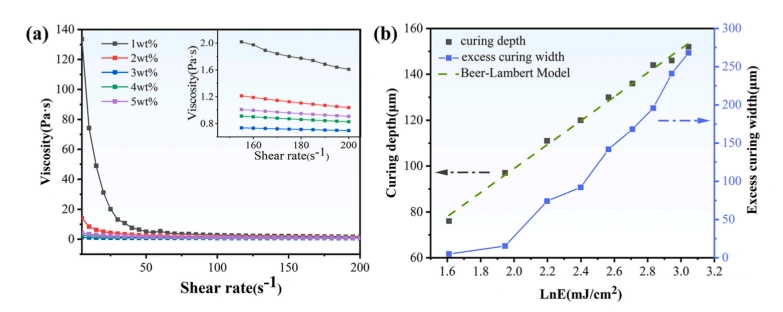
Fig. 3 — Slurry characterization before printing: (a) rheological curves for ZrO2 slurries (82 wt% solid loading) at different 41000 dispersant contents, showing that 3 wt% gives the lowest viscosity across the full shear-rate range; (b) cure depth and excess cure width as a function of exposure energy density, with the working point at 7 mJ/cm² marked by the dashed line. (Reprinted from Zhao et al., Ceramics International 52 (2026) 16735–16744, with permission from Elsevier.)
With the printing window locked in, they turned to the central question: which cleaning agent should they use, and how should they apply it?
Choosing the Right Cleaning Agent
Six cleaning agents went into the screen: TMPTA, PHEA, HDDA, PEG400, a 2H+P blend (HDDA mixed with PHEA at a 2:1 mass ratio), and anhydrous ethanol. Each agent was tested at 50 °C for 30 min, and the mass loss was measured relative to the total resin in the green body.
The results split cleanly into two camps:
- Ethanol extracted the most resin. It pulled 1.94 wt% of the resin out — almost twice as much as the next-best agent.
- The 2H+P blend extracted less resin, but in a more controlled way. It removed 1.18 wt%, with mass loss distributed evenly between the surface and the core.
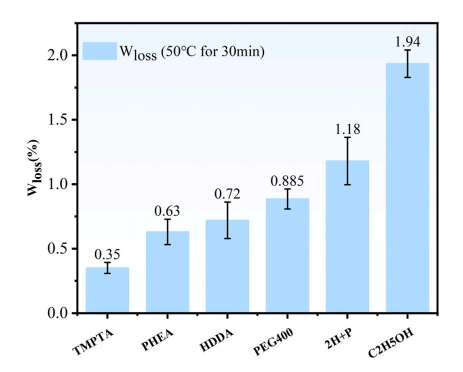
Fig. 4 — Mass loss of ZrO2 green bodies after cleaning with six different agents (50 °C, 30 min). Ethanol gives the highest single-pass extraction (1.94 wt%), while the 2H+P blend achieves a respectable 1.18 wt% with much better uniformity between surface and core. (Reprinted from Zhao et al., Ceramics International 52 (2026) 16735–16744, with permission from Elsevier.)
The team dug into this difference with thermogravimetric (TG) sampling on the cleaned green bodies. They scraped out a small cube from the surface layer (Fig. 1a) and another from the core (Fig. 1b), then ran each sample through a TG analyzer to see how much resin remained.
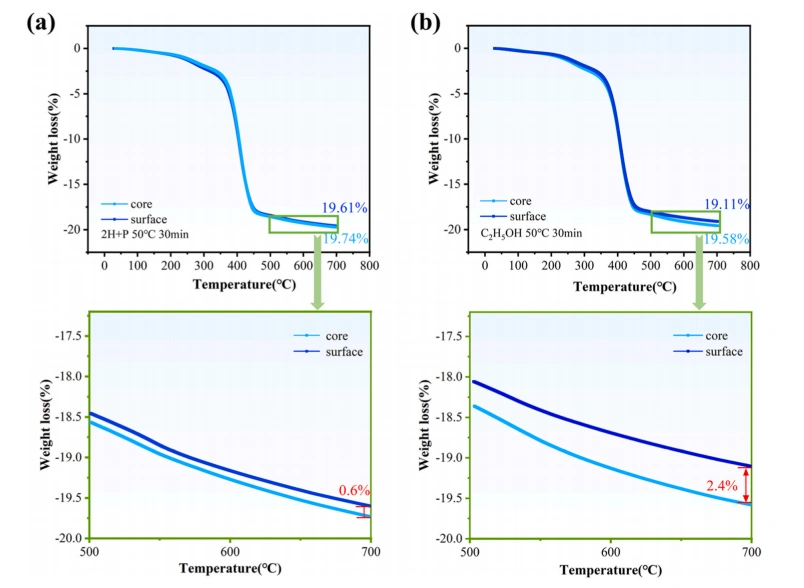
Fig. 5 — TG curves of the cleaned ZrO2 green bodies, comparing the surface sample (dark blue) and the core sample (light blue) for each cleaning agent. (a) After 2H+P cleaning, the surface–core mass-loss gap is only 0.6%, indicating uniform pore formation. (b) After ethanol cleaning, the same gap is 2.4% — four times larger. (Reprinted from Zhao et al., Ceramics International 52 (2026) 16735–16744, with permission from Elsevier.)
The TG curves tell a clear story. With 2H+P, the weight-loss curve for the surface and the core run almost on top of each other; the difference at 700 °C is just 0.6 wt%. With ethanol, the surface loses much more weight than the core, leaving a 2.4 wt% gap. The visible appearance of the cleaned parts confirms the gap: 2H+P-treated green bodies look identical from surface to core, while ethanol-treated samples show distinct discoloration and microcracks on the surface.
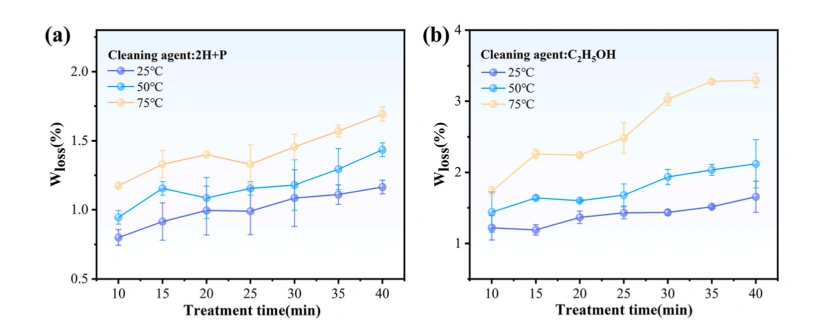
Fig. 6 — Optical micrographs of the cleaned ZrO2 green bodies at different temperatures (25 °C, 50 °C, 75 °C) and treatment times (10, 25, 40 min). (a) 2H+P cleaning preserves structural integrity across all conditions. (b) Ethanol cleaning introduces visible cracks (red rectangles) at elevated temperatures and longer times. (Reprinted from Zhao et al., Ceramics International 52 (2026) 16735–16744, with permission from Elsevier.)
So why does ethanol extract more resin, yet 2H+P builds a better pore network? The answer lies in the chemistry.
Ethanol diffuses fast and dissolves resin aggressively, but it over-extracts the surface while leaving the core relatively untouched. The pores concentrate at the skin, act as stress concentrators during heating, and the green body cracks.
The 2H+P blend takes a gentler path. HDDA — a low-viscosity diluent — swells the polymer network and opens up space. PHEA — a hydroxyl-rich monomer — then anchors to the network through hydrogen bonding, gradually lifting resin away from particle surfaces. The result is uniform pore formation from surface to core, without the stress concentration that cracks ethanol-treated parts.
The takeaway: in cleaning, more extraction does not always mean better results. A uniform, moderate extraction is more valuable than a violent, uneven one.
Practical tip: The interaction between cleaning agent and slurry chemistry is material-specific. If you are developing a new ZrO2 or Al2O3 formulation, ADT’s custom ceramic slurry service can help you match the binder system to your printing and post-processing requirements — including cleaning compatibility.
Temperature and Time: Tuning the Cleaning Window
With 2H+P identified as the preferred agent, the team optimized the cleaning temperature and time. They tested 25 °C, 50 °C, and 75 °C, and tracked mass loss out to 40 minutes.
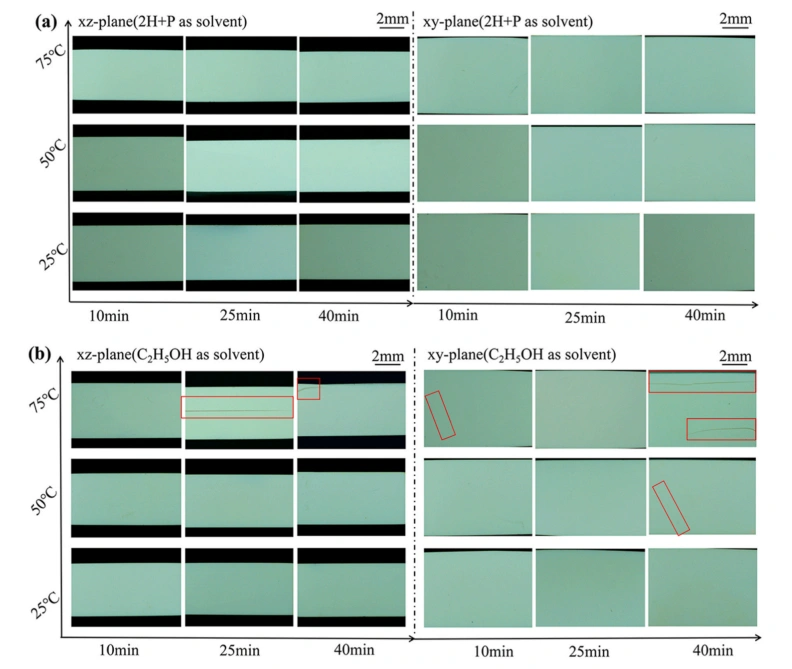
Fig. 7 — Mass loss of ZrO2 green bodies under varying cleaning conditions: (a) 2H+P cleaning agent and (b) anhydrous ethanol cleaning agent. Mass loss rises with both temperature and time for both agents, but the slope is steeper for ethanol, and the scatter is wider. (Reprinted from Zhao et al., Ceramics International 52 (2026) 16735–16744, with permission from Elsevier.)
Several useful patterns emerge:
- Higher temperatures extract more resin, faster. At 75 °C, both agents reach their plateau within 25–35 minutes. At 25 °C, the process is still climbing at 40 minutes.
- Ethanol extracts more resin at every condition. The ethanol curves sit above the 2H+P curves at every temperature, but they also show larger error bars, indicating less reproducibility.
- 2H+P is more predictable. The mass-loss curves for 2H+P are tighter and more monotonic, which matters when you want a stable, repeatable cleaning step in production.
A practical concern emerged at higher temperatures: ethanol’s boiling point (78.4 °C) is close to the 75 °C test condition, so it vaporizes inside the polymer network and cracks the green body. The 2H+P blend stays well below its boiling point, avoiding this failure mode entirely.
The team settled on 75 °C and 10 min for 2H+P, and 25 °C and 25 min for ethanol. These conditions gave a yield rate of 70% for 2H+P versus only 30% for ethanol — meaning that three out of ten ethanol-cleaned parts showed visible cracking before debinding even started.
From Cleaning to Debinding: Why Pore Channels Matter
The cleaning step itself does not deliver the final benefit. The benefit comes during thermal debinding, when the pore channels built by the cleaning step let pyrolysis gas escape.
To confirm the mechanism, the team ran TG analysis on un-cleaned ZrO2 green bodies and compared the decomposition profile to a 75 °C / 10 min 2H+P-cleaned sample. They also tested four different thermal debinding schedules with heating rates between 82 hours and 28 hours.
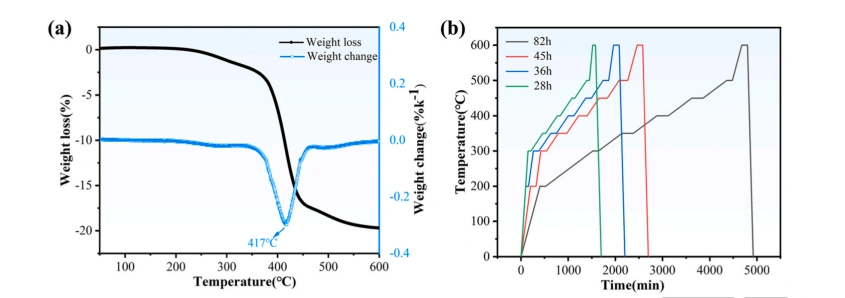 Fig. 8 — (a) TG curves of ZrO2 green bodies in N2 atmosphere, showing the sharp pyrolysis peak near 417 °C. (b) Thermal debinding curves with different total cycle times (82 h, 45 h, 36 h, 28 h) — the cleaning treatment makes the shorter cycles possible without cracking. (Reprinted from Zhao et al., Ceramics International 52 (2026) 16735–16744, with permission from Elsevier.)
The un-cleaned green bodies developed severe interlayer cracks during thermal debinding at the 82-hour schedule, and through-interlayer cracks appeared at the 45-hour schedule. The cleaning treatment suppressed both failure modes. Macropore-free, crack-free 45-hour debound green bodies were produced routinely — a clear sign that the pore channels did their job.
The reason is intuitive once you see it. During thermal debinding, the polymer network decomposes into volatile fragments that have to diffuse out of the part. In an un-cleaned green body, the only escape route is through the bulk polymer itself, which is dense and slow to release gas. Internal pressure builds, and the part fails. With cleaning-induced pore channels, the gas has a low-resistance pathway from the interior to the surface, so pressure never reaches the cracking threshold.
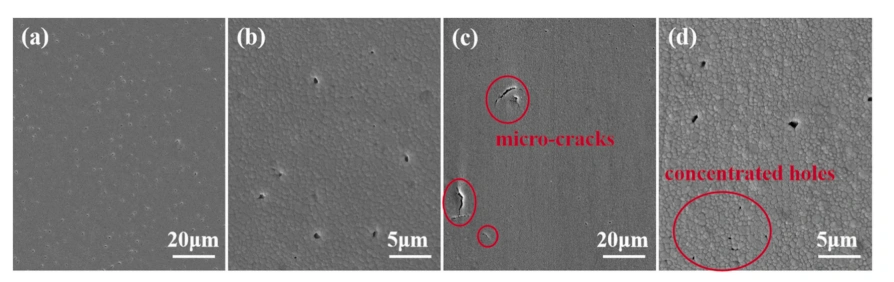 Fig. 9 — SEM images of ZrO2 ceramics sintered at 1500 °C for 4 h after different cleaning treatments: (a, b) 2H+P-cleaned samples show a uniform, defect-free surface; (c, d) ethanol-cleaned samples show microcracks and concentrated holes that originated from the uneven cleaning and survived the sintering step. (Reprinted from Zhao et al., Ceramics International 52 (2026) 16735–16744, with permission from Elsevier.)
The downstream consequence is visible after sintering. Sintered ZrO2 ceramics from the 2H+P process show a clean, uniform microstructure at the micrometer scale. Sintered parts from the ethanol process still carry microcracks and pore clusters — the legacy of the uneven cleaning.
How Pore Channels Improve the Final Pore Structure
To quantify the impact on pore structure, the team used mercury intrusion porosimetry on green bodies with and without the 2H+P cleaning treatment.
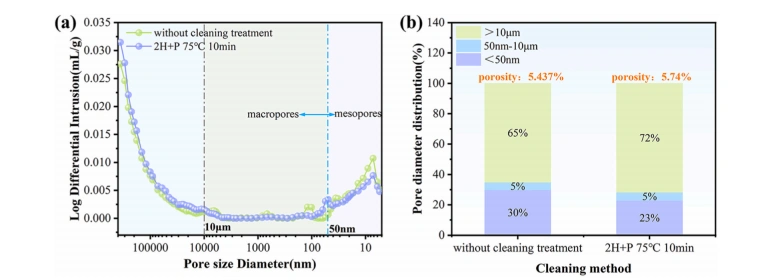 Fig. 10 — Pore size analysis of ZrO2 green bodies with and without the 2H+P cleaning treatment (75 °C, 10 min). (a) Log differential intrusion versus pore size, showing the shift toward larger pores after cleaning. (b) Pore diameter distribution: cleaning increases the fraction of pores larger than 10 μm from 65% to 72%, with porosity rising only slightly from 5.437% to 5.741%. (Reprinted from Zhao et al., Ceramics International 52 (2026) 16735–16744, with permission from Elsevier.)
Two observations stand out. First, the cleaning treatment shifts the pore size distribution toward the macropore range: the fraction of pores larger than 10 μm rises from 65% to 72%, and the proportion of sub-50 nm mesopores drops from 30% to 23%. Second, the total porosity barely changes (5.44% to 5.74%), which means the cleaning step is redistributing pore sizes rather than simply adding new void space.
This distinction matters for two reasons. The macropore channels serve as escape routes for pyrolysis gas. The remaining mesopores stay small enough that they do not compromise the mechanical strength of the green body during handling. The cleaning treatment effectively exchanges some “useless” mesopores for “useful” macropores — a structural change that pays off in both faster debinding and stronger sintered parts.
Linking Cleaning to Sintered-Ceramic Mechanical Properties
The team’s most striking result is the mechanical performance of the sintered ZrO2 ceramics. After 2H+P cleaning and 45-hour debinding, the parts were sintered at 1500 °C for 4 hours and tested for Vickers hardness and flexural strength. The 2H+P-treated parts reached an average Vickers hardness of 1316.5 HV and a maximum flexural strength of 1000.4 MPa. The ethanol-treated parts, processed under identical conditions otherwise, reached only 1269.8 HV and 587.2 MPa maximum.
In other words, the choice of cleaning agent almost doubled the flexural strength of the sintered part, even though both groups ran the same printing, debinding, and sintering protocols.
The team summarized the property comparison against literature values from other DLP-printed ZrO2 ceramics in their Table 2. Among the studies they compared, their 45-hour debinding cycle is shorter than most published values, and their 1000.4 MPa flexural strength is the highest reported for a DLP-printed ZrO2 system using a thermally debound workflow.
Finding the Optimal Sintering Window
Beyond the cleaning story, the study mapped sintering behavior across four temperatures: 1475 °C, 1500 °C, 1525 °C, and 1550 °C.
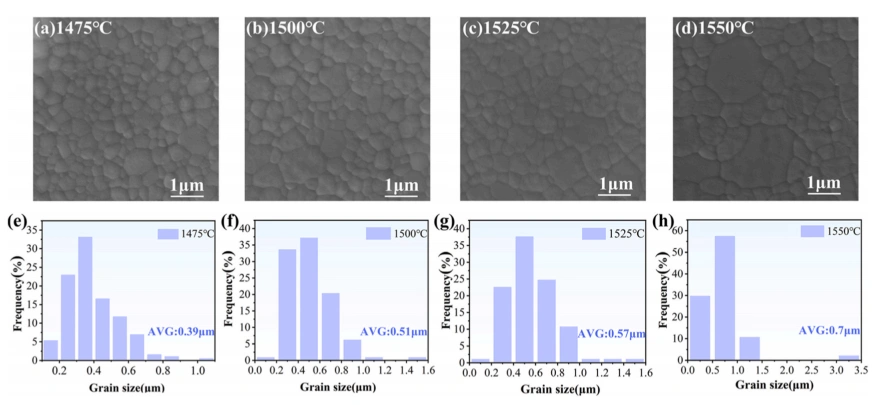 Fig. 11 — (a–d) SEM images of ZrO2 ceramics sintered at different temperatures for 4 h, and (e–h) the corresponding grain size distributions. Average grain size grows from 0.39 μm at 1475 °C to 0.7 μm at 1550 °C. (Reprinted from Zhao et al., Ceramics International 52 (2026) 16735–16744, with permission from Elsevier.)
Grain size scales predictably with temperature, but mechanical properties follow a different curve. Both hardness and flexural strength peak at 1500 °C — 1316.5 HV and 1000.4 MPa maximum — then drop sharply at 1550 °C to just 635.8 MPa.
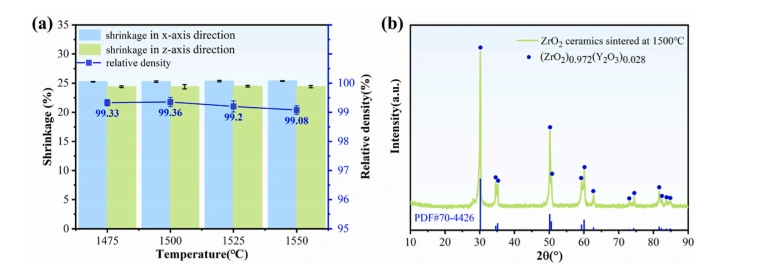 Fig. 12 — (a) Vickers hardness and (b) flexural strength of ZrO2 ceramics sintered at different temperatures for 4 h. Both peak at 1500 °C and fall sharply at 1550 °C. (Reprinted from Zhao et al., Ceramics International 52 (2026) 16735–16744, with permission from Elsevier.)
The decline above 1500 °C comes from abnormal grain growth. At 1550 °C, a few very large grains appear among smaller ones, compressing the matrix and trapping residual porosity. The practical lesson is clear: 1500 °C for 4 h is the sweet spot. Pushing higher to chase full densification backfires.
What This Means for Your Research
The study has three practical lessons that you can apply directly to your own DLP 3D printing workflow, regardless of the specific ceramic material you use.
First, do not over-extract resin in the cleaning step. It is tempting to pick the cleaning agent that removes the most mass, but uniformity matters more than quantity. A moderate extraction distributed evenly through the part will outperform a violent, surface-biased one every time. When you screen cleaning agents, measure mass loss from both the surface and the core, not just the average.
Second, choose cleaning agents that match the polymer chemistry. Ethanol works well for many DLP-printed polymers, but it is too aggressive for tightly cross-linked ZrO2 systems with high solid loading. A blend of a low-viscosity diluent (HDDA) and a hydroxyl-rich monomer (PHEA) gave the team better pore uniformity and avoided the surface cracking that plagues ethanol cleaning. If you develop your own slurry, test cleaning agents that can interact with your specific resin system — not just generic solvents.
Third, map the full sintering window for your material. The team’s data shows that the optimal sintering temperature for this ZrO2 is 1500 °C, not the highest temperature available. Going to 1550 °C reduced strength by 25% because of abnormal grain growth. Before you commit to a sintering profile, run a small temperature matrix — even just three or four data points — and measure both density and mechanical properties. The optimum is rarely at the upper end of the equipment’s capability.
For broader context, recent reviews by Chen et al. on 3D printing of ceramics and by Liu et al. on crack formation mechanisms in ceramic additive manufacturing are worth reading alongside this study. You can also read our previous research breakdown on how DLP 3D printing parameters affect Al2O3 green body strength — the two studies complement each other, covering printing parameters and post-processing optimization respectively.
From Lab to Production: What This Means for Ceramic AM Applications
A 60% reduction in debinding time is not just an academic milestone. It changes the production math for anyone running DLP 3D printing in a real lab or pilot line. Let us look at three application areas where this matters most.
Dental Ceramics: Faster Turnaround for Custom Parts
Zirconia dominates the dental ceramics market — crowns, bridges, and implant abutments all rely on ZrO2’s combination of strength, toughness, and biocompatibility. DLP 3D printing opens the door to fully customized, patient-specific geometries that traditional milling cannot achieve. But a 120-hour debinding cycle makes rapid prototyping nearly impossible. You cannot iterate on a crown design in a week if the debinding step alone eats five days.
Cutting that cycle to 45 hours means a research lab can run two full print-debind-sinter cycles in a single week instead of one. For dental labs exploring DLP as a production route, the throughput improvement is the difference between a pilot project and a viable workflow. ADT has documented a related zirconia debinding and sintering case study that shows how these parameters play out in real parts, not just test coupons.
Bioceramic Scaffolds: Where Pore Channels Do Double Duty
Tissue engineering scaffolds need controlled porosity — and the pore channel network that this study builds for debinding happens to align with the porous architecture that bone ingrowth requires. The 2H+P cleaning treatment creates interconnected channels in the 10+ μm range, which is exactly the window that supports cell penetration and nutrient transport in bone scaffold applications.
If you are working on functional bioceramic structures, the cleaning-treatment approach offers a dual benefit: it speeds up your debinding cycle and builds a pore network that your biological application can use. The key is to tune the cleaning time and temperature so the channels match your target porosity range.
Structural and Functional Ceramics: Enabling Iteration
For aerospace, semiconductor, and industrial ceramic applications, the bottleneck is often not the printing — it is the iteration cycle. When you print a new turbine blade prototype or a custom insulator, you want to test it, adjust the design, and print again. A 120-hour debinding step freezes that loop. At 45 hours, you can print on Monday, debind through Wednesday, sinter Thursday, and have results by Friday — a workable weekly cadence for a research group.
This matters especially for thin-wall and high-complexity ZrO2 parts, where debinding cracking is the primary failure mode. ADT’s work on 100 μm zirconia thin-wall structures demonstrates the kind of geometries that benefit most from a crack-resistant debinding pathway.
Final Thoughts and What’s Next
The systematic study from Zhao and his colleagues shows how a carefully chosen post-printing cleaning step can transform the economics of DLP 3D printing for ZrO2 ceramics. By replacing more than 75 hours of furnace time with 10 minutes in a heated cleaning bath, the team cut the debinding cycle to 45 hours while pushing maximum flexural strength past 1000 MPa — numbers that would have seemed unrealistic for DLP-printed zirconia just a few years ago.
The cleaning-treatment approach is not specific to ZrO2. The same logic — build uniform pore channels before debinding so pyrolysis gas has a clear escape route — should generalize to other DLP-printed ceramics, including alumina, silicon nitride, and bioactive glass compositions. The specific chemistry of the cleaning agent will need to be tuned to each slurry, but the design principle is portable.
There is one important caveat to keep in mind. The team tested one ZrO2 formulation, one slurry composition, and one printer. Their 45-hour debinding cycle is a strong result, but it is not necessarily a universal number. The real value of the paper is the framework: choose a cleaning agent for uniformity rather than raw mass loss, match it to the polymer chemistry, and validate the cleaning window with surface-and-core TG analysis before you commit to a production process.
For now, if you are losing days of furnace time to a slow debinding cycle, the message is simple. Add a cleaning step, choose your agent carefully, and measure the result. The hours you save will compound fast.
Ready to Optimize Your Ceramic 3D Printing Workflow?
The debinding bottleneck is solvable — and you do not have to solve it alone. Whether you are setting up a new DLP 3D printing lab or scaling an existing workflow, ADT offers the equipment, materials, and expertise to help you get from slurry to sintered part faster.
- DLP Ceramic 3D Printer — High-precision systems designed for technical ceramics including ZrO2, Al2O3, and SiC. Built for research-grade resolution and production-grade reliability.
- Custom Ceramic Slurries — Formulations tuned for printability, debinding behavior, and sintering density. Match your binder system to your post-processing needs from day one.
- 3D Printing Services — Need parts printed, debound, and sintered before investing in your own equipment? ADT’s team can run your geometries end to end.
- Technical Support — Process optimization, training, and troubleshooting from a team with 10+ years of ceramic AM experience and 40+ invention patents.
Have a specific debinding challenge? Contact the ADT team to discuss your material, geometry, and cycle-time requirements.
Related Reading
- How DLP 3D Printing Parameters Shape the Strength of Al2O3 Ceramic Green Bodies — Our previous research breakdown on printing parameters for Al2O3. Together with this article, it forms the core of our DLP 3D Printing Optimization topic cluster.
- Ceramic 3D Printing Project Cases — Real-world case studies including zirconia debinding, thin-wall structures, and bioceramic scaffolds.
- Academic Research Series — More peer-reviewed research interpretations from ADT’s team.
References
- Zhao, Y., Liu, S., Liu, F., & Huang, J. (2026). Pore channels optimization in digital light processing-printed ZrO2 green bodies for accelerated debinding and defect reduction through cleaning treatment. Ceramics International, 52, 16735–16744. https://doi.org/10.1016/j.ceramint.2026.02.263
- Chen, Z., Li, Z., Li, J., et al. (2019). 3D printing of ceramics: A review. Journal of the European Ceramic Society, 39(4), 661–687. https://doi.org/10.1016/j.jeurceramsoc.2018.11.013
- Lakhdar, Y., Tuck, C., Binner, J., et al. (2021). Additive manufacturing of advanced ceramic materials. Progress in Materials Science, 116, 100736. https://doi.org/10.1016/j.pmatsci.2020.100736
- Liu, Z., Ma, C., Chang, Z., Yan, P., & Li, F. (2023). Advances in crack formation mechanism and inhibition strategy for ceramic additive manufacturing. Journal of the European Ceramic Society, 43(13), 5078–5098. https://doi.org/10.1016/j.jeurceramsoc.2023.05.008
- Nurmi, N., Frankberg, E., Rinne, M., et al. (2024). Enabling fast debinding of ceramic vat photopolymerization prints with supercritical carbon dioxide as a solvent. Additive Manufacturing, 84, 104143. https://doi.org/10.1016/j.addma.2024.104143